

The Agent Stack For Building Human Relationships - Sales, Job Hunting, Networking, Partnerships and Fundraising
Trust state gates, context debt scoring, and vertical-specific not-yet checks — the five-layer infrastructure that runs your relationship pipeline across all five verticals from 10 contacts to 500.

AI didn’t solve the outreach problem. It accelerated the collapse.
If you missed Part 1, here’s the setup: relationship context debt builds every time you act without knowing where a relationship actually is. The not-yet gate is the structured check that catches premature moves before they go out.
In case you missed part 1…
Now we build the infrastructure that holds the system at scale.
This issue is long and covers multiple use cases. Navigate to what’s relevant: in active sales, go to Section 5. Job hunting, Section 6. Want the full agent architecture, read it all.
FREE DOWNLOAD - RelateOS Field Guide for Sales, Job Hunting, Networking, Partnerships and Fundraising
Two ways to run this system.
Free: the RelateOS Field Guide — five vertical guides, 25 prompts, works on any LLM, no install.
Full system: the RelateOS Plugin — seven agents, ten relationship lanes, compounding wiki, one-click setup on Claude Code or Cowork.
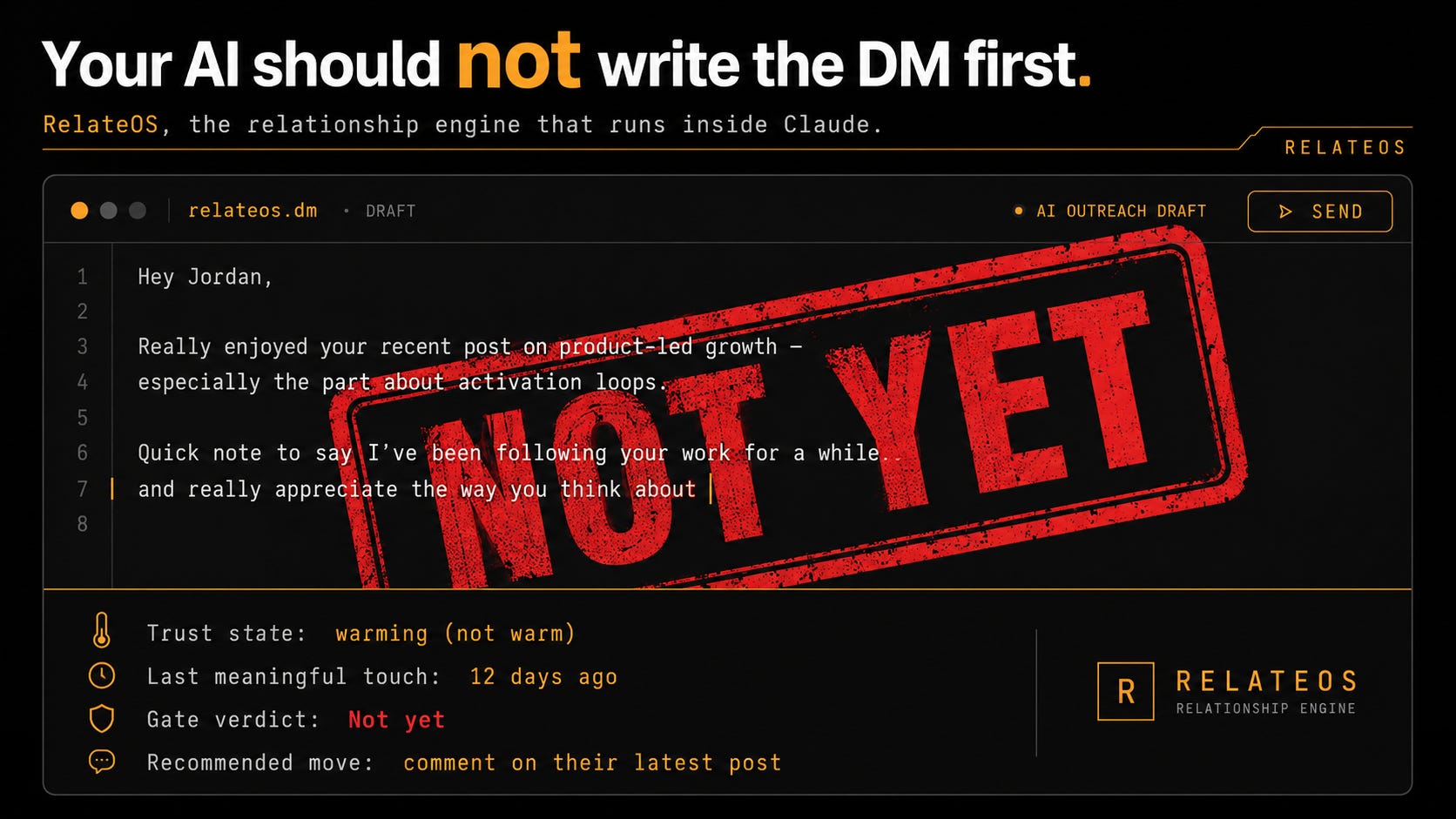
Table of Contents
Why Relationships Are the Last Unautomatable Advantage
Why You Need an Agent for This, and Which One
The Networking OS Architecture and Setup
How the Architecture Prevents Runtime Failures
Sales Implementation
Job Hunting Implementation
Three More Use Cases, One Field Guide
The Installer, and the Close
Prompt Library (Prompts A, B, 1–11)
All my Agent Brevv Page Links for You
Why Relationships Are the Last Unautomatable Advantage
Cold email reply rates in 2026 sit at 3.43% (Instantly.ai Benchmark Report 2026).
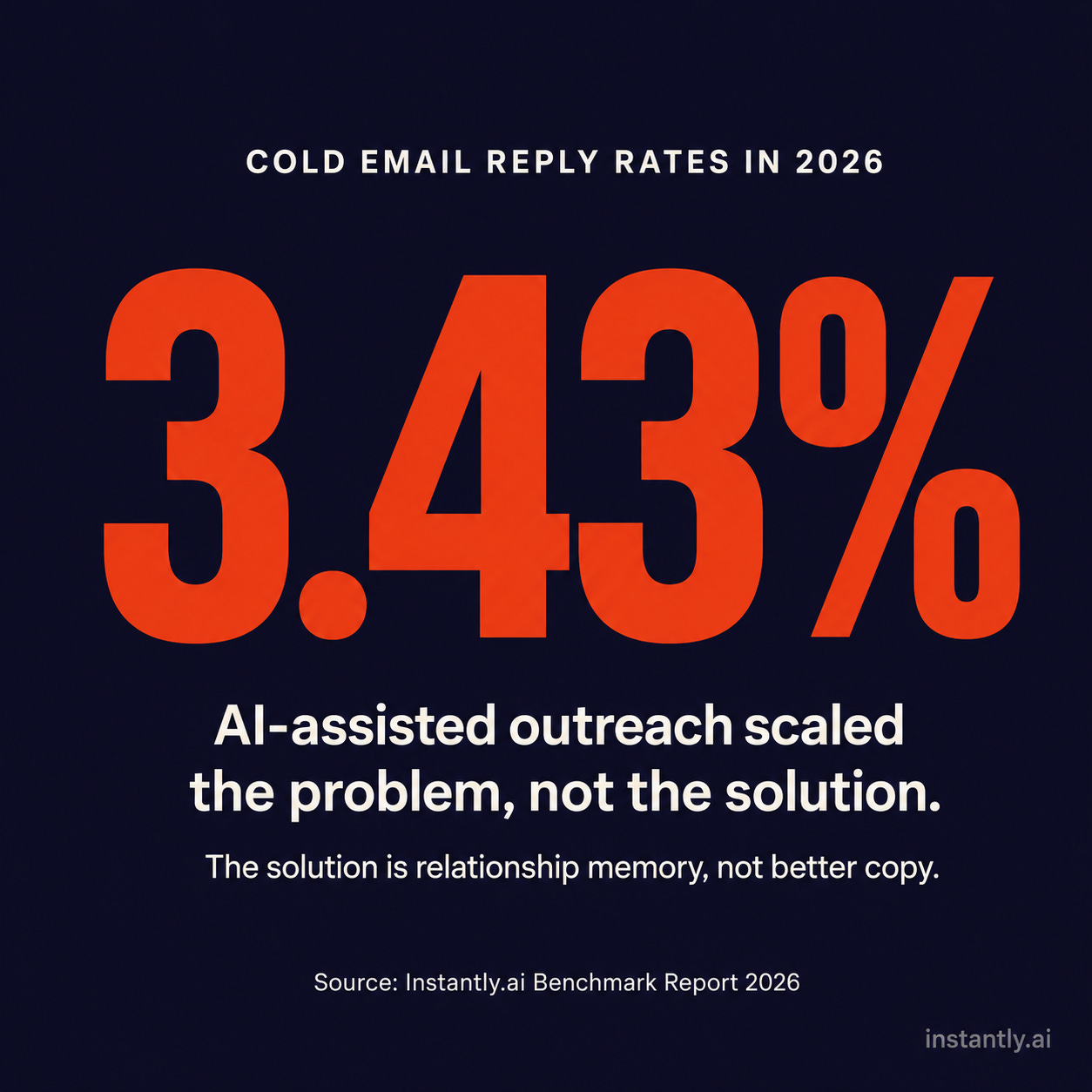
AI didn’t fix the problem. It scaled the problem.
The very tools that were built to solve the problem were exploited and killed the channel.
Era 4 is context-first, memory-led (2026+). The only thing that breaks through is a message that carries genuine trust and creative taste.
The one-file system from Part 1 is the manual version. Let’s see how you can scale it.
What breaks across five scenarios when you operate without relationship memory:
Job hunting: Candidates blast AI-generated recruiter DMs and track applications in spreadsheets. What breaks is losing track of where each recruiter relationship actually was: warm, cold, stalled, or already decided. Every follow-up starts from scratch.
Sales: AI-assisted outreach sequences sound similar across touchpoints because the tool writing the follow-up has no memory of the conversation before it. Every message is a cold email.
Networking: The failure mode is ignoring trust state completely and reaching out after months only when you need something. The gap between giving and asking is that people have stopped responding.
Investment: One premature ask closes a VC relationship that took six months to build. The failure is acting on your urgency rather than the relationship’s trust state. AI made it faster to send that premature ask than ever before.
Partnerships: Every collab conversation that failed after the first call is because of lesser trust. No one focused on the relationship state. When either party had bandwidth to follow up, they spent time in maximizing the profits.
For your agent:
Ask: “Assume I reach out to one of these relationships today without reading the file. Which failure mode is most likely to hit me — and what specific thing have I been telling myself that makes it feel safe to skip the check?”
It gives you: the rationalization you’re most likely running right now, named before you act on it
Use it when: outreach feels urgent and you haven’t looked at the relationship file in more than a week
Part 1 of this newsletter built the one-file system.
This part shows what happens when you try to run that system across 30+ active relationships without agent infrastructure acting as your relationship assistant.
Why You Need an Agent for This, and Which One
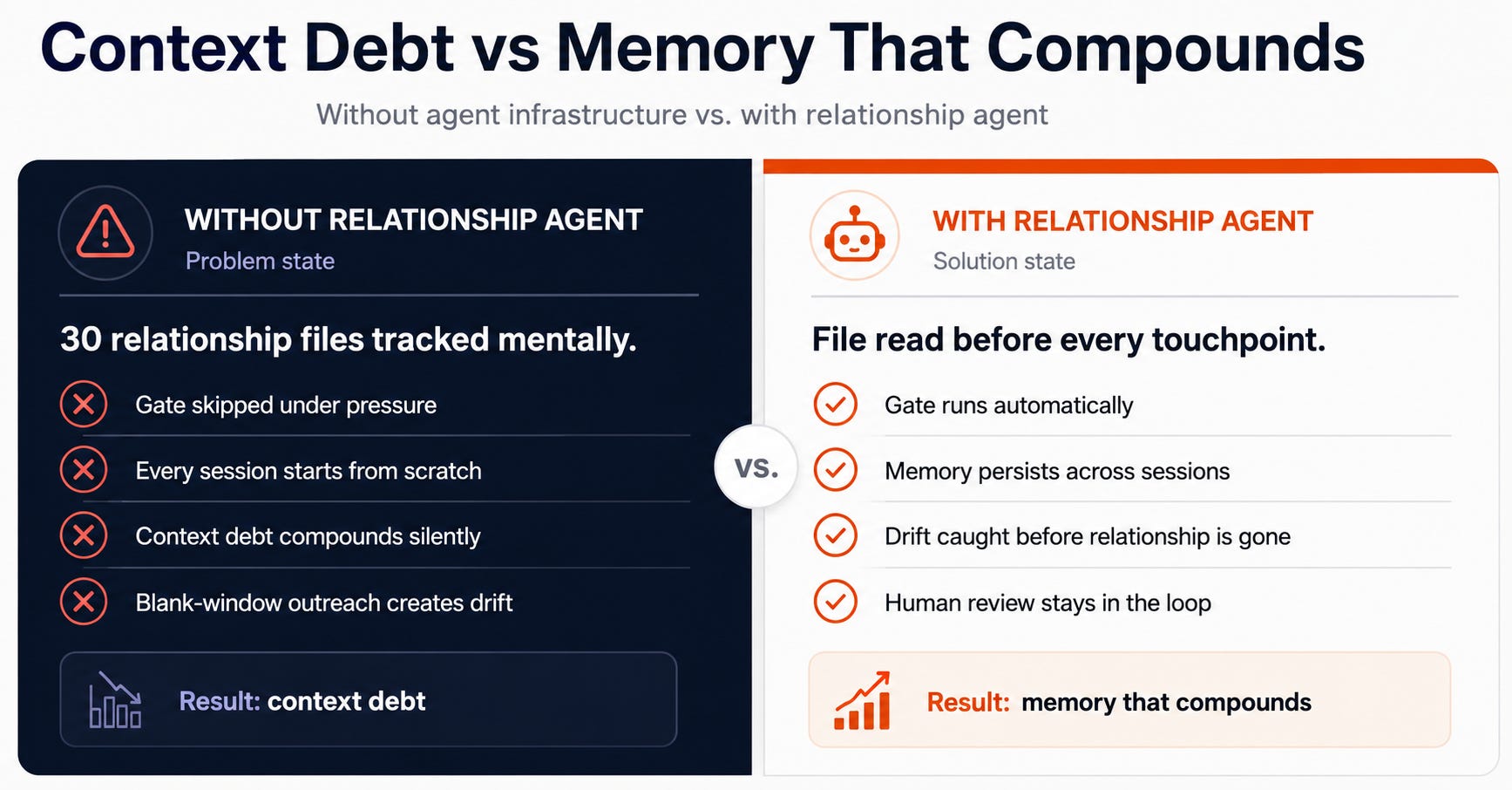
The one-file system doesn’t work at thirty relationships being built and maintained.
It’s not because the logic breaks — but because manually tracking 30 relationship files degrades the system efficiency.
These agents don’t write more messages. They stop you from sending premature ones and focus on helping you first build the trust.
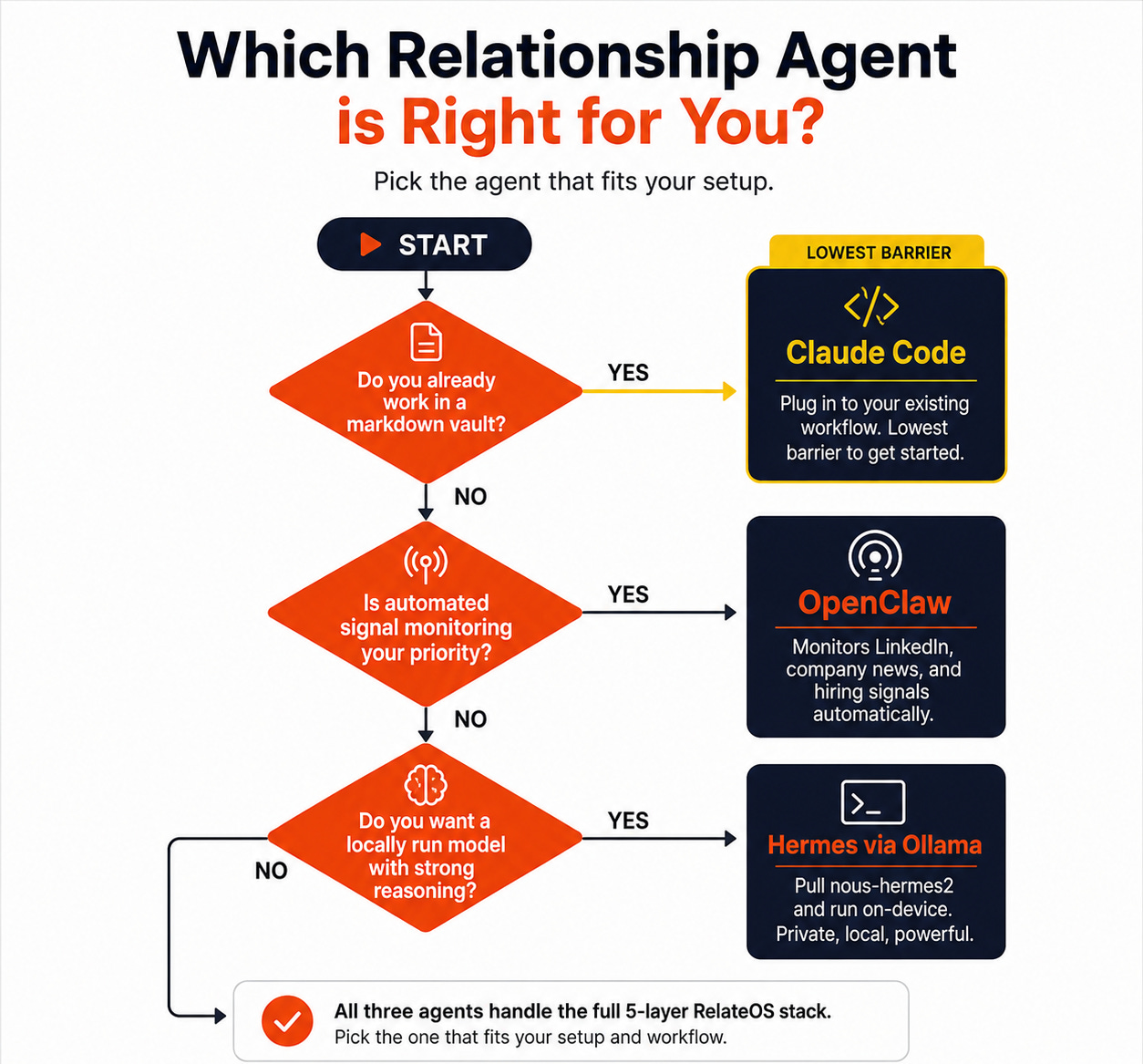
You can build this with Hermes, OpenClaw, or Claude Code. Any of the three handles the full stack.
What any of them does when configured:
Reads the relationship file before every touchpoint
Runs the not-yet gate automatically and flags what passes
Monitors public signals (LinkedIn activity, company news, hiring signals, funding rounds) and logs them as file updates before you’d notice them
Updates the touch log after every action
Holds system state across sessions so you never paste the file manually again
The memory compounds. You stop operating from a blank window.
For your agent:
Ask: “Here are the five things a relationship agent handles: reading the file before touchpoints, running the gate, monitoring public signals, updating the touch log, and holding state across sessions. Which of these am I currently doing manually — and where in that manual process am I most likely to skip steps when I’m under pressure?”
It gives you: a gap map of where context debt is actively building in your current workflow
Use it when: you’re on the fence about whether the setup is worth it
What Actually Breaks at Scale — and When
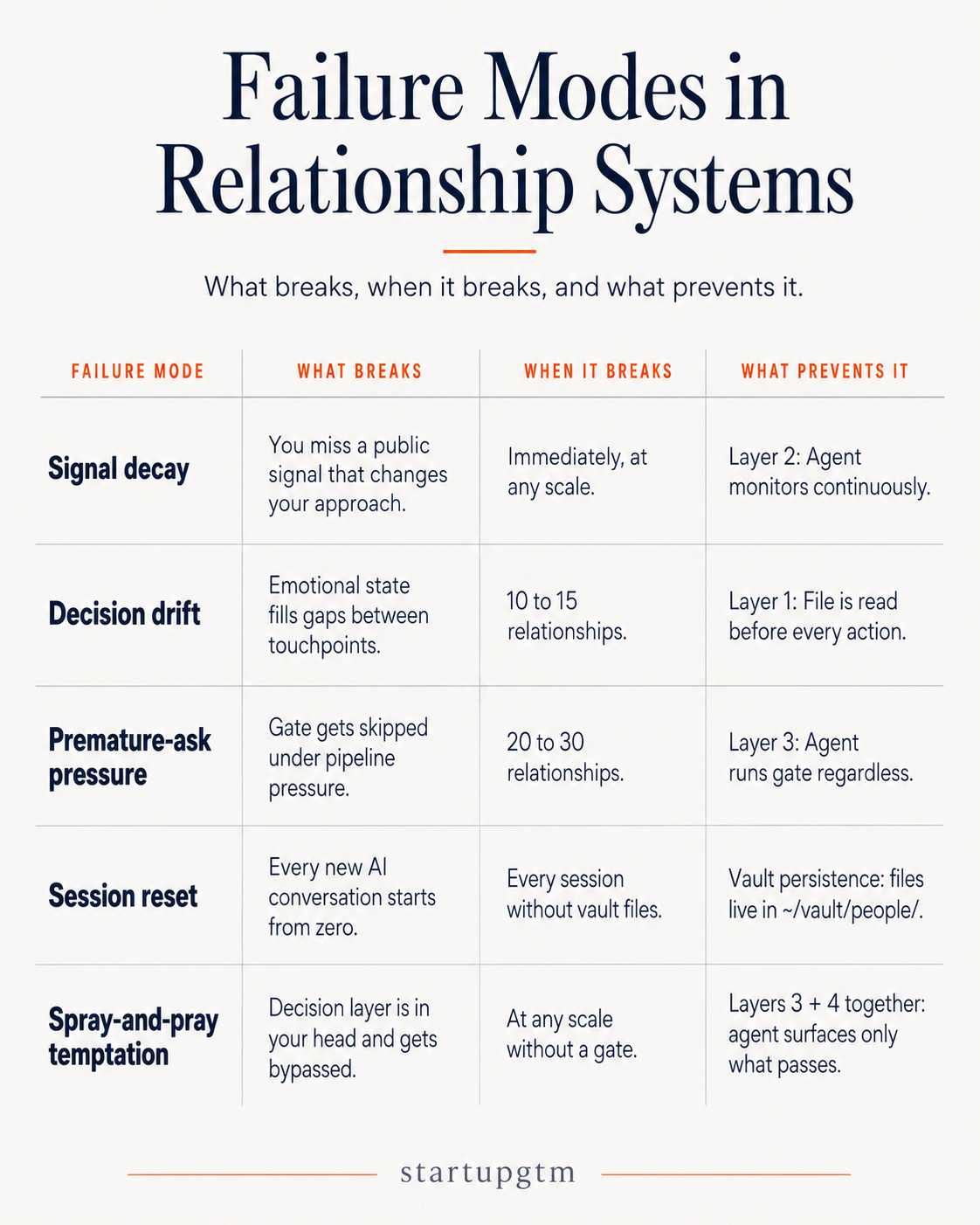
Here’s what actually breaks at scale — and when each break happens:
Signal decay
What breaks: You miss a public signal that changes your approach.
When it breaks: Immediately, at any scale.
What prevents it: Layer 2: Agent monitors continuously.
Decision drift
What breaks: Emotional state fills gaps between touchpoints.
When it breaks: 10 to 15 relationships.
What prevents it: Layer 1: File is read before every action.
Premature-ask pressure
What breaks: Gate gets skipped under pipeline pressure.
When it breaks: 20 to 30 relationships.
What prevents it: Layer 3: Agent runs gate regardless.
Session reset
What breaks: Every new AI conversation starts from zero.
When it breaks: Every session without vault files.
What prevents it: Vault persistence: files live in
~/vault/people/.
Spray-and-pray temptation
What breaks: Decision layer is in your head and gets bypassed.
When it breaks: At any scale without a gate.
What prevents it: Layers 3 + 4 together: agent surfaces only what passes.
The scale thresholds — when each problem becomes unavoidable:
0-10 relationships: Manual discipline is enough. Use the one-file system from Part 1.
10-20: Manual discipline degrades under pressure. Build Layer 1 and Layer 3 at minimum.
20-50: Manual collapses. Full five-layer stack required.
50-100+: OpenClaw, Hermes, or Claude Code with automated signal capture is the only path that works.
The agent decision isn’t about sophistication. It’s about which failure mode you’re about to hit and whether you’re ahead of it or behind it.
Who this applies to: Anyone managing more than 15 active relationships with real stakes — a live raise, a sales pipeline over $500k, a job search with multiple active conversations. Below 10, the manual system holds. Above 20, it doesn’t.
Adapt it with this prompt:
I'm managing [X] active relationships right now across [verticals]. Map my failure mode risk.

For each of the five failure modes below, tell me:
- Am I already experiencing this? (Evidence from what I've described)
- How close am I to the threshold where it becomes unavoidable?
- What's the minimum viable action to prevent it at my current scale?

The five modes: signal decay, decision drift, premature-ask pressure, session reset, spray-and-pray temptation.

My current situation: [describe your relationship load and current tracking system]
Pick Your Agent
Hermes: best if you want a local / cloud run model with strong reasoning and persistent memory across sessions
OpenClaw: best if automated signal monitoring and file updates are the priority
Claude Code: best if you’re already working in a markdown vault and want the relationship layer to plug into what you already trust
All three work as relationship memory operators, not outreach assistants. The agent enforces the gate. You make the call.
The Networking OS Architecture and Setup
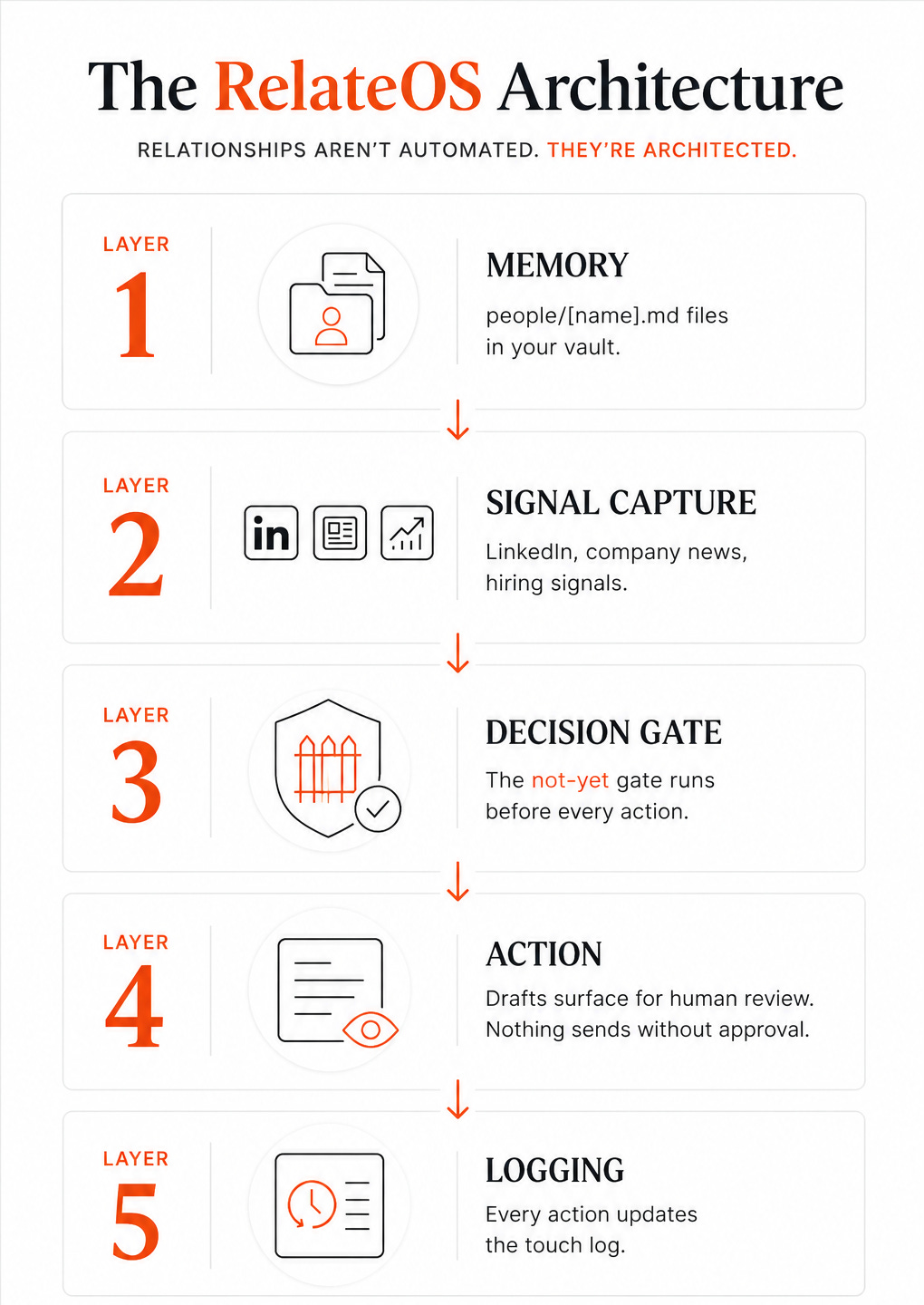
The one-file system from Part 1 is Layer 1 of a five-layer stack. Here’s how the full architecture sits:
Memory
Thepeople/[name].mdfile, extended with role-specific fields per vertical.
This is the source of truth for every relationship.
It lives in your vault, not in a context window.Signal capture
Captures public signals, LinkedIn activity, company news, and podcast mentions.
Dedicated agents can handle this at scale.
For smaller setups, Claude Cowork can also run a daily signal sweep.Decision
The not-yet gate runs against every inbound signal before any action is recommended.
In configured systems, this runs automatically.
In Claude Cowork setups, the gate can run on demand or on a cron.Action
Drafts surface for human review.
Nothing sends without approval.
The agent recommends the move type and the reason.
You approve or override.Logging
Every action updates the touch log in the relationship file.
The memory layer stays updated because the logging layer completes the job.
The RelateOS Field Guide is free. [DOWNLOAD]
Five vertical guides — selling, fundraising, networking, job hunting, partnerships. Each one has the memory schema, the not-yet gate calibration for that vertical, and a 5-prompt sequence you paste into any LLM chat. No install. Works on Claude Free, ChatGPT, Gemini, Grok.
If you’re managing one active relationship in any of these five lanes and you’ve been running it from memory, this is the manual version of everything covered in this issue.
The 45-Minute RelateOS Start (Do This Before Anything Else)
Before you touch any of the setup paths below, this is the minimum viable starting point. No tools, no configuration, no decision about which agent to use. Just a relationship file and a gate run.
Who this is for: Anyone who just read Part 1 and Part 2 and wants to start today without committing to a full agent setup. The 45-minute protocol is the proof of concept. The agent layer builds on top of it.
0-5 min — Choose your relationship.
Pick the one conversation you most can’t afford to lose context on. Not the highest stakes overall — the highest context-decay risk right now. Usually: the relationship where the most was revealed in the last interaction and the least was written down.
5-15 min — Build the file from memory.
Open a markdown file. Name it [name]-[company].md. Using the schema from your vertical (buyer, investor, candidate, network), write down everything you remember right now. Don’t edit yourself. Include things that seem obvious — they won’t be obvious in two weeks.
15-25 min — Run the memory pull prompt.
Paste the memory pull prompt below into Claude, then paste the full conversation history from your most recent exchange (email, Slack, wherever it lived). Let it reconstruct what was revealed, what signals came in, and what would be premature to ask. Add the output to your file.
25-35 min — Run the gate.
Paste the not-yet gate prompt for your vertical (Prompt A for sales, Prompt B for fundraising, or the gate from Section 6 for job hunting). Run it against the file you just built. Read the verdict without arguing with it.
35-45 min — Act on the verdict and set a review date.
Gate passes: draft the message with the file in context. Gate says Not Yet: execute the one public-first move the verdict suggests. Log what you did. Set a review date in the file. Close the file.
You now have one working relationship memory file and one gate run. That’s the system operating at minimum. Everything else builds on top of that.
Adapt it with this prompt:
I'm doing the 45-minute RelateOS quick-start. I've built a rough file from memory.
Now help me reconstruct the relationship more accurately.

Read everything I've pasted below. Extract every signal — what they said, what they didn't say,
what the timing of their responses revealed, what I've assumed vs. what was actually stated.
Build the relationship memory file using the schema I need for
[sales / fundraising / job hunting / networking / partnership].
Flag the three most important things I don't have yet.

My relationship context: [paste rough notes + conversation history] 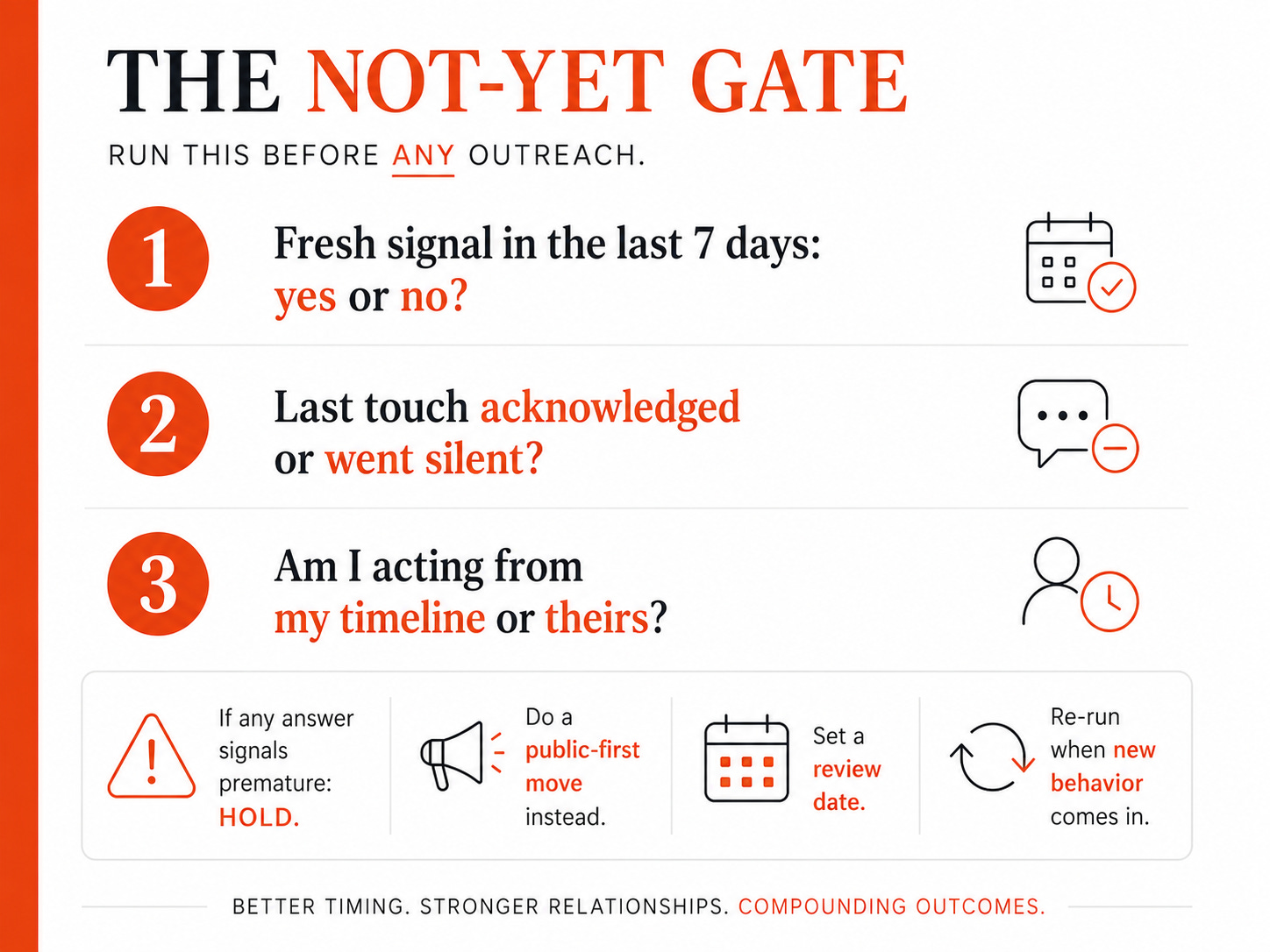
The setup paths below are representative. Actual commands and config options vary by tool version — check each tool’s docs for the current install flow.
If the relationship already has a conversation history in Claude or ChatGPT but no file yet, this prompt reconstructs the state before you build the file:
Pull everything you have from our past conversations about [name/company/relationship]. Reconstruct the full relationship state: what we've discussed, what signals have come in, where the trust state actually is based on their behavior — not my interpretation of it. Then tell me: what's the single most important thing I might have forgotten that changes how I should approach the next move?
For your agent:
Ask: “I’m setting this up for the first time. Here’s my current situation: [describe — how many active relationships, which vertical, how you currently track them]. What’s the highest-leverage first file to build — the one where having the memory would most change what I’d actually do in the next 48 hours?”
It gives you: a specific starting point instead of an abstract setup exercise
Use it when: you’re implementing for the first time and don’t know which relationship to start with
Setup Path for Claude Code Users (Lowest Barrier)
# Step 1: Create the people/ directory in your vault
mkdir -p ~/vault/people

# Step 2: Create your first relationship file
touch ~/vault/people/[name].md

# Step 3: Open Claude Code in your vault and populate the file
# cd ~/vault && claude
# Paste your relationship context and run the not-yet gate prompt from Part 1

# Step 4: Add the gate as a reusable slash command
# Create .claude/commands/gate.md in your vault
# Point the command at ~/vault/people/ to run the gate across all files on demand

# Step 5: Schedule a daily not-yet gate sweep
# Add a hooks entry in your Claude Code settings
# Set it to run the gate prompt across all files in people/ each morning
Setup Path for Hermes (NousResearch)
Hermes runs locally via Ollama. Pull the model, then configure it to read your vault directory as the memory source and define the gate prompt as the system instruction.
# Pull Hermes via Ollama
ollama pull nous-hermes2

# Point it at your vault
# In your agent config, set the memory path to ~/vault/people/
# Set the system prompt to the not-yet gate logic from Part 1
Setup Path for OpenClaw
Connect OpenClaw to your vault directory and configure the signal sources you want it to monitor: LinkedIn activity, company news, hiring signals. Set the update trigger to write new signals directly into the relevant relationship file in ~/vault/people/. Full setup docs at the OpenClaw repo.
One concrete starting action before any of the above: pick one relationship — the one conversation you most can’t afford to lose the thread on. Create the file. Run the Part 1 gate prompt against it before your next touchpoint. That’s the manual version of Layer 3. The agent layer builds on top of that.
How the Architecture Prevents Runtime Failures
Part 1 named relationship context debt as the core failure mode. Here’s how each failure mode appears in practice:
Signal decay: A buyer posts something directly relevant to your deal. You miss it and you reach out a week later with stale context. The message is irrelevant now because the signal is already gone. The agent’s signal capture layer continuously runs and monitors the public layer continuously.
Decision drift: You go back to a relationship after six weeks and can’t remember where you left it. Your emotional state fills the gaps: “they seemed interested,” “I think they liked the proposal.” Agent reads the relationship file before you act. The memory is built over time and is actually there to assist you.
Premature-ask pressure: When you’re managing 40 active relationships manually, the not-yet gate becomes the thing you skip under pipeline pressure. The agent runs it regardless.
Session reset: Without vault-based file persistence, every new agent conversation starts without context and relationship memory dies when the session ends. The architecture solves this because the file lives in the vault, not the context window.
Spray-and-pray temptation: When the decision layer is in your mind, it gets skipped. But when the agent only identifies what passes the gate, the options narrow to what’s actually making sense as per trust state. You stop seeing the full list of possible outreach and start seeing only the list of appropriate outreach.
I’ve lost relationships to decision drift I didn’t know were drifting — because I was running it mentally. The agent with relationship memory files makes me see the drift before the relationship is already gone.
For your agent:
Ask: “I’m managing [X] active relationships right now. Assume I’m going to silently lose one of them to decision drift in the next 30 days without realizing it. Based on what I’ve described, which relationship is it most likely to be — and what specific thing am I not doing that would catch it before it’s gone?”
It gives you: your highest-risk relationship named before it goes quiet
Use it when: your pipeline feels full and everything feels fine — that’s exactly when drift happens
The Trust State Framework
The mechanism underneath decision drift is that trust state isn’t measured — it’s felt. And feelings decay, get revised, and get colored by what you need to be true right now. Here’s the framework that catches it:
Trust State = f(Interactions × Quality × Recency × Reciprocity)
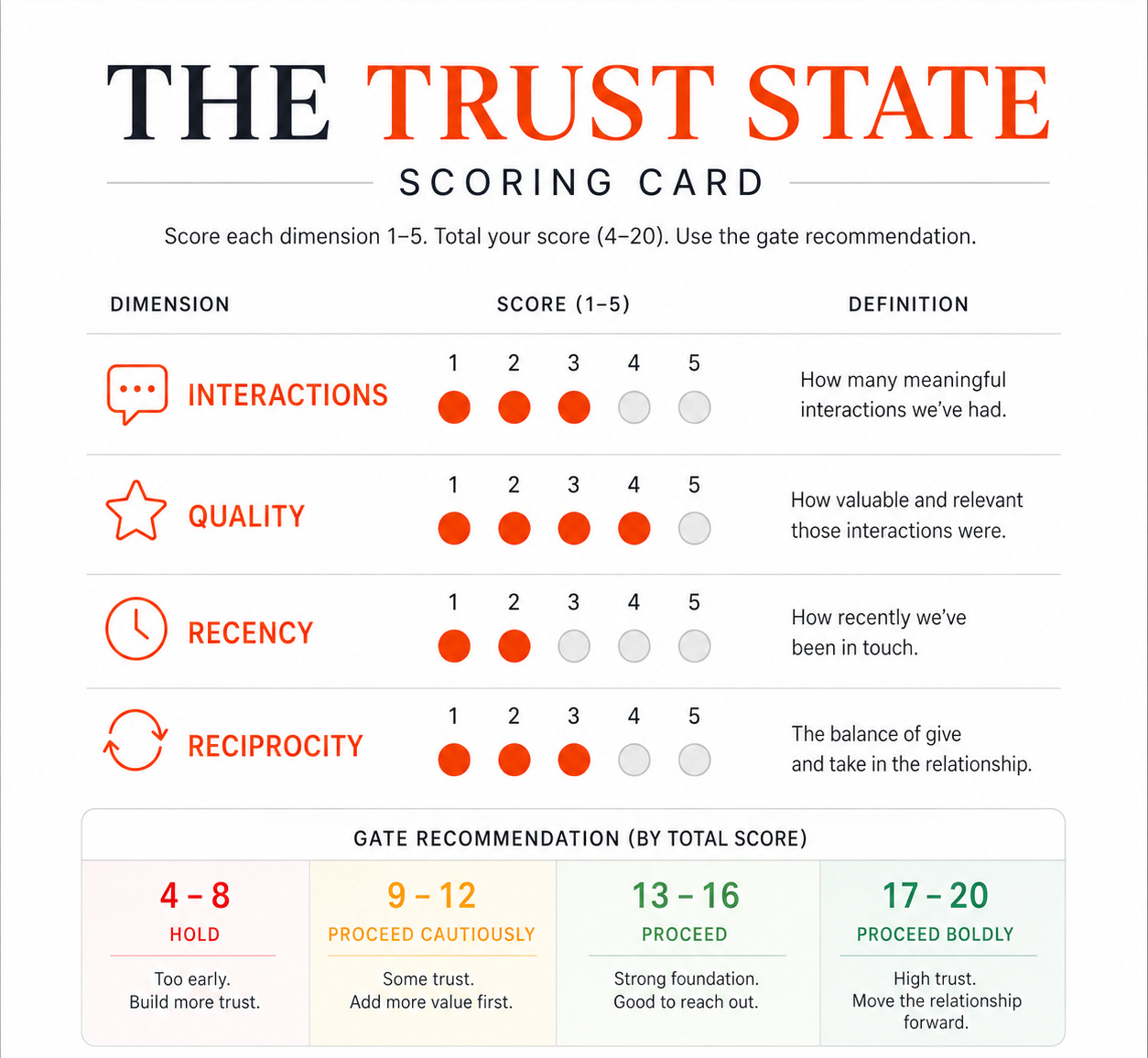
This is not a formula to calculate. It’s a lens to look through. Score each dimension 1-5 for any active relationship:
Interactions
1: No real exchange. Pre-relationship.
2: One or two surface exchanges. Pleasantries, logistics.
3: Multiple exchanges, some substance. Beginning of something real.
4: Consistent meaningful exchanges. Mutual investment visible.
5: Deep, ongoing. Both sides initiate. High candor.
What does not count: sent emails with no reply, LinkedIn likes, profile views, and one-sided comments. Interactions require two-way engagement.
Quality
1: Surface only. No vulnerability, no specifics, no real information exchanged.
2: Some operational substance. Schedules, processes, logistics.
3: Meaningful content. Problems disclosed, criteria shared, genuine views exchanged.
4: Significant depth. Vulnerabilities shared, honest assessments given, trust demonstrated.
5: Full candor. They have told you things they have not told others.
Recency
1: Last meaningful interaction more than 6 months ago.
2: 3 to 6 months ago.
3: 1 to 3 months ago.
4: 2 to 4 weeks ago.
5: Under 2 weeks ago.
Trust state decays. A relationship with ten high-quality interactions from 18 months ago is not the same as one from 6 weeks ago. Recency acts as a discount rate on everything else.
Reciprocity
1: You have given nothing. Or they have given everything and you have given nothing.
2: Significant asymmetry in one direction.
3: Roughly balanced.
4: They have given slightly more. Healthy ledger in your favor.
5: Highly balanced. Both sides actively contributing.
What the total score means:
4 to 8: Almost certainly Not Yet
Public-first moves only.9 to 12: Possible Go
Safe for a low-stakes move.
Not ready for a significant ask.13 to 16: Likely Go
Good for most moves.
Gate should still confirm.17 to 20: Strong Go
The relationship is ready.
Who this applies to: Everyone who’s ever felt “I think we’re in a good place” about a relationship and then been wrong. The scoring replaces gut feeling with documented evidence.
Adapt it with this prompt:
Score this relationship on the Trust State Framework. For each dimension, cite specific evidence
from the file — don't infer, score only what's documented.

Interactions (1-5): [evidence]
Quality (1-5): [evidence]
Recency (1-5): [evidence]
Reciprocity (1-5): [evidence]

Total score and gate recommendation (4-8 = Not Yet / 9-12 = Possible Go / 13-16 = Likely Go / 17-20 = Strong Go).

Then: how does your assessment compare to mine? Where am I overconfident?
Where am I being overly cautious? Give me the most accurate read, not the one that confirms
what I want to do.

Relationship file: [paste]
My current read: [2-3 sentences on where you think this is]
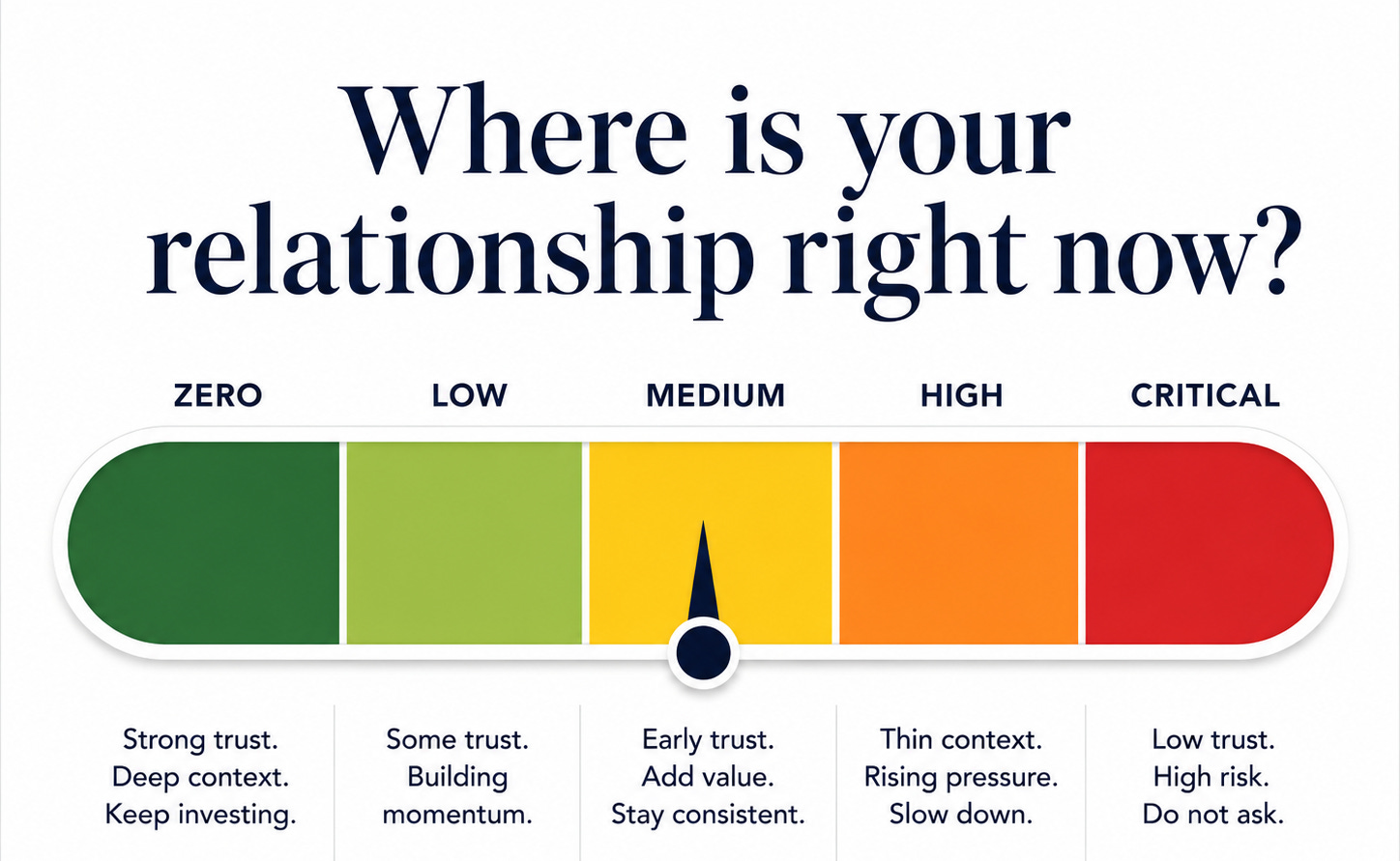
An unassisted operator managing active relationships with real discipline tops out around 10-15. With this stack, 20-50 is manageable. At 100+, OpenClaw, Hermes or Claude Code carries the load.
Sales Implementation
The specific failure state in B2B selling: “the follow-up looks irrelevant and AI slop.”
This is not because of the weak copy — but because the AI drafting it had no memory of the prior conversations.
The buyer has already revealed the following in earlier calls:
a budget freeze
a slipped timeline
an internal champion change
None of that exists in the context window where the follow-up is drafted.
Cold email reply rate in 2026: 3.43% (Instantly.ai). AI-assisted outreach scaled the problem — not the solution.
Your standard CRM doesn’t capture a buyer file — instead it tracks contact records, deal stages, and activity logs. It doesn’t capture trust state: how much of their time and attention the buyer has actually invested with me, what they’ve revealed, the business signals, where they are psychologically, and what would feel premature to ask at the next touch.
The Sales Memory File Schema
# buyers/[name-company].md

## Pressure profile
What's driving their need right now (not what you assume):
What they've revealed vs. what you've inferred:

## Deal stage as trust proxy
Substantive interactions so far (calls, demos, docs shared):
Buy-in signals (agreed to next step, shared internal criteria, made an intro):

## Stakeholder map
Who else has visibility into this purchase:
Objections heard vs. objections not yet surfaced:
Internal champion status:

## Touch log
- YYYY-MM-DD: [what happened, what they revealed, what would be premature next]

## Not-yet gate (sales calibration)
Fresh signal in the last 7 days: [yes/no]
Last touch acknowledged or went silent: [acknowledged/silent]
Acting from my timeline or theirs: [mine/theirs]
Verdict: [Not yet / Public-first / Gate passes]
If you don’t know about pressure profiles, check this link —
The 3-Step Sales Workflow
Step 1: After every interaction, share your call or notes with agent and update the buyer file. Log what was said, what they revealed, what their objections signaled, and what would be premature to ask at the next touch. The compounding effect of doing it consistently is that you never enter a conversation cold again.
Quick reasoning check — run this before you close the file:
I just spoke with [name]. Before I log anything: what's the single most important thing they revealed about where they actually are — not where I hope they are? What am I at risk of rationalizing away in an hour that I should log right now?
For your agent:
Ask: “Here’s everything I remember from the last conversation with [name]: [paste rough notes]. Read this like a first-principles analyst. What did they actually tell me — separating what they said from what I’ve inferred? Where have I filled gaps with assumptions I’m treating as facts?”
It gives you: a cleaned signal read that separates confirmed facts from interpretation before you log anything
Use it when: a call felt positive and you’re about to log it — that’s when confidence becomes rationalization
Step 2: Before any new touchpoint, open the buyer file in Claude Code or ask an agent to look at the buyer context and run the gate. Or paste the file with this prompt:
You are a relationship memory operator for B2B selling. Read this buyer file.

Produce:
1. Trust state summary (2-3 sentences): where is this relationship from the buyer's side?
2. Go / Not Yet verdict: if Go, name the one appropriate move type and why it fits.
   If Not Yet, name what would need to change and what public-first action fits now.
3. Premature-ask flag: what to avoid at the next touchpoint given the current trust state.

Rules: default to Not Yet when context is ambiguous. Do not draft a message. Assess only.

File: [paste buyer file]
For a full four-phase sales playbook — from initial file architecture through agent integration and scaling to 30-50 buyer files — that’s in the RelateOS Field Guide below.
If the relationship has lived in chat — your Claude sessions, ChatGPT threads, email chains — and there’s no file yet, this prompt builds the context from scratch:
Read our entire conversation history above. Extract every signal about this relationship — what they said, what they didn't say, what the timing of their responses revealed, and what I've assumed vs. what was actually stated. Build a relationship memory file using the buyer schema above. Then ask me 10 hard questions about this relationship: use devil's advocate (what am I rationalizing?), first principles (what do I actually know vs. assume, based only on behavior?), and customer voice (what is this person actually experiencing on their end?). Don't ask the easy questions. Ask the ones I've been avoiding.
Step 3: Act on the verdict. Gate passes, write the message with the file in context. Gate says not yet, do the public-first move: comment on something they’ve published, share a resource, add a note to the file, set a review date.
Worked Example (Anonymized)
# buyers/jordan-revops-seriesc.md

## Pressure profile
What's driving their need: Q3 renewals review; board asking for RevOps efficiency metrics
What they've revealed: budget freeze on discretionary tools flagged on call 2;
  timeline slipped from Q2 to Q3

## Deal stage as trust proxy
Substantive interactions: intro call, follow-up call, shared deck
Buy-in signals: agreed to second call; shared internal evaluation criteria;
  VP Sales intro at end of call 2

## Stakeholder map
Who has visibility: CFO reviewing all tools above $10k; VP Sales is internal champion
Objections heard: "we're already paying for 6 tools"
Objections not yet surfaced: CFO position unknown

## Touch log
- 2026-05-01: Intro call. Budget freeze mentioned. Strong on problem, cautious on timeline.
- 2026-05-12: Second call. Shared evaluation criteria. VP Sales intro — warm signal.
- 2026-05-20: Sent follow-up note after intro. No reply in 8 days.

## Not-yet gate
Fresh signal in last 7 days: No
Last touch acknowledged or silent: Silent (8 days)
Acting from timeline: Mine (pipeline pressure, not their behavior)
Verdict: Not yet
Gate output: Not Yet. The silence after the follow-up is ambiguous, but acting on silence with another follow-up compounds the pressure signal from their side.
Recommended action: comment on the VP Sales’ recent LinkedIn post about Q3 planning. Set a 10-day review date. Re-run the gate when new behavior comes in.
Two weeks later, the VP Sales mentions in a comment thread that their Q3 evaluation cycle is moving faster than expected. That’s the signal. Gate runs again. This time it passes.
For your agent:
Ask: “Read this buyer file. Now give me the customer voice: not what I think Jordan is experiencing, but what they’re most likely dealing with on their end right now. Why has this gone quiet from their perspective — and what would make them want to reply?”
It gives you: the buyer’s actual context mapped to their world, not your deal timeline
Use it when: you’ve been staring at silence and you’re about to send something that’s really about your anxiety
Quick reasoning check — when it goes quiet:
This relationship has gone quiet. Before I do anything: what's the most generous interpretation of their silence — and what's the most accurate one? What would I need to see from them before outreach makes sense?
Job Hunting Implementation
The system isn’t limited to founders. Job hunting is the highest-stakes relationship game most people run outside of B2B sales — and it has the exact same failure mode: following up without memory of where the relationship actually is.
One critical disambiguation before the playbook.
The AI Career Engine newsletter covered resume optimization, LinkedIn profile rewriting, and ATS keyword strategy. That’s a different thing.
Here is the link in case you haven’t checked it out yet —

Those tools help you compete in the application volume game.
This section is about the relationship game that runs in parallel: the 3 recruiters and 2 hiring managers you’ve already spoken with across 2 active roles. The Career Engine optimizes your assets. RelateOS manages the relationships with the humans who’ll make the actual decision. Most candidates run the first system and neglect the second entirely.
The specific failure state in job hunting: tracking application status in a spreadsheet while losing track of where each recruiter relationship actually was. Warm, stalled, or already decided.
Every follow-up note reads like AI slop because there is no context. The recruiter sees “just following up” for the fifth time. Neither the candidate’s AI nor the recruiter has memory of any prior conversation.
Job Hunting Has Four Relationship Persona Slots
# candidates/target-company-[role].md

## Recruiter file
Name and firm:
Last touchpoint and what was said:
Cadence signals (how fast they reply, who initiates):
What they've revealed about the process:

## Hiring manager file
Name and role:
Public signals (LinkedIn activity, recent posts, topics they care about):
What they've surfaced in interviews or public:
What would feel premature to ask:

## Internal champion file
Name and relationship to role:
How they came into the picture:
What they've volunteered vs. what you've asked for:
Reciprocity ledger (what have you done that made this useful for them):

## Referrer file
Name and relationship to the champion:
Chain warmth (how close is the referral actually):
What they know about your situation:

## Touch log (across all four)
- YYYY-MM-DD: [persona, what happened, what was revealed, what would be premature]

## Not-yet gate (job hunting calibration)
Is this follow-up about genuine usefulness or my anxiety:
Has there been a real change in signal since the last touch:
Would this feel to them like a check-in or a push:
Verdict: [Not yet / Public-first / Gate passes]
The 3-Step Job Hunting Workflow
Step 1: After every interaction with any of the four personas, ask the agent to log it in the relationship file.
Add the following in the persona-specific section of the file:
What they said
What they didn’t say that matters
What the timing of their response signaled
Quick reasoning check — after any interaction:
I just spoke with [recruiter / hiring manager / champion / referrer] for [role at company]. What did their response timing and what they chose not to say tell me about where I actually stand — separate from what they said out loud?
For your agent:
Ask: “I just spoke with [persona] and here’s my read: [summary]. Cross-question this. What’s the most plausible alternative interpretation of this conversation that I’m not considering? What would a skeptic say about where I actually stand?”
It gives you: the version of events you’re not letting yourself see, before you build your strategy on the wrong read
Use it when: a conversation went well and you’re already planning your next move
Step 2: Before any follow-up, paste the file with this prompt.
Quick reasoning check — before you reach out:
I want to follow up with [persona] about [role]. Is this because something genuinely changed on their end, or because silence feels like falling behind? If it's anxiety: what's one thing I could do for this person right now that has nothing to do with my application?
You are a relationship memory operator for a job search. The candidate has active
conversations across up to four persona types: recruiter, hiring manager,
internal champion, referrer.

Read the relationship file and produce:
1. Trust state by persona: where is each active relationship from their side?
2. Go / Not Yet per persona: which relationships have earned a touch and which haven't?
3. Premature-ask flag: what asks would damage any of these relationships at their
   current trust state?

Rules: the not-yet gate for job hunting asks "Is this follow-up about genuine
usefulness or my anxiety?" Default to Not Yet when the answer is anxiety.
Do not draft a message. Assess only.

File: [paste candidate relationship file]
For the full 90-day job search relationship calendar and per-persona priority system, that’s in the RelateOS Field Guide below.
Step 3: Act on the verdict per persona. A recruiter relationship might be at “public-first” while the hiring manager relationship has earned a direct follow-up. The gate treats each persona separately because the trust state moves at different speeds.
Worked Example (Anonymized)
A candidate targeting a VP Product role at a SaaS company. The recruiter (agency) reached out first. After a couple of calls, they mentioned the hiring manager’s name but hadn’t made an introduction yet. An internal champion (a former colleague now at the company) made the original intro.
# candidates/[company]-vp-product.md

## Recruiter file
Name: Agency recruiter, third-party firm
Last touchpoint: Video call 2026-05-15, discussed comp expectations and timeline
Cadence: They initiated both calls; replies within 24 hours
What revealed: Final decision in 6-8 weeks; 2 other finalists mentioned

## Hiring manager file
Name: Chief Product Officer (name known from LinkedIn)
Public signals: Posted last week about product org structure changes
What surfaced: Not directly met yet; recruiter mentioned they're "cautious but interested"
Premature: Any direct outreach before recruiter coordinates introduction

## Internal champion file
Name: Former colleague, now Senior PM
Relationship: Worked together 2 years; genuinely close
What volunteered: Made intro unprompted; says CPO "values people who ask good questions"
Reciprocity: Referred them to an engineering candidate last month

## Touch log
- 2026-05-08: Champion intro call. They initiated. Warm.
- 2026-05-15: Recruiter video call 2. Strong signal. 6-8 week timeline. 2 other finalists.

## Not-yet gate
Is this follow-up about usefulness or anxiety: Anxiety (no new signal in 8 days)
Real change in signal: No
Would this feel like a check-in or push: Push
Verdict: Not yet
Gate output: Not Yet for recruiter and hiring manager. Champion relationship has earned a touch. The candidate referred someone to them last month and there’s no ask involved in a brief check-in.
Recommended action: send the champion a 2-line note acknowledging the referral outcome. Comment publicly on the CPO’s post about product org structure with a genuine observation. No asks anywhere. Set a 10-day review for recruiter.
Two weeks later, the recruiter reaches out. They’re moving forward. The gate ran the right sequence.
You stop sending the same “just following up” note again and again, weeks in a row. The relationship compounds across the hiring cycle instead of resetting at every touch.
For your agent:
Ask: “Here are my four active personas in this job search and where each relationship is: [paste file or summary]. Rank them by where the relationship is most at risk of going quiet in the next two weeks — and tell me the one specific thing to do about the highest-risk one before that window closes.”
It gives you: a prioritized action map by persona, not a generic follow-up schedule
Use it when: you have multiple conversations in flight and everything feels equally urgent
Three More Use Cases, One Field Guide
Same architecture. Three more high-stakes contexts.
Fundraising
The failure state is specific. You sent a momentum update on week three and the investor had mentally moved on two weeks earlier. You didn’t know they’d forwarded your deck to a partner who passed on it internally. You didn’t know their fund was closing an LP review and new commitments were paused.
The investor file doesn’t track contact dates. It tracks signal behavior: what did they actually do after the last touch? Forwarded the deck, asked a follow-up question, made an intro, gone quiet? The gate runs against that signal log before anything goes out.
One key gate question: have I given them enough signal to earn the right to ask about timing, or am I acting on my urgency?
Quick reasoning check — before any investor outreach:
Before I send this update: what has [investor name] actually done since we last spoke — not what I think they might be thinking, but what they did? If the answer is nothing, what does that tell me about the right move right now?
For your agent:
Ask: “Here’s what this investor said they’d do after our last conversation: [what they said]. Here’s what they actually did: [what happened]. Map the gap between the stated intent and the actual behavior. What does the behavior — not the words — signal about where they actually are on this?”
It gives you: a behavioral read that separates stated interest from actual intent
Use it when: an investor seems interested but nothing is moving forward and you’re not sure why
For the full investor relationship playbook — including the 30-day action map, belief gap priority system, and fundraising trust state calibration by stage — that’s in the RelateOS Field Guide.
Networking
The failure mode is almost always the same. Six months of silence, then an ask. The relationship decayed while you were heads-down and the first message back reads like a transaction.
The networking file tracks the reciprocity ledger: what have you given this person that wasn’t tied to an ask? The gate won’t pass if the ledger is empty. Public-first moves rebuild the balance before any ask is appropriate. The file makes the gap visible before the relationship is already gone.
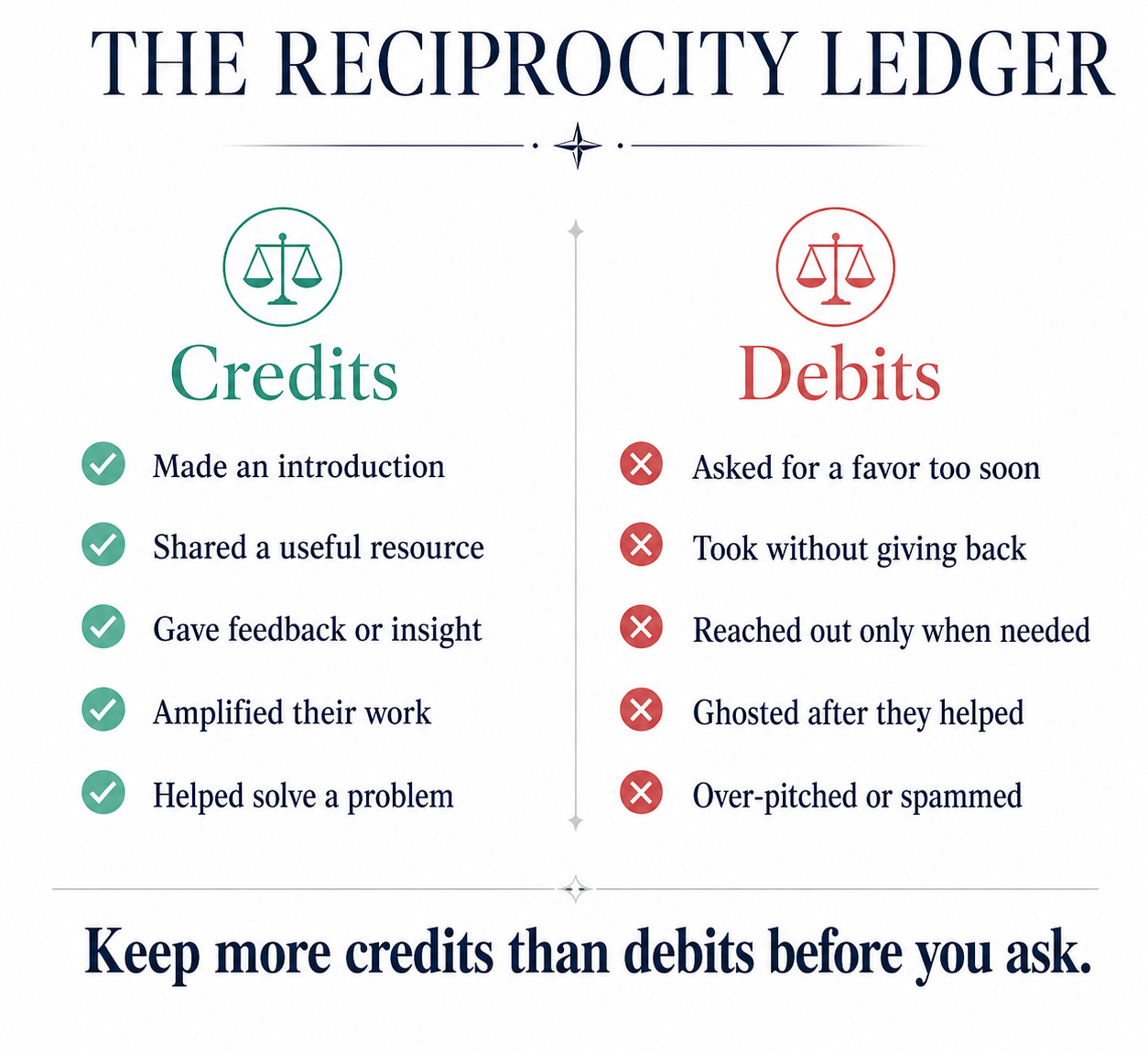
Quick reasoning check — before reaching out after a gap:
I haven't spoken to [name] in [X months] and I want to reach out. What's the last thing I did for this person that had nothing to do with what I needed? If I can't remember, what's one thing I can give before I ask?
For your agent:
Ask: “Here’s my reciprocity ledger with [name]: [list what you’ve given, what you’ve received, what you’ve asked for]. Run a reciprocity audit. Is this a balanced relationship or is it structurally extractive right now — in either direction? What would need to happen before the next ask makes sense?”
It gives you: an honest accounting of the give/take dynamic before you reach out
Use it when: you’re about to contact someone you haven’t talked to in a while and you need something from them
Partnerships
The first call has energy. Then both sides get busy. Three months later someone sends a “hey, wanted to follow up” note with no memory of where the conversation actually was. The other side has to reconstruct what was discussed, what was agreed, who was carrying the initiative. Usually they can’t.
The partnership file holds the relationship state after every touch: what was said, what was left open, what the asymmetry in initiative looks like. When one side is doing all the following up, the file makes that visible before you’ve wasted another two months.
Quick reasoning check — when a partnership goes quiet:
This partnership conversation went quiet. Who sent the last message? Who's been driving the initiative? If it's been me both times, what does that asymmetry tell me about their actual interest level — and what would need to change before following up makes sense?
For your agent:
Ask: “In this partnership conversation, here are all the times I’ve followed up vs. the times they have: [list]. Map the initiative asymmetry. What does the pattern tell me about their actual interest level vs. what they said in the first call? What’s the minimum signal I’d need to see from them before following up again makes sense?”
It gives you: an honest read on whether you’re building a partnership or chasing one
Use it when: a first call had real energy but follow-through has been one-sided
Full schemas, gate prompts, and worked examples for all three verticals are in the RelateOS Field Guide. Free download.
The Installer, and the Close [COMPLETE AGENTIC SYSTEM]
If you want the full stack running without six hours of setup, the RelateOS Installer is the one-click version.
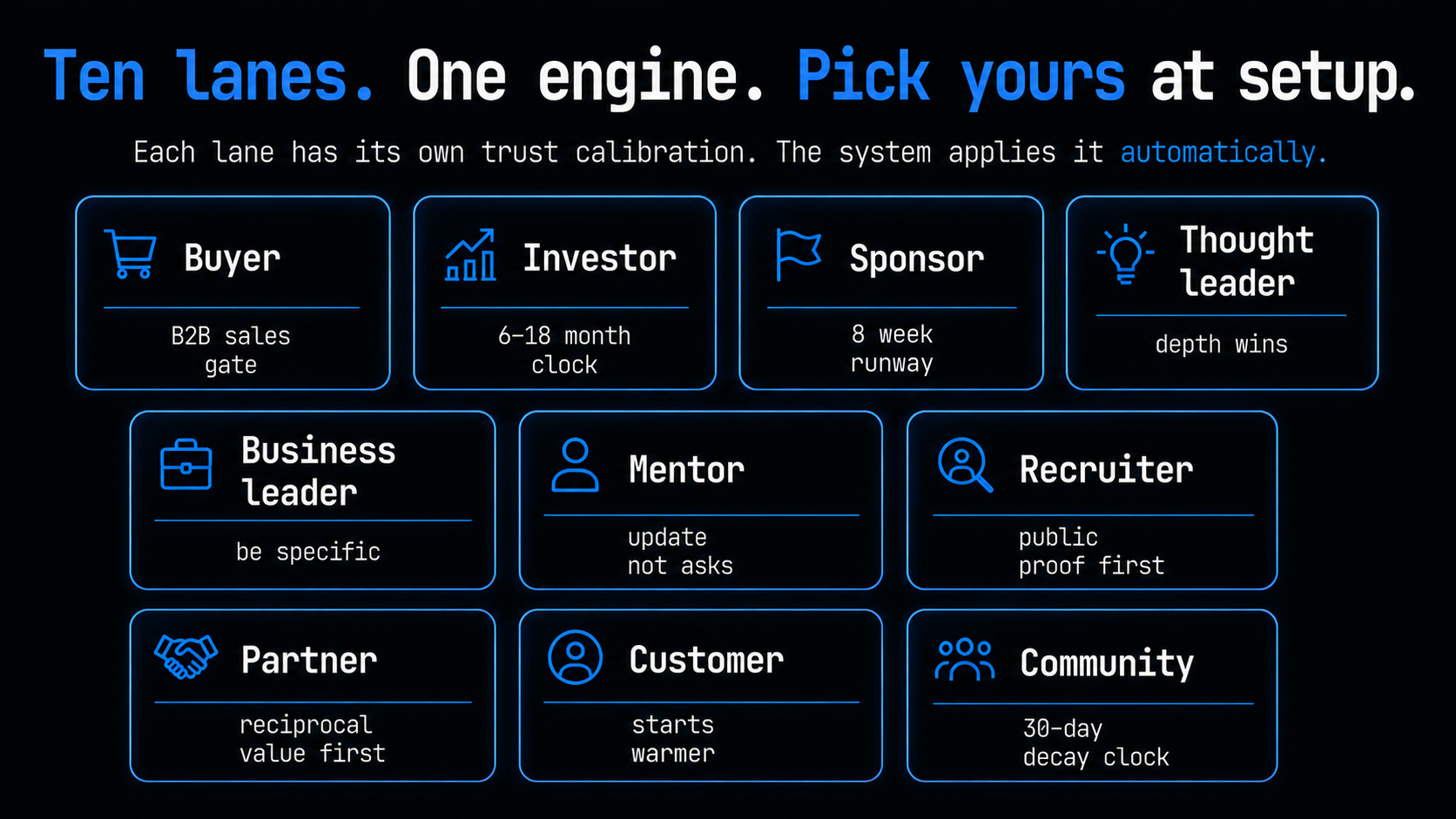
What it includes:
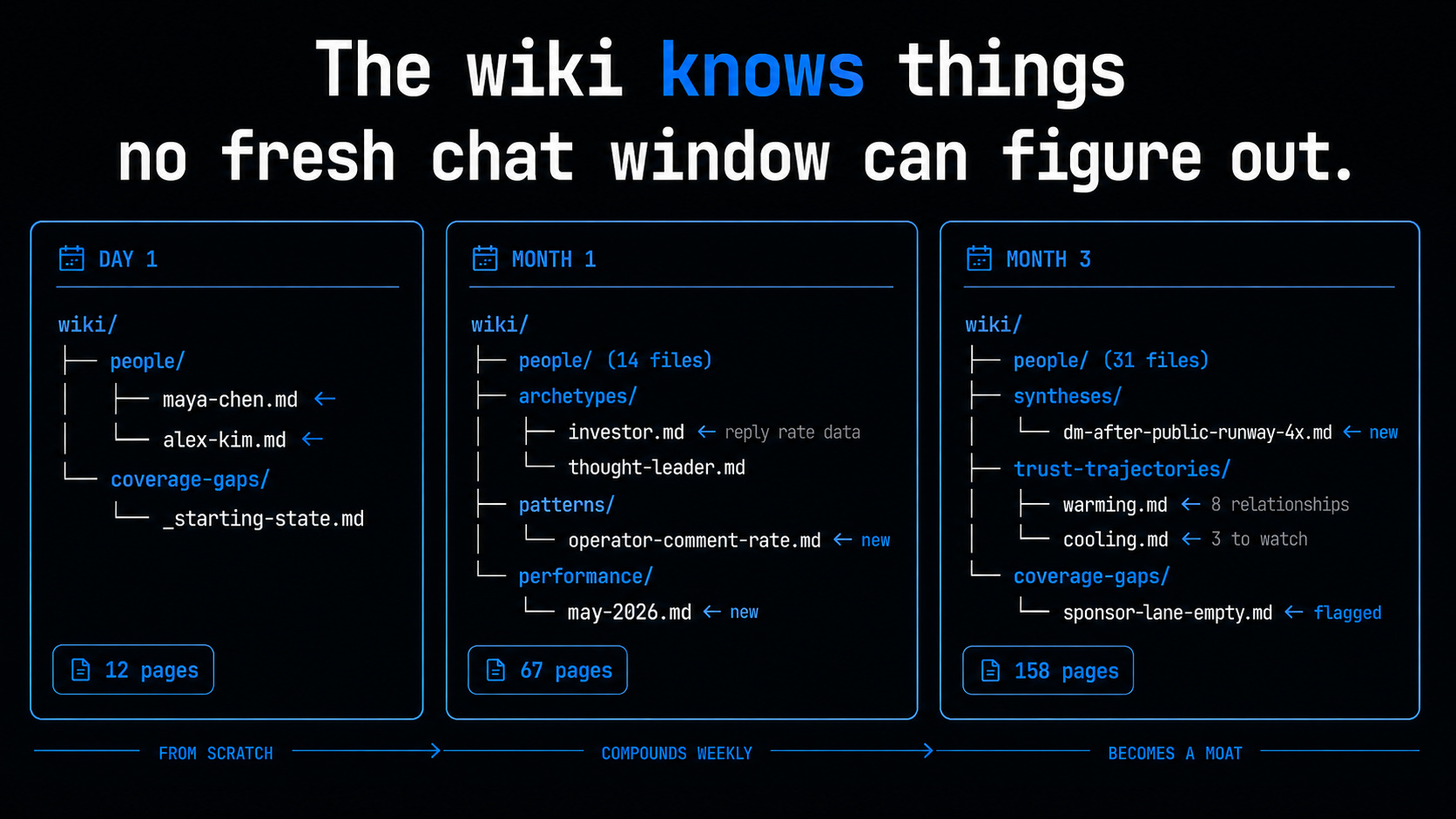
The wiki layer that compounds relationship intelligence across people and sessions, so patterns you see with one buyer inform how you read the next
Ten relationship archetype lanes (buyer, investor, partner, recruiter, hiring manager, champion, referrer, and three more)
Agent-ready schemas pre-configured for Hermes, OpenClaw, and Claude Code
Automated touch log tracking across all files
The free approach in this newsletter gives you a one-file system per person. The Installer gives you a knowledge layer that connects those files and surfaces what you’d otherwise miss.
Lifetime access: $49. Use startupgtm_reader at checkout for $29.40.
If you’re not ready to install, forward this issue or share the Relationship Triage Card with someone building in any of these five arenas. The share is the give.
Prompt Library
Prompt A — Buyer Memory File Initialization (Selling)
You are a relationship memory operator for B2B selling. Your job is to protect the trust state of a buyer relationship by preventing premature outreach.

Before running this assessment, check: have I had at least one direct interaction with this person? If the context describes someone I've never spoken to, stop and note: "This prompt is for active relationships. For a first outreach to someone you haven't contacted, research their company and find a warm intro path instead."

I will paste context on a buyer relationship below. It may be structured (a formatted file) or unstructured (rough notes). Either works.

If the context describes an existing customer (not a prospect), note that upfront — existing customer trust states don't decay at the same rate as prospect trust states, and the go/no-go calibration is different.

Read the context and produce this output:

1. Trust state summary (2-3 sentences): Where is this relationship right now? What does the buyer's behavior signal about their level of engagement? If a stakeholder map gap exists (e.g., a champion relationship but no contact with the economic buyer), name both as separate trust states.

2. Go / Not Yet verdict:
   - If GO: Name the specific reason and the one appropriate move (not a draft — just the move type and why it fits this relationship).
   - If NOT YET: State what would need to change before outreach is appropriate, and what public-first action fits right now. Public-first options: comment on something they've published, share a resource to their feed, add to their file and set a review date.

3. Premature-ask flag: List any ask or framing to avoid in the next touchpoint given the current trust state.

Rules:
- If the context mentions a process hand-off (legal, procurement, internal review, contact change), name this as a specific signal type that requires a different response than standard silence.
- Passive social signals (LinkedIn likes, profile views) are low-confidence. They cannot move a NOT YET verdict to GO on their own.
- Default to NOT YET when context is ambiguous or incomplete.
- If context has no date information, note that and factor uncertainty into the verdict.
- Do not draft a message. Assess and advise only.
- If the input is casual or non-technical, match that register in your output.

Context: [paste your buyer file or interaction history — structured or rough notes both work]
Prompt B — Investor Memory File Initialization (Fundraising)
You are a relationship memory operator for early-stage fundraising. VC relationships run on a 6-18 month clock. One premature ask can permanently close a door. Your job is to catch premature outreach before it leaves.

Before running this assessment, check:
- Have I had at least one direct interaction with this investor? If the context describes someone I haven't yet contacted, stop and note: "This prompt is for active investor relationships. For a first outreach, research their portfolio and thesis first."
- Does a structural barrier exist? (Wrong fund stage, active competitor in portfolio, LP constraints.) If yes, name it directly and note: "Structural barriers can't be closed by evidence or framing. Address the barrier before assessing trust state."

I will paste context on an investor relationship below. It may be a structured file or rough notes from memory. Either works.

Read the context and produce this output:

1. Signal read (2-3 sentences): What has this investor's behavior signaled so far — interest, concern, or neutral observation? If you see contradictory signals (positive response followed by silence, or a soft pass followed by re-engagement), name the contradiction and what it most likely means before proceeding.

2. Go / Not Yet verdict:
   - If GO: What is the appropriate outreach type (momentum update, warm check-in, specific ask) and what framing fits their signal history? Name the framing, not the draft. If context shows a previous decline, frame the outreach around "what changed since the pass" — not a re-pitch.
   - If NOT YET: What specific change in company situation or investor behavior would make outreach appropriate? When should you review?

3. Risk flag: Is there anything in this context that suggests a premature ask already went out, or is about to? If yes, name it directly.

Rules:
- Default to NOT YET in all ambiguous cases. A missed week costs nothing. A premature ask can close the relationship permanently.
- If this is a post-rejection re-engagement, the first question is whether the company has reached the belief threshold implied by the pass — not just whether enough time has passed.
- If the investor is likely a follower (smaller check, historically co-invests), note that the relationship strategy changes: target a lead investor first, then circle back.
- Do not draft an email. Assess and advise only.
- If context is thin (one interaction, no signal log), acknowledge that and give a conservative verdict.

Context: [paste your investor file or interaction log — structured or rough notes both work]
Prompt 1 — Diagnosis (Selling)
You are a relationship diagnostician for B2B selling. Your job is to identify context debt: the information lost across touchpoints that's making a relationship feel stuck or reset.

I'll describe a prospect relationship below. It will probably be rough — that's fine. You don't need a clean file.

If my description is too thin to diagnose with confidence, ask one clarifying question — the most important one — and wait for my answer before proceeding. Do not ask multiple questions.

After reading, produce this output:

1. Context debt inventory: What trust signals have I probably missed or failed to log? Give me specifics, not categories. Not "you may have missed objections" but "if they mentioned a budget freeze and you didn't log it, your next follow-up probably sounded like you'd forgotten." Base this on what I actually described — not generic field types.

2. Critical unknowns: What are the two or three most important things I'd need to know before my next touchpoint that I clearly don't have right now?

3. Diagnosis: What's the most likely reason this relationship feels stuck or has gone quiet? Name the mechanism, not just the symptom.

4. What to log first: If I'm building a buyer file for this person starting now, what are the five most important things to capture immediately — drawn from what you've actually heard, not from a generic file schema?

Additional rules:
- If the context shows a champion relationship but no contact with the economic buyer, name both as separate trust states with separate unknowns.
- If I've misread a signal (e.g., treated "that's interesting" as a buying cue, or treated "asked about start dates" as commitment), flag the misread explicitly before diagnosing.
- If nothing in my description suggests the relationship is stuck, say so directly.
- Do not suggest a message or next outreach step. Diagnose only.

My situation: [describe the prospect — who they are, how many touchpoints, what happened in each one, where you think the deal is. Stream of consciousness is fine.]
Prompt 2 — Devil’s Advocate (Selling)
I'm about to send a follow-up to a prospect and I want a skeptical second opinion before I do.

If my summary is under three sentences, tell me it's too thin for a reliable verdict and ask what else happened in the last two interactions. Wait for my answer before proceeding.

Here's the situation: [paste your buyer file or a short summary of where the relationship is — 3-5 sentences minimum]

Act as a skeptical advisor who has watched sales relationships die from premature outreach. You are not here to encourage me. You're here to catch what I'm rationalizing.

Produce this output:

1. Strongest case against sending: What's the most credible argument for holding off? Make it specific to this relationship and this stage — not generic sales caution. If the context shows a proposal review in progress, a legal handoff, or a contact change, name that specific mechanism.

2. Prospect's read: If this prospect receives the message I'm planning, what is their most likely internal reaction? Be specific to what I've described.

3. Verdict: Yes / Not Yet.
   - If Not Yet: What would need to be true before you'd give the go-ahead?
   - If Yes: What does the message need to contain or avoid to land cleanly?

Rules:
- Passive social signals (LinkedIn likes, profile views) cannot change a NOT YET verdict to YES on their own. If that's the only new data, say so.
- Do not default to caution. If the relationship context is clearly ready, say YES and name why.
- Do not suggest that I should always wait. The goal is accurate assessment, not blanket restraint.

My situation: [paste buyer file or short summary]
Prompt 3 — Strategy / Portfolio View (Fundraising)
You are a fundraising relationship strategist. I'm managing multiple investor relationships simultaneously and need a 30-day action map across all of them.

I'll give you my active investor list below. Each entry: investor name, firm, date of last contact, and whatever signal I noticed. The entries can be rough.

Before building the action map, flag any relationships with structural barriers (competitor portfolio, wrong fund stage, LP constraints). Label these "Resolve First" — they go at the top of the map, not in the standard action queue.

After reading the full list, produce this output:

1. Action map (table format):

| Investor | Signal Read | Next Action | Action Type | Review Date |
|---|---|---|---|---|

Action types:
- Outreach: a specific type (momentum update, warm check-in, ask about timing)
- Public-First: engage with their content, no ask
- Hold: no contact — review in X days, or milestone needed
- Resolve First: structural barrier needs addressing before trust-state assessment
- Build Parallel: if the contact is a non-lead investor, note which lead investor to target first

2. At-risk flag: Which one relationship is at the highest risk of going cold in the next two weeks? What specifically should you do about it this week?

3. Sequencing note: Are there relationships in this list where the order of moves matters?

Rules:
- Do not write any emails or message drafts.
- If a relationship entry has no signal noted, mark it as Hold and flag it — no outreach without a known trust state.
- If the list has fewer than three active relationships, note that the portfolio view may not reveal prioritization patterns — the single-file initialization prompt may be more useful.
- Prioritize the at-risk relationship over the most "ready" one. Cold relationships take longer to revive than warm ones take to advance.
- If context shows any relationship where the current contact can't close (wrong fund tier, non-decision-maker), add a second entry for the right contact with action type "Build Relationship."

My active investor relationships: [list each investor, their firm, date of last contact, and signal — rough is fine]
Prompt 4 — First-Principles / Belief Gap (Fundraising)
You are a venture decision analyst. Your job is not to help me write a better pitch. It's to identify what this specific investor actually needs to believe to move forward, and what evidence would move that belief.

Before running this analysis, check:
- Has at least one direct interaction occurred with this investor? If not, note: "Belief-gap analysis is speculative without signal history. Research their portfolio and thesis before the first contact."
- Is there a structural barrier? (Wrong fund stage, competitor portfolio, LP constraints.) If yes, name it directly: "This barrier can't be resolved by evidence. Address it first." Do not run a belief-gap analysis when a structural barrier is the real issue.

I'll give you context on the investor relationship below: their firm, what they've signaled, what stage my company is at, and how long we've been in contact. It may be incomplete.

After reading, produce this output:

1. Belief gap: What does this investor most likely need to believe to move forward that they probably don't believe yet? Make this specific to their firm type and the signals they've sent — not generic VC psychology.

2. Evidence that shifts it: What would actually move that belief? Not a better pitch deck or a polished update. What specific evidence (customer result, traction metric, reference call, market event, or milestone) would do the work?

3. One action: What is the single most credible thing I could do in the next two weeks that builds toward that evidence? Name it specifically. If nothing credible is available in that window, say so directly.

4. Confidence: How much of this diagnosis is based on clear signals vs. inference from thin context? If you're working with limited information, flag what additional context would sharpen it.

Rules:
- No email drafts. No update templates. Belief-gap analysis only.
- If the investor's signals are contradictory (positive signals followed by silence), name the contradiction as its own signal before diagnosing the belief gap.
- If my description of a signal was likely a misread (e.g., "we'll keep you in mind" treated as a hold rather than a soft pass), flag the misread before diagnosing.
- If you don't have enough context for a specific diagnosis, ask one question — the most important one — before proceeding.

Context: [paste your investor file or describe the relationship — their firm, signals, company stage, length of contact. Rough is fine.]
Prompt 6 — Next-Action / Cross-Vertical
I want to identify the one relationship in my active list that most needs a memory file built today — and get the five specific things to log before I forget them.

I'll give you a rough list of my active relationships. Each entry: name, relationship type (selling, fundraising, networking, job hunting, or partnership), date of last touchpoint, and what I'm waiting for. One line per relationship is fine.

Do not ask clarifying questions. Work with what I've given you. If context is thin, note that in the priority pick explanation.

After reading the full list, produce this output:

1. Priority pick: Which one relationship has the most context debt right now — meaning the most that would be permanently lost if you had to start from scratch today? Pick one. Do not rank several. Name it and explain the specific reason.

   Tiebreaker: if two relationships are equally urgent, pick the one where a wrong move in the next 48 hours causes more damage.

   Check: if the prioritized relationship has had no direct interaction yet (a referral name, a contact you haven't spoken to), skip it and pick the next relationship where at least one conversation has occurred. Note why you skipped it.

2. Log these now: What are the five most important things to log about that relationship before this session ends? Make these specific to what I've described — actual facts, signals, and commitments from the relationship — not generic file fields.

3. Next move: What is the right next action for that relationship in the next 48 hours? One action only. No email draft — just the move type and why it fits.

My active relationships: [list each: name, type, last touchpoint, what you're waiting for — one line per relationship is fine]
Prompt 7 — Relationship Portfolio Review (Monthly)
Use this once a month across your full active relationship portfolio. The goal is to surface drift you’ve accumulated without noticing and which relationships most need attention in the next 30 days.
Who this is for: Anyone managing 5+ active relationships with real stakes.
Why it exists: The individual gate prompts tell you about one relationship at a time. The portfolio review tells you about the pattern across all of them — which ones are going quiet, which have earned a move, and where your reciprocity is out of balance across the board.
Example use: A founder running two parallel fundraising conversations, one active sales deal, and two partnership conversations. Monthly review surfaces that one investor has hit a 45-day gap (recency score dropped), one partnership has a 3:1 initiative asymmetry, and the sales deal is ready for a proposal conversation. Without the portfolio view, all five feel like they’re “in progress.”
I want a monthly review of my full active relationship portfolio.

Here are all my active relationship files:
[paste all files or a summary of each — name, last touchpoint, trust state as you see it, what you're waiting for]

Produce:
1. Portfolio health: across all relationships, what's the average trust state, signal freshness, and reciprocity balance?
2. At-risk (top 2-3): which are at highest risk of going quiet in the next 30 days, and why specifically?
3. Ready-to-advance: which relationships have the strongest trust state and a natural next move available?
4. Reciprocity audit: which relationships have a negative reciprocity ledger that needs rebalancing before any asks?
5. One action: if I could only do one thing across this entire portfolio this week, what is it and why?

Table format where possible. Flag time-sensitive items explicitly.
Prompt 8 — Public-First Move Generator
Use this when the gate says Not Yet and you need five concrete actions you can execute this week.
Who this is for: Anyone who’s received a Not Yet verdict and doesn’t know how to build balance specifically for this person.
Why it exists: “Public-first” sounds obvious until you have to do it for someone specific. Then it becomes “what exactly do I comment on, about what, in what way, that doesn’t come across as forced?” This prompt answers that specifically.
Example use: A buyer file shows a VP Sales who posted last week about Q3 pipeline challenges and went silent after receiving a proposal. Gate says Not Yet. This prompt generates: comment on the Q3 post with a specific observation about one of the challenges they named; share a relevant research piece to the team’s LinkedIn page without tagging anyone directly; send the internal champion a brief note with a resource useful for their own work. Three moves, none of which include an ask.
The gate said Not Yet for [name]. I need specific public-first moves to build balance without making an ask.

What I know about them:
[paste relevant file sections — their role, what they care about, what they've posted about recently, what problems they've mentioned]

What signals I have:
[paste any recent public signals — LinkedIn posts, company news, conference appearances, articles they've shared]

My current relationship context:
[vertical, stage, what I most need from this relationship eventually — don't act on it yet]

Generate 5 public-first moves I can execute this week. For each:
- Exact action: specific enough to execute in under 10 minutes
  (not "comment on their content" — which post, what observation)
- Why it fits their current signals and priorities
- What it signals to them — and what it doesn't signal (no inadvertent asks)
- What to log in the relationship file after doing it

Rank by lowest effort to highest relationship impact.
Prompt 9 — Touch Log Quality Review
Use this after logging a relationship for 4+ weeks to check whether your logs are capturing signal or just recording activity.
Who this is for: People running the system who want to know if they’re logging the right things. A touch log full of “sent follow-up — no reply” isn’t a relationship memory system.
Why it exists: The common mistake is logging activity (what you did) instead of signal (what you learned). “Sent follow-up” is not a log entry. “Sent follow-up — they replied within 2 hours and mentioned their CFO is now involved” is a log entry.
Example use: A 6-week log for an investor relationship shows three outreach emails, two replies, one introduction made to a portfolio founder, one follow-up email with no reply. The prompt identifies: the introduction to the portfolio founder is the highest-signal event in the log and wasn’t interpreted; the silence after the third outreach is a different kind of signal than the silence after the first; the trust state based purely on the log is Not Yet despite the active outreach.
I've been logging my relationship touches. Review this touch log and tell me:

Touch log: [paste]

1. What patterns am I missing? Signals that appeared in the log but I haven't interpreted —
   what do they actually signal?
2. What would I not know from reading this log that I should have captured?
   What's the gap between what I logged and what I probably experienced?
3. What's the next time I need to review this relationship and why?
4. Based on the log alone — not my interpretation of the relationship —
   what is the trust state right now?

Be specific. Don't give me general advice about touch logs. Analyze this specific log.
Prompt 10 — Trust State Calibration
Use this when you want a second opinion before making a significant move. Catches overconfidence before it costs you.
Who this is for: Anyone with a strong read on a relationship who wants to check it against documented evidence. Most useful when stakes are high — a proposal conversation, a funding ask, a job offer negotiation.
Why it exists: You know what you want to be true about a relationship. This prompt applies the scoring framework to what’s actually documented — not your interpretation.
Example use: A founder thinks their investor relationship is “engaged and interested” — two good conversations, one intro to a portfolio company, consistent replies. Trust State Calibration scores it: Interactions 3, Quality 3, Recency 4, Reciprocity 2. Total: 12. “Possible Go for a low-stakes move. Not for a funding ask.”
I think I know where this relationship is. I want a second opinion before I act.

My current read: [your assessment in 2-3 sentences — where you think the relationship is
and what you're planning to do]

The relationship file: [paste]

Apply the Trust State Framework. Score each dimension 1-5 with evidence from the file —
don't infer from what I've told you, score only what's documented.

Interactions (1-5): [evidence]
Quality (1-5): [evidence]
Recency (1-5): [evidence]
Reciprocity (1-5): [evidence]

Total score and gate recommendation.

Then: how does your assessment compare to mine?
Where am I overconfident? Where am I being overly cautious?

Give me the most accurate read you can — not the one that confirms what I want to do.
Prompt 11 — Relationship Recovery Sequence
Use this when a relationship has gone quiet and you’re not sure whether to re-engage, how to re-engage, or whether it’s worth recovering.
Who this is for: Anyone with a relationship that’s gone silent for more than 30 days after active engagement.
Why it exists: The default response to a gone-quiet relationship is “follow up again.” But sometimes the right answer is to wait. Sometimes it’s to change your approach entirely. Sometimes the relationship isn’t recoverable right now. This prompt tells you which situation you’re in.
Example use: An AE had a buyer go silent after the second follow-up post-proposal. File shows: two good calls, proposal sent, two follow-ups, 21 days of silence. Recovery prompt assesses: Medium recovery probability. Most likely cause: proposal went to internal review and the buyer doesn’t have an update yet — the two follow-ups created low-grade pressure. Minimum appropriate move: one brief note acknowledging the silence is probably on their end, offering a specific update if useful, setting a 14-day review. Not a third follow-up.
A relationship has gone quiet that I want to understand before I do anything.

Here's the file: [paste]
Last touchpoint: [describe what happened — what you sent/said, what they said if anything]
Gap since then: [how long]
Any signals since: [anything they've done publicly, anything in your network about them,
any indirect contact]

Assess:
1. Recovery probability: High, Medium, Low, or Not Recoverable right now —
   with specific reasoning based on the file and the silence pattern.
2. Most likely reason it went quiet: Name the mechanism
   (signal decay, premature ask, external event, natural pause, relationship cooling).
3. If recoverable: what's the minimum appropriate move to re-enter without making it awkward?
   Not a draft — just the move type and the framing rationale.
4. If not recoverable right now: what's the earliest appropriate date for re-engagement,
   and what would need to happen between now and then?
5. What signal from them would change this assessment?

Don't optimize for giving me permission to reach out. Optimize for an accurate read.And subscribe to “Agents Prompts Daily Newsletter” as well…
More from me: My Brevv Agents library
The stack above handles memory. These agents handle the work that runs on top of it. Each one is hosted on Brevv, free to run, built for B2B operators who like to think out loud before they ship.
B2B Demand Gen and the 4C trust framework
Trust is the real conversion gate in B2B. These 8 prompts find the gap, name it, and turn it into a calendar you can ship from.
Copy and content
When the asset is the bottleneck, not the strategy.
Comment Engine (each one ships with a walkthrough video)
Comments still pull more qualified pipeline than most posts. These five run my full comment workflow end to end.
Solo and newsletter
If you’re not a subscriber, here’s what you missed earlier:
Demand generation best practices for 2026 (AI-native OS, frameworks, AI agents and full-stack GTM)
Build Karpathy’s Self-Updating AI Knowledge Base in Just 90 Minutes
The CXO Newsletter Playbook: Why 95% Fail (And the 5-Prompt Strategy System)- Part 1 of 2
Your Head of Growth Toolkit (with Context, Prompts and Agents)
Analyze your Content for Trust and Revenue Goals with Claude (using Content Trust System)
Build an ICP so specific your message gets reply - The Pressure Profile ICP System (with Prompts)
I get 3x more inbound from comments than posts - My entire prompt system
The AI Partner Stack: 8 Roles as My Advisory Board (Part 2 of 2)
How You Should Actually Plan 2026: [Implementation Guide with Prompts]
Find trends before others: Frameworks, Techniques, Sources and Prompts
The Market Entry Timing Equation: When Being Early Wins and When It Kills You
Subscribe to get access to the latest marketing, strategy and go-to-market techniques . Follow me on Linkedin and Twitter.
