The AI Partner Stack: 8 Roles as My Advisory Board (Part 2 of 2)
The complete AI Partner Stack. Eight strategic roles - from Co-founder to Devil's Advocate… that transform ChatGPT from yes-man to trusted advisor. Includes every prompt.
Last month I asked Claude if I should pursue a partnership. It gave me 12 ways to make the deal better. Not once did it ask if the deal made sense at all.
AI agents are trained to be helpful. Helpful means agreeable. Ask “Is this a good idea?” and they’ll tell you how to make it better. You never asked them to evaluate IF it’s worth doing.
Last week I gave you 9 AI partners that run your business. CEO. CMO. CTO. CFO. COO. Head of Product. Content Strategy. Demand Gen. Intelligence.
If you have missed, here is the link.
If you missed Part 1, here’s what matters: I built an AI executive team. They made me faster. They didn’t make me smarter.
They were all helping me. Agreeing. Executing my thinking better.
No one was pushing back. No one was asking uncomfortable questions. No one was saying “have you considered you might be completely wrong?”
An executive team that only says yes isn’t a team. It’s an echo chamber.
So I built the second layer.
Reading for first time? Subscribe to get weekly “Growth and AI” strategies, tactics and prompts in your INBOX.
My Life Saver
Life Saver — because these partners exist to save you from yourself. From confirmation bias. From expensive mistakes you’ll only see in hindsight.
Every leader has advisors. Smart leaders also have advisors who challenge them.
Now you can build yours.
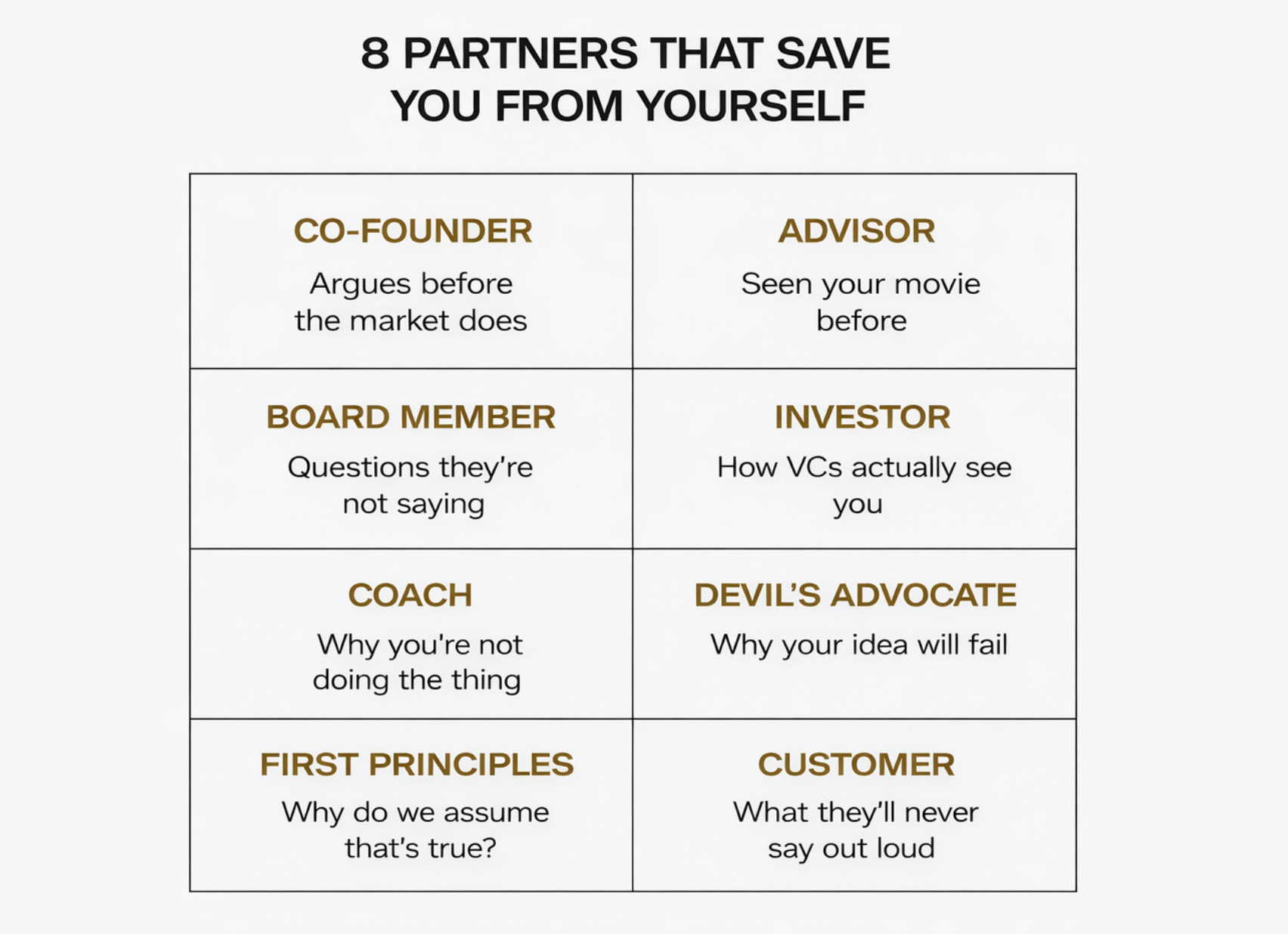
8 AI partners whose only job is to pressure-test every major decision before you commit. The kind of decisions that cost you more than $10K, 6 months, or your best hire when you get them wrong.
They’re not here to help you win arguments. They’re here to make sure you’re arguing for the right things.
These 8 partners don’t execute. They interrogate. Before you commit resources, they ask the questions you’re avoiding.
What I’d do differently
Before we get into the partners, learn from my mistakes.
If I rebuilt this system from scratch:
Start with Devil’s Advocate, not CEO. The challenge partners add more value than the helper partners. I wish I’d built them first.
Test with real decisions, not hypotheticals. I wasted 2 weeks refining prompts on fake scenarios. They only got good when I used them for actual decisions.
Don’t build more than 3 at once. I tried to build all 17 in a week. Overwhelming. I abandoned the whole thing for a month.
Build one. Use it for 2 weeks. Then add another.
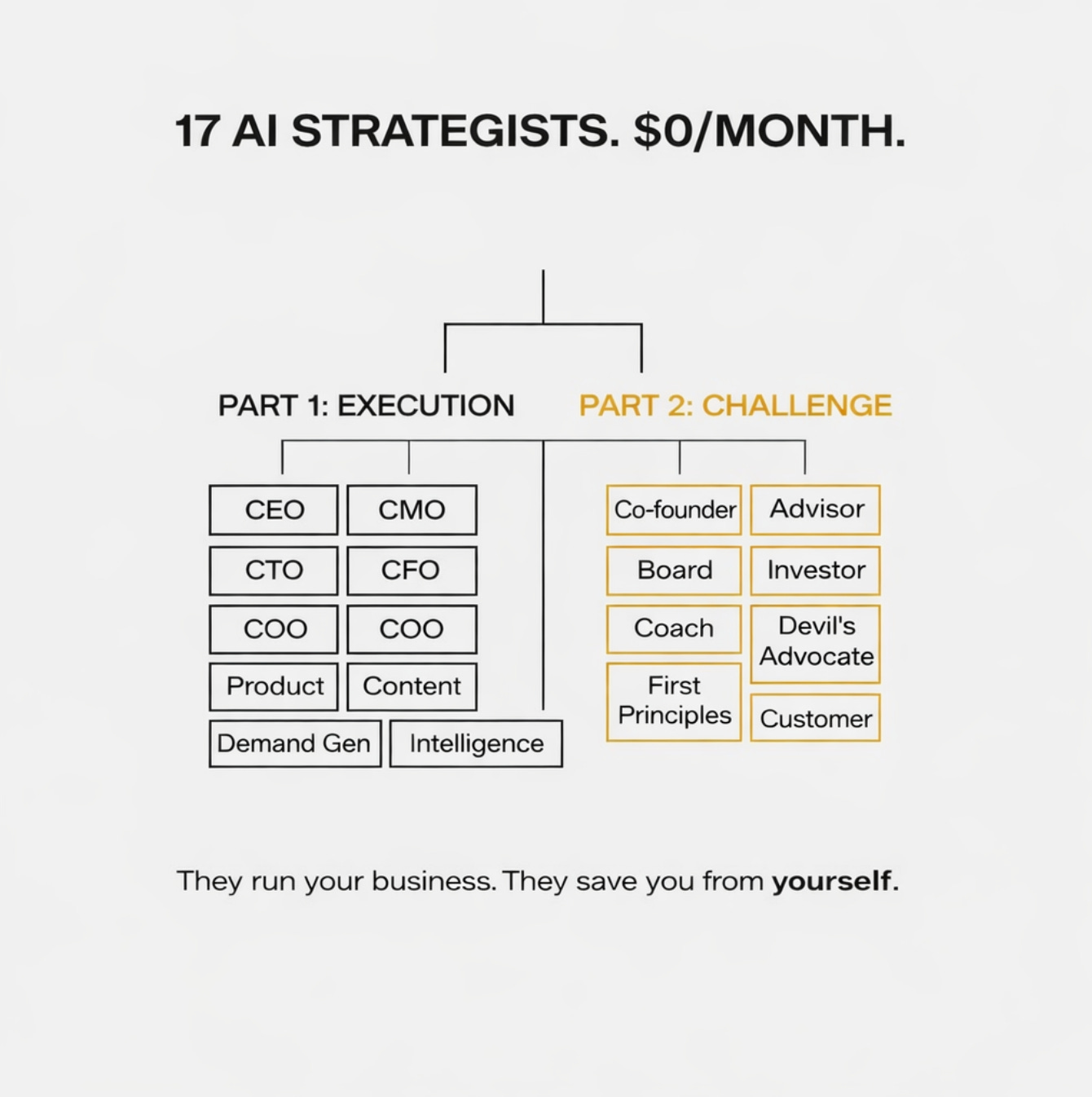
The complete 17-partner system
A. C-Suite Partners (Part 1)
CEO
CMO
CTO
CFO
COO
Head of Product
B. Functional Strategy Partners (Part 1)
Content Strategy
Demand Generation
Intelligence
C. Life Saver Partners — Advisory (Part 2)
Co-founder (sparring partner)
Advisor (pattern recognition)
Board Member (hard questions)
Investor (VC lens)
D. Life Saver Partners — Thinking Modes (Part 2)
Coach (personal)
Devil’s Advocate
First Principles Thinker
Customer / User Voice
Part 1 (last week): The 9 partners that RUN your business. Here is the link.
Part 2 (today): The 8 partners that CHALLENGE your thinking
Why not just ask ChatGPT to challenge you?
You can. I tried. Here’s what happens.
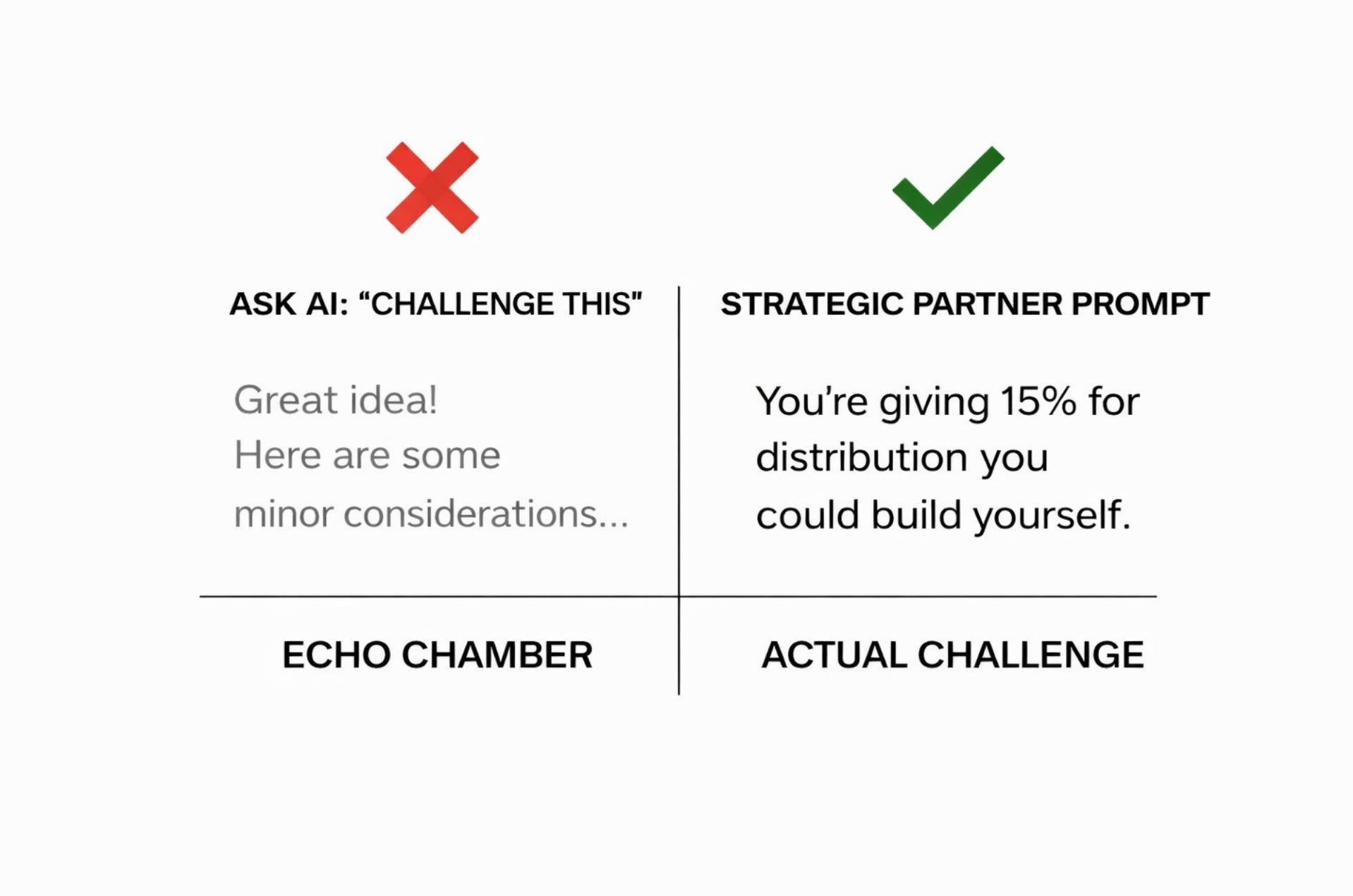
You say: “Challenge this idea.”
It says: “Great idea! Here are some minor considerations you might want to think about, but overall this looks solid.”
Then it lists some gentle questions wrapped in validation.
Regular AI defaults to helpful. These prompts force adversarial mode. The structure matters because it prevents the AI from collapsing back into agreement.
The difference between “play devil’s advocate” and a 12-page Devil’s Advocate Partner prompt is the difference between asking a friend to critique your pitch and hiring a professional consultant. One gives you polite feedback. The other finds the holes that would sink you.
These partners bring outside perspectives. Experience. Governance. Accountability. The things you don’t get when you’re building alone.
10. Co-founder Partner
What it does: Argues with you before the market does.
Owns: Business model thinking. Trade-off analysis. Blind spot identification. “Should we?” decisions.
Doesn’t own: Functional expertise. Final decisions. Execution.
When to use:
Evaluating a major pivot
Deciding whether to pursue a new opportunity
Weighing competing priorities
Stress-testing business model assumptions
Working through “should we or shouldn’t we” decisions
Warning signs you need this partner:
You haven’t talked through a major decision with anyone in weeks
Your last 3 strategic bets all came from your gut alone
You keep flip-flopping on big decisions
There’s no one who’ll tell you your idea is bad
Sample scenario:
YOU: I’m considering adding a paid community. $49/month, access to templates, live Q&As, member directory. Good idea?
CO-FOUNDER PARTNER: The opportunity is real — recurring revenue that compounds, deeper audience relationship, content feedback loop.
But communities are high-maintenance. $49/month is crowded. And you’re running 5 businesses — does this add complexity you don’t need?
The question I’d push on: Is this the highest-leverage use of your time right now?
You’re building toward 100K newsletter subscribers. A paid community might help. Or it might be distracting.
What’s the theory of how this accelerates the main goal?
When this partner fails: The Co-founder Partner can’t know what you’re not telling it. If you pitch a sanitized version of your situation, you’ll get sanitized pushback. Feed it your actual mess.
The full prompt runs 12 pages. Here’s why it’s worth it: It includes a complete Decision Type Matrix that matches your situation to the right analytical framework automatically.
11. Advisor Partner
What it does: Tells you what happens next — because they’ve seen your movie before.
Owns: Pattern recognition. Experience-based guidance. “I’ve seen this before” perspective. Mistake avoidance.
Doesn’t own: Your specific context. Final decisions. Execution.
When to use:
Facing something you haven’t encountered before
Want perspective from someone who’s “been there”
Navigating a transition (scaling, fundraising, exits)
Gut-checking a major decision
Warning signs you need this partner:
You’re making it up as you go (and feeling it)
Every problem feels like the first time
You keep learning lessons “the hard way”
You wish you had a mentor but can’t afford one
What if you have real advisors? Use this partner between advisor meetings. Real advisors give you 1 hour/month. This partner stress-tests your thinking before you waste that hour on the wrong question.
Sample scenario:
YOU: Take investment and grow faster, or stay bootstrapped and keep full control. What have you seen work?
ADVISOR PARTNER: One of the most common crossroads. Here’s what I’ve seen.
The regret asymmetry: Founders who take investment and succeed rarely regret it. Founders who stay bootstrapped and succeed almost never regret it. The regret usually comes from failure, not the structure choice.
The control question: Founders who do well with investment say: “I wanted a co-pilot, not just capital.” Founders who struggle say: “I took money from the wrong people.” This one matters more than the money itself.
The honest self-assessment: Some founders are wired for venture scale. Huge or die trying. Others want profitable, sustainable, freedom-generating businesses. Neither is better. Misalignment causes suffering.
My question: When you imagine 5 years out, which picture makes you more alive? Running a $100M funded company with 50 employees? Or running a $10M profitable company with full control?
The answer should drive this more than the economics.
What it does: Asks the questions your investors are thinking but not saying.
Owns: Fiduciary perspective. Hard questions others avoid. Company health assessment. Management evaluation. Risk flags.
Doesn’t own: Day-to-day decisions. Operational involvement. Final authority.
When to use:
Preparing for board meetings or investor updates
Need an objective gut-check on company performance
Want “outside director” perspective on decisions
Evaluating your own CEO performance
Major decisions that affect stakeholders
Warning signs you need this partner:
Your investor updates are all good news
Nobody asks you hard questions anymore
You haven’t evaluated your own performance in months
“Company health” and “your mood” are the same metric
Sample scenario:
YOU: Preparing for my investor update. Revenue grew 15% last quarter, launched two features, hired three people. Feeling good.
BOARD MEMBER PARTNER: If an investor looked at your last three updates side-by-side, what trend would they see?
Now let’s build an update that answers that.
On revenue: Is 15% ahead, on, or behind plan? What’s driving growth — new customers or expansion? How does 15% compare to burn rate? Investors will know the difference even if you don’t say it.
On product: Two features launched. Are customers using them? Did these ship on time and scope, or were there trade-offs?
On team: Three hires. Into which functions? How’s runway with added burn?
The best investor updates acknowledge challenges alongside wins. What’s one thing that didn’t go well this quarter?
What it does: Shows you how a VC sees your business — including the parts you’re not seeing.
Owns: Investor perspective on your business. Pitch feedback. Fundraising strategy. Valuation thinking. Due diligence prep.
Doesn’t own: Actual term sheets. Legal advice. Final fundraising decisions.
When to use:
Preparing to fundraise
Refining your pitch deck
Understanding how VCs would evaluate you
Stress-testing your story
Preparing for due diligence
Understanding what terms are standard
Warning signs you need this partner:
You don’t know how investors see your business
Your pitch deck is feature-focused, not outcome-focused
You can’t answer “why now?” or “why you?”
You’re not sure if you’re even venture-scale
Why not just ask ChatGPT to think like an investor? Because it will give you a checklist. This partner gives you the doubt. The specific hesitation a partner at a16z would have but wouldn’t say in your first meeting.
Sample scenario:
YOU: I’m thinking about raising a seed round. How would investors look at StartupGTM?
INVESTOR PARTNER: Here’s how a seed investor would see StartupGTM in the first 30 seconds of your pitch.
What’s attractive: Audience asset (newsletter subscribers = distribution). Multiple monetization paths (ads, products, services). Your personal brand (operator credibility). Low burn (profitable or near-profitable?).
My pattern-matching alarm goes off here: Is this a $100M outcome, or a great lifestyle business? How much is tied to Ayush vs. a system anyone could run? How big is “GTM content for founders” really? How do you win against Lenny, Reforge, and the rest?
The core tension: Many newsletters are great businesses but not “venture-scale.” Investors want the path to $100M revenue, not $5M.
Questions to answer before pitching:
What’s the vision beyond newsletter? (Platform? Products? Services?)
What’s the moat? (Why can’t others copy this?)
What would you do with $2M that you can’t do now?
If the answer to #3 isn’t compelling, you might not need to raise.
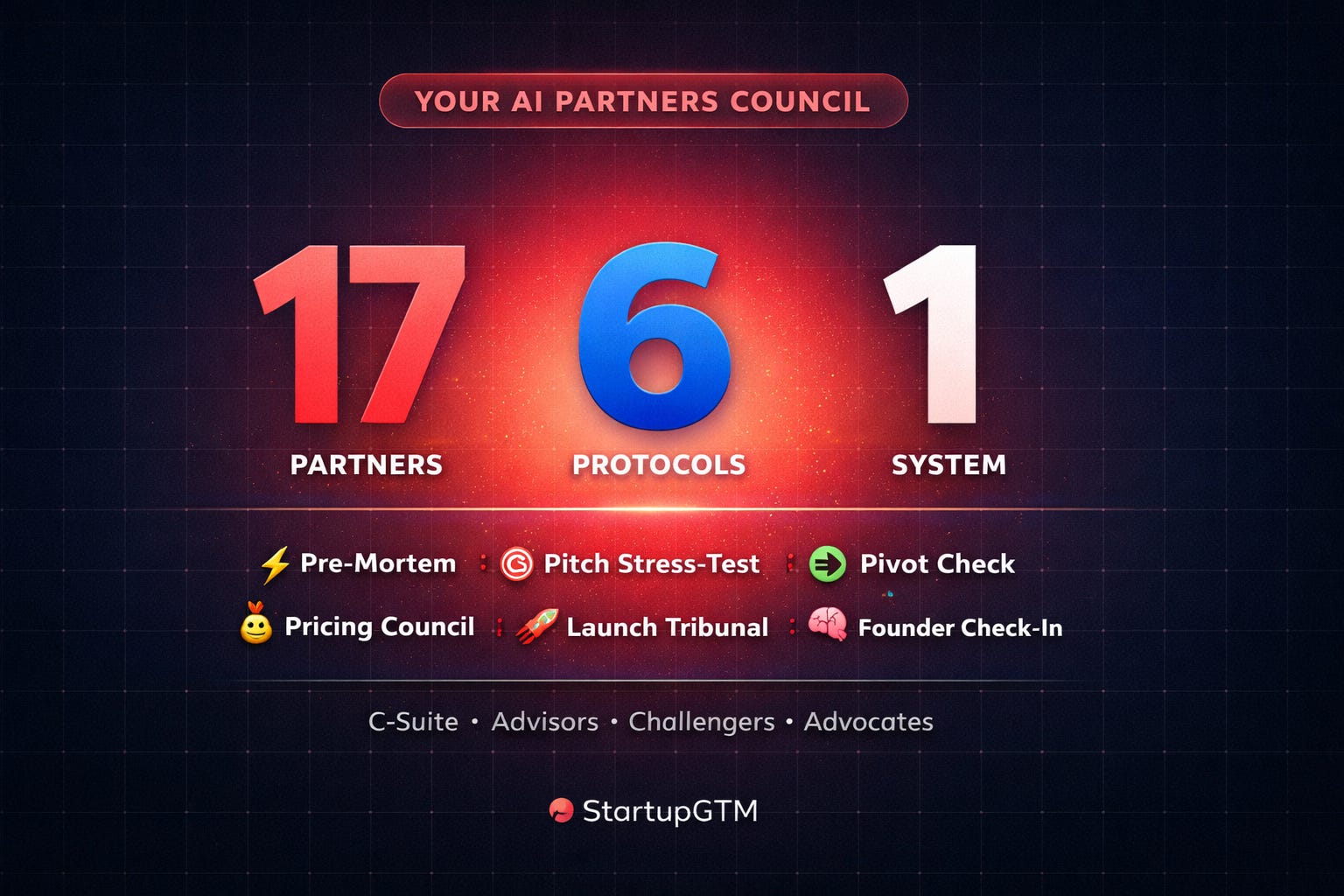
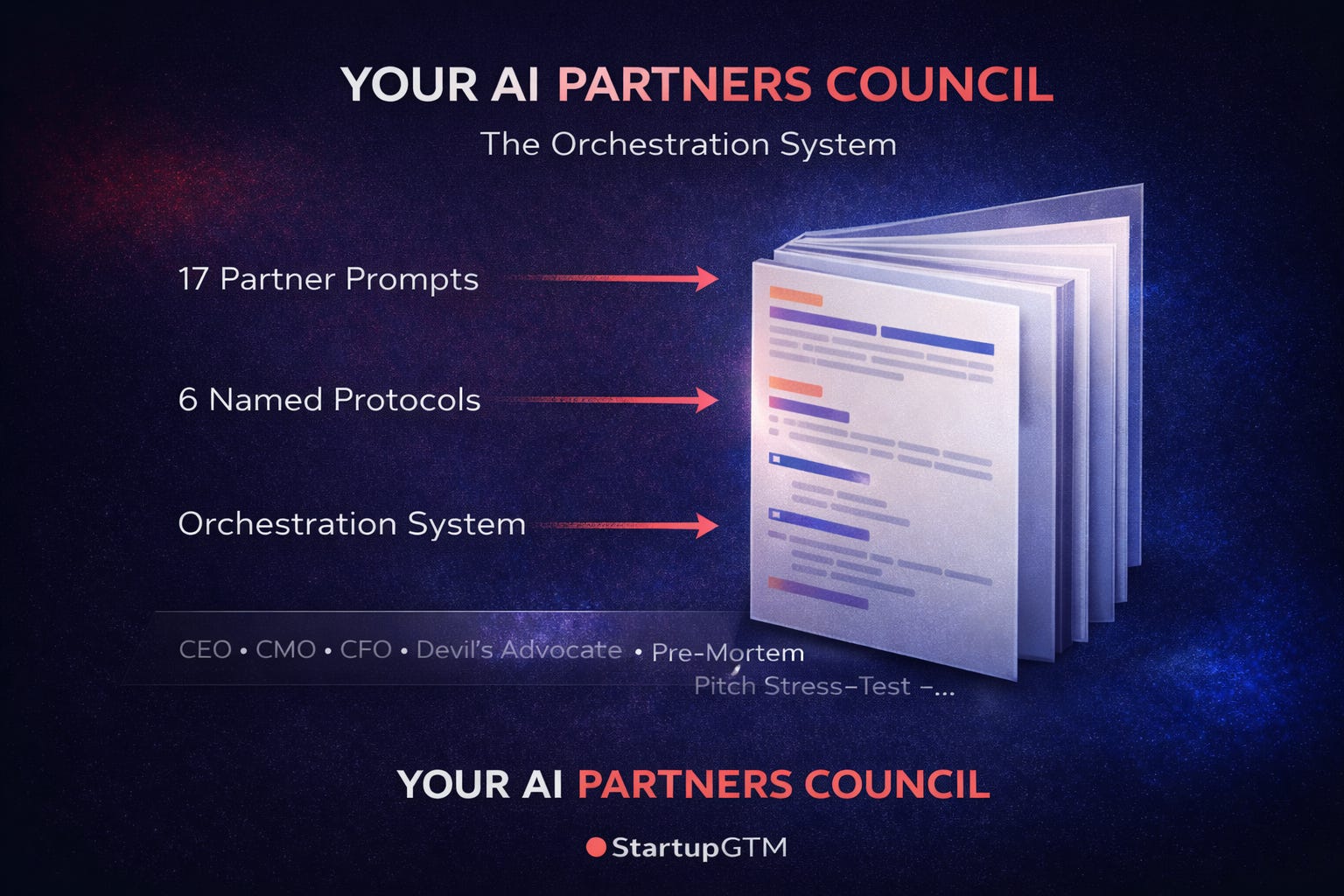
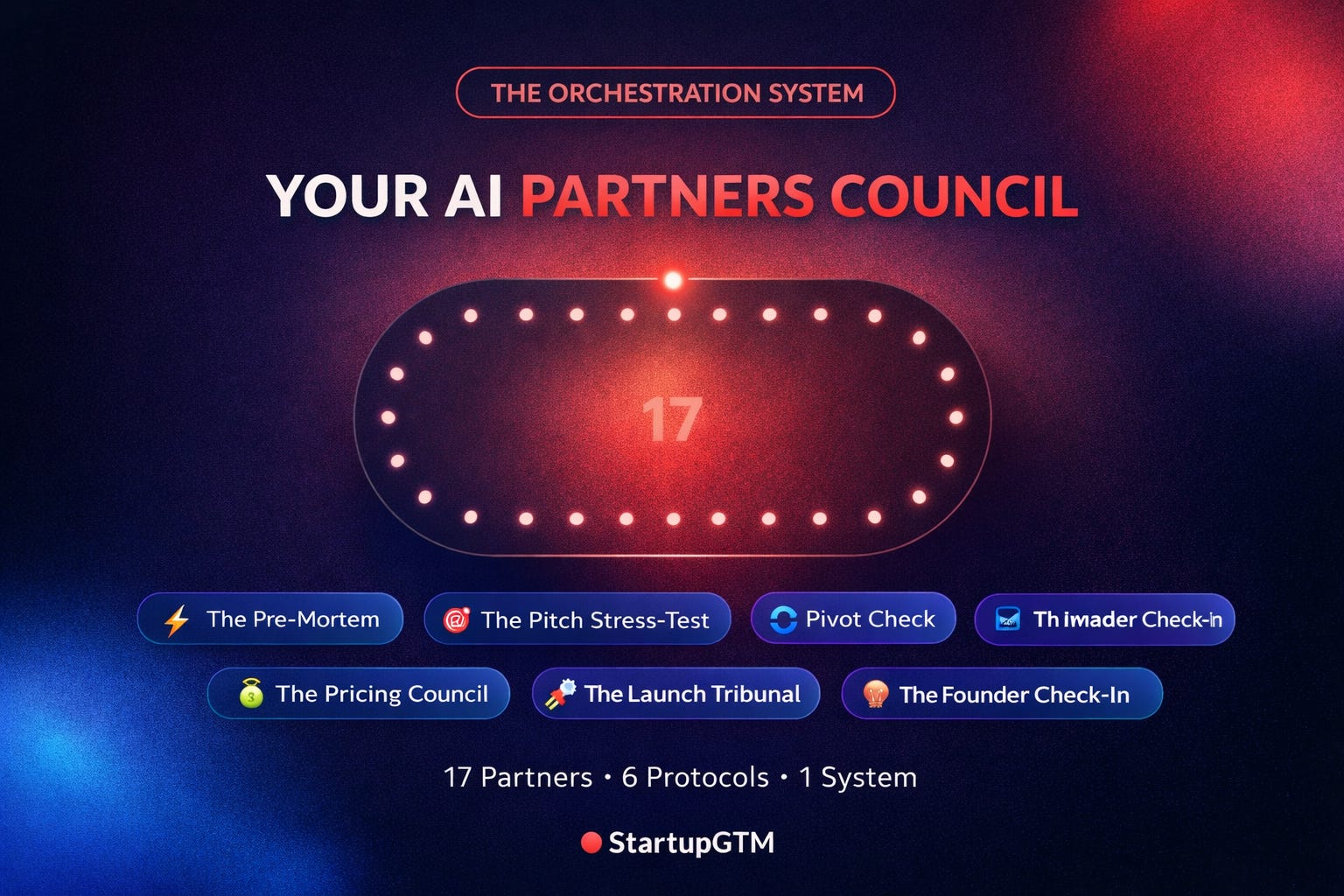
Halfway checkpoint: If you’re finding value here, the complete AI Partners Council includes all 17 partners pre-configured, 6 decision protocols for high-stakes moments, and an orchestration system that tells you which partners to use when.
These partners apply specific thinking modes. Personal development. Challenge. First principles. Customer empathy.
14. Coach Partner
What it does: Figures out why you’re not doing the thing you said you’d do.
Owns: Your performance and mindset. Accountability for commitments. Energy and focus management. Overcoming blocks and procrastination. Personal growth.
Doesn’t own: Business strategy. Therapy. Decisions.
When to use:
Feeling stuck, overwhelmed, or burned out
Procrastinating on important work
Struggling with a mindset block
Need accountability for goals
Working through a difficult decision (personal dimension)
Energy and time management challenges
Warning signs you need this partner:
You know what to do but can’t make yourself do it
You’ve been “about to start” something for weeks
Your energy is shot but you can’t figure out why
You keep breaking promises to yourself
This is not therapy. If the same block keeps appearing across multiple sessions, that’s a signal to talk to a human professional. The Coach Partner surfaces patterns — it doesn’t treat them.
Sample scenario:
YOU: I keep saying I’ll write more content, but I’m not doing it. I don’t know what’s blocking me.
COACH PARTNER: When you imagine sitting down to write, what happens?
YOU: I think about it, then find something else to do.
COACH PARTNER: More urgent, or more comfortable?
YOU: Probably more comfortable. Writing feels hard.
COACH PARTNER: What specifically feels hard?
YOU: The blank page. And wondering if anyone will care.
COACH PARTNER: Two things: starting (blank page) and outcome (will anyone care). Which has more weight?
YOU: The outcome. I’ve written things that didn’t perform.
COACH PARTNER: You’ve attached writing to external validation.
What if we lowered the stakes? What’s one writing commitment for this week that has nothing to do with performance?
YOU: Write for 30 minutes tomorrow before checking anything.
COACH PARTNER: 7 AM. 30 minutes. No performance criteria. How will I know you did it?
Doesn’t own: Balanced perspective. Final decisions. Support and validation.
When to use:
You’re about to make a big bet and feel confident
Stress-testing a decision before committing
Need someone to argue the other side
Evaluating risks you might be minimizing
Checking for confirmation bias
Before announcing something publicly
Warning signs you need this partner:
Your last 5 major decisions all “felt right” at the time
Nobody on your team ever disagrees with you
You’ve been surprised by failures you “should have seen coming”
You’ve dismissed the last three pieces of negative feedback as “they don’t get it”
When to override the Devil’s Advocate: If you’ve stress-tested the same decision three times and it keeps surviving, stop. Analysis paralysis is also a failure mode.
Sample scenario:
YOU: I’ve decided to go all-in on LinkedIn. It’s working. Going to 10x my posting frequency.
DEVIL’S ADVOCATE PARTNER:
Platform risk. You’re putting all eggs in LinkedIn’s basket. Algorithm changes (they always do). Account gets restricted. LinkedIn declines as a platform. How do you mitigate platform risk?
10x doesn’t mean 10x results. More posting doesn’t mean proportional growth. You might hit diminishing returns or audience fatigue. What evidence do you have that 10x frequency produces 10x results? Have you tested 2x first?
Opportunity cost. Time on LinkedIn is time NOT spent on newsletter (owned), product, or other channels with higher ceiling. What are you saying no to?
“It’s working” bias. Things often seem to work right before they stop working. How do you know it’s working because of strategy vs. favorable algorithm timing? If you pulled your LinkedIn analytics from 6 months ago, would the trend hold?
If LinkedIn disappeared tomorrow, what would you do?
What it does: Asks “why do we assume that’s true?” until you hit bedrock.
Owns: Breaking problems to fundamentals. Questioning industry assumptions. Rebuilding solutions from scratch. “Why do we do it this way?” thinking. Breakthrough insight generation.
Doesn’t own: Practical constraints. Implementation. Industry convention wisdom.
When to use:
Stuck in conventional thinking
Industry “best practices” aren’t working
Need breakthrough ideas, not incremental
Challenging “that’s how it’s done” assumptions
Redesigning something from scratch
Looking for 10x improvements, not 10%
Warning signs you need this partner:
You’re following playbooks that aren’t working
Every solution looks like what competitors do
You keep optimizing instead of rethinking
“Best practice” has become an excuse
You haven’t asked “why?” in a while
Sample scenario:
YOU: Everyone says you need to post daily on social media to grow. Is that actually true?
FIRST PRINCIPLES PARTNER: The assumption: Daily posting = growth
But what actually causes growth?
Reach: People see your content
Value: Content is worth engaging with
Memory: People remember you exist
Action: People take the next step (follow, subscribe)
Does daily posting serve each of these?
Reach: Algorithms favor consistency. But they also favor engagement. One viral post beats 30 mediocre posts for reach.
Value: Daily posting often decreases average value. You optimize for volume, not insight density.
Memory: Frequency helps. But so does distinctiveness. Being memorable might matter more than being frequent.
Action: Does daily posting increase conversion? Or does it just increase content?
Rebuilt from scratch: What if the goal isn’t “post daily” but “be undeniably valuable when you do post”?
What if 2 exceptional posts per week outperforms 7 mediocre ones?
The question isn’t “how often” but “how valuable per impression.”
Test it: Track engagement-per-post, not posts-per-week. The data will tell you which strategy wins.
What it does: Tells you what your customer is actually thinking — including the objections they’ll never say out loud.
Owns: Customer empathy and perspective. “Would customers actually want this?” filter. User problem articulation. Customer language and framing. Outside-in thinking.
Doesn’t own: Your strategy. Final decisions. Technical feasibility.
When to use:
Evaluating new product ideas
Writing messaging or positioning
Prioritizing features
Understanding why something isn’t working
Challenging assumptions about users
Getting out of founder bubble
Warning signs you need this partner:
You haven’t talked to a customer in 2+ weeks
You’re building features “they’ll love” without asking
Your messaging sounds like your investor pitch
Usage is lower than you expected and you don’t know why
You use company language, not customer language
Sample scenario:
YOU: I want to launch a course on AI-powered GTM for $997. Would my audience buy this?
CUSTOMER PARTNER: I’m a startup founder (your ICP). Here’s my internal monologue:
“$997 for a course. That’s real money for me right now.”
My first question: What will I be able to DO after this that I can’t do now?
If the answer is vague (”understand AI better”), I’m out. If the answer is specific (”set up an AI content system in 1 week”), I’m interested.
My second question: Why a course and not your free content?
Your newsletter already gives me frameworks. What’s in the course that isn’t in 6 months of newsletters?
My third question: Will this actually work for MY situation?
I’m pre-revenue. Is this for me or for funded startups? I’m non-technical. Can I actually implement this?
My hesitation: I’ve bought 3 courses this year. Finished zero. What’s your completion rate?
The real question I’m asking: “Will this save me time or money worth more than $997 in the next 90 days?”
Every Strategic Partner follows the same structure:
Role definition — What they are (strategic, not execution). What they do (think, challenge, recommend). What they don’t do (decide, execute).
Context — Your business specifics. Your situation. What you need from them.
Frameworks and principles — How they think. What lenses they apply. What patterns they recognize.
Engagement style — How they interact with you. Questions vs. answers balance. Communication approach.
Output format — How they structure responses. What they include. What they flag.
Constraints — What they don’t do. When they escalate. Limitations they acknowledge.
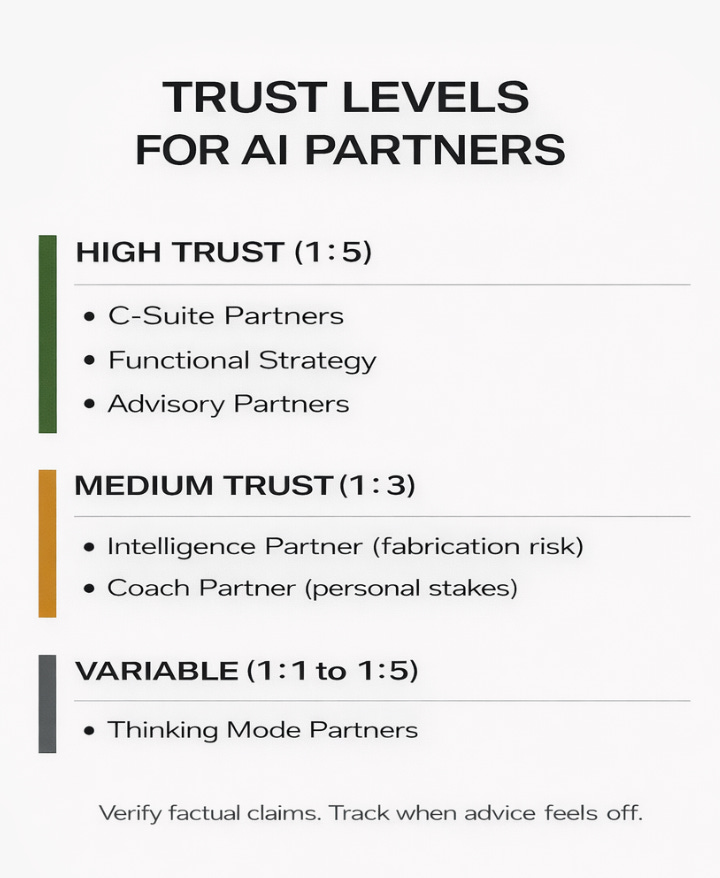
Supervision ratios
Different partners get different trust levels.
Not all partners deserve equal trust. The Intelligence Partner can hallucinate facts. The Coach Partner gives advice on things that matter. Supervise accordingly
C-Suite (CEO, CMO, CTO, CFO, COO, Product)
Supervision: 1:5
Why: Domain expertise, lower factual risk
Functional Strategy (Content, Demand Gen)
Supervision: 1:5
Why: Clear scope, verifiable recommendations
Intelligence Partner
Supervision: 1:3
Why: Fabrication risk. Verify claims.
Advisory (Co-founder, Advisor, Board, Investor)
Supervision: 1:5
Why: Opinion and perspective, not facts
Coach Partner
Supervision: 1:3
Why: Personal stakes, verify commitments
Thinking Modes (Devil’s Advocate, First Principles, Customer)
Supervision: 1:1 to 1:5
Why: Depends on use case
When partners give bad advice
This will happen.
Intelligence Partner hallucinations: I once had it confidently tell me a competitor had raised a Series B. They hadn’t. The partner invented a funding round. Always verify factual claims with a second source.
Coach Partner misreads: The coaching framework works for performance blocks, not clinical issues. If the same block keeps surfacing, that’s a signal the partner is out of its depth.
Devil’s Advocate overkill: Sometimes the partner will find holes in a decision that’s actually solid. If you’ve run the same decision through three times and it keeps surviving, trust yourself.
How to catch it: Track your partner interactions for a week. Note when advice felt off. Look for patterns. Adjust supervision ratios accordingly.
Using partners together
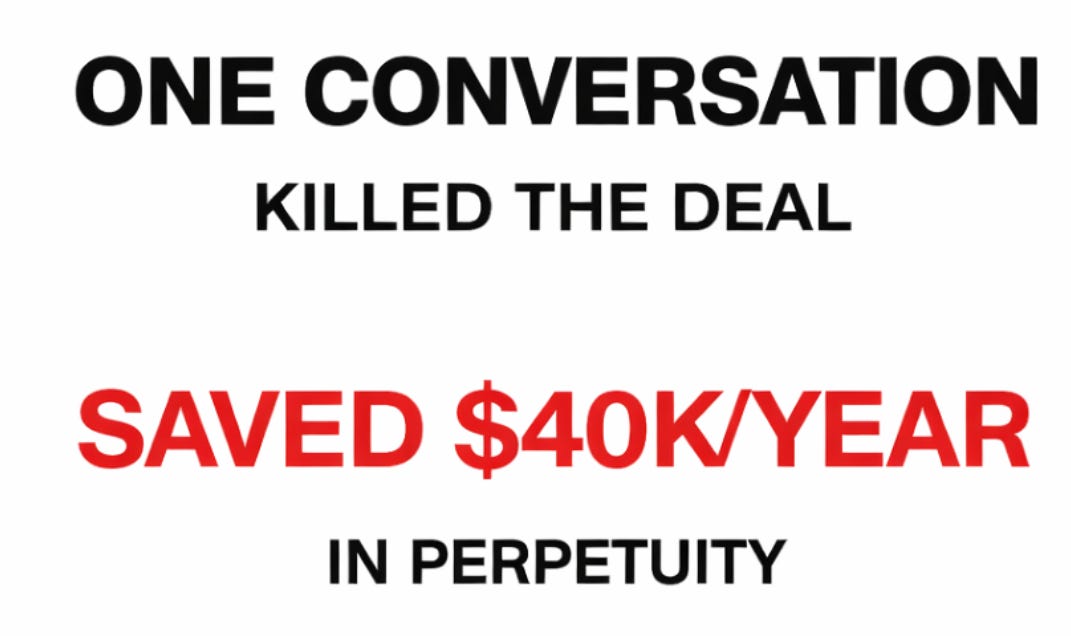
The $40K save came from running Investor Partner first, then Devil’s Advocate second. Sequence matters.
Challenge partners should come AFTER strategy partners, not before.
For big decisions, here’s the workflow:
Strategy partner (CEO, CFO, CMO depending on domain) — Get initial framing
Challenge partner (Devil’s Advocate, Board Member) — Stress-test the framing
Customer partner — Reality-check against user perspective
Back to strategy partner — Incorporate feedback, finalize
For fundraising decisions:
Investor Partner — How VCs will see this
Board Member Partner — Governance considerations
Devil’s Advocate — What could go wrong
Back to you — Decision time
When partners disagree
This will happen. Board Member says fundraise; Advisor says bootstrap.
Your job isn’t to find the “right” partner. It’s to understand WHY they disagree. The disagreement itself is the insight.
Ask yourself: What assumption is each partner making? What would have to be true for each to be right?
Usually, the answer is: “It depends on what I want.” And that’s the real decision.
When to use which partner
Is this a WHAT decision or a HOW decision?
WHAT decisions (strategy, direction, should-we) → Co-founder, Board, First Principles, CEO
Big-picture decisions → Co-founder, CEO, Advisor, Board Member
Functional strategy → CMO, CTO, CFO, COO, Head of Product
Content and marketing → Content Strategy, Demand Gen Strategy, CMO
Technology decisions → CTO Partner
Financial thinking → CFO Partner
Operations and scale → COO Partner
Competitive intelligence → Intelligence Partner
Fundraising and investors → Investor Partner, Board Member Partner
Personal performance → Coach Partner
Stress-testing ideas → Devil’s Advocate Partner
Breakthrough thinking → First Principles Partner
Customer perspective → Customer Partner
Making a big bet and feeling nervous → Devil’s Advocate + Investor Partner (in that order)
The golden rule
Strategic Partners recommend. You decide.
Never outsource decisions to AI partners. Use them to surface options you hadn’t considered, challenge your assumptions, identify blind spots, and structure your thinking.
But the decision, and the accountability, is always yours.
What goes in [CONTEXT]
The [CONTEXT] sections ask for your company stage, revenue, team size, and current priorities.
Be specific.
“Early stage startup” gets generic advice.
“$8K MRR, 2 founders, burning $12K/month, need to hit $15K MRR to extend runway” gets real advice.
The more specific your context, the more specific the pushback.
Good context example:
Company: XYZ
What we do: Revenue AI Platform for B2B sales teams
Business Model: SaaS
Stage: Seed
Revenue: $15K MRR
Growth Rate: 12% MoM
Burn Rate: $25K/month
Runway: 8 months
Team Size: 4
Current Top Priority: Close 3 enterprise pilots
Biggest Constraint: Founder-led sales, no sales hire yet
Bad context example:
Company: My startup
What we do: AI stuff
Stage: Early
Revenue: Some
Building your first partner
Don’t build all 17 at once. I tried. Overwhelmed myself. Abandoned the whole thing for a month.
Start with one based on your biggest bottleneck.
Week 1: Build
Choose one partner
Customize the prompt with your context
Test with a real scenario (not hypothetical)
Refine based on output
Expect 3-4 sessions, 15-20 minutes each
The first two will feel clunky — that’s normal
Weeks 2-4: Calibrate
Use weekly with tighter supervision
Track what’s useful vs. what misses
Refine prompt based on patterns
You’ll start noticing which parts of the prompt you actually use
Month 2+: Expand
Add second partner
Build library over time
Each partner compounds value
The complete 17-partner summary
Part 1: Your AI Executive Team (9 Partners)
C-Suite Partners:
CEO Partner — Vision, priorities, resource allocation
CMO Partner — Brand, positioning, market strategy
CTO Partner — Technology strategy, build vs. buy
CFO Partner — Unit economics, pricing, runway
COO Partner — Systems, processes, scaling
Head of Product Partner — Roadmap, prioritization, PMF
Functional Strategy Partners:
Content Strategy Partner — What to create, when, why
Demand Gen Strategy Partner — Channel mix, funnel optimization
Intelligence Partner — Competitive and market intelligence
Coach Partner — Personal performance, accountability
Devil’s Advocate Partner — Challenge, stress-test
First Principles Partner — Break down, rebuild
Customer Partner — Voice of the user
The $40K decision
I mentioned this at the top, but it’s worth repeating.
Three days before signing a partnership deal, I ran it through my Investor Partner.
“You’re giving 15% revenue share for distribution you could build yourself in 6 months.”
I’d been so focused on the upside I missed the math. That one conversation killed the deal.
That’s when I knew this system actually worked.
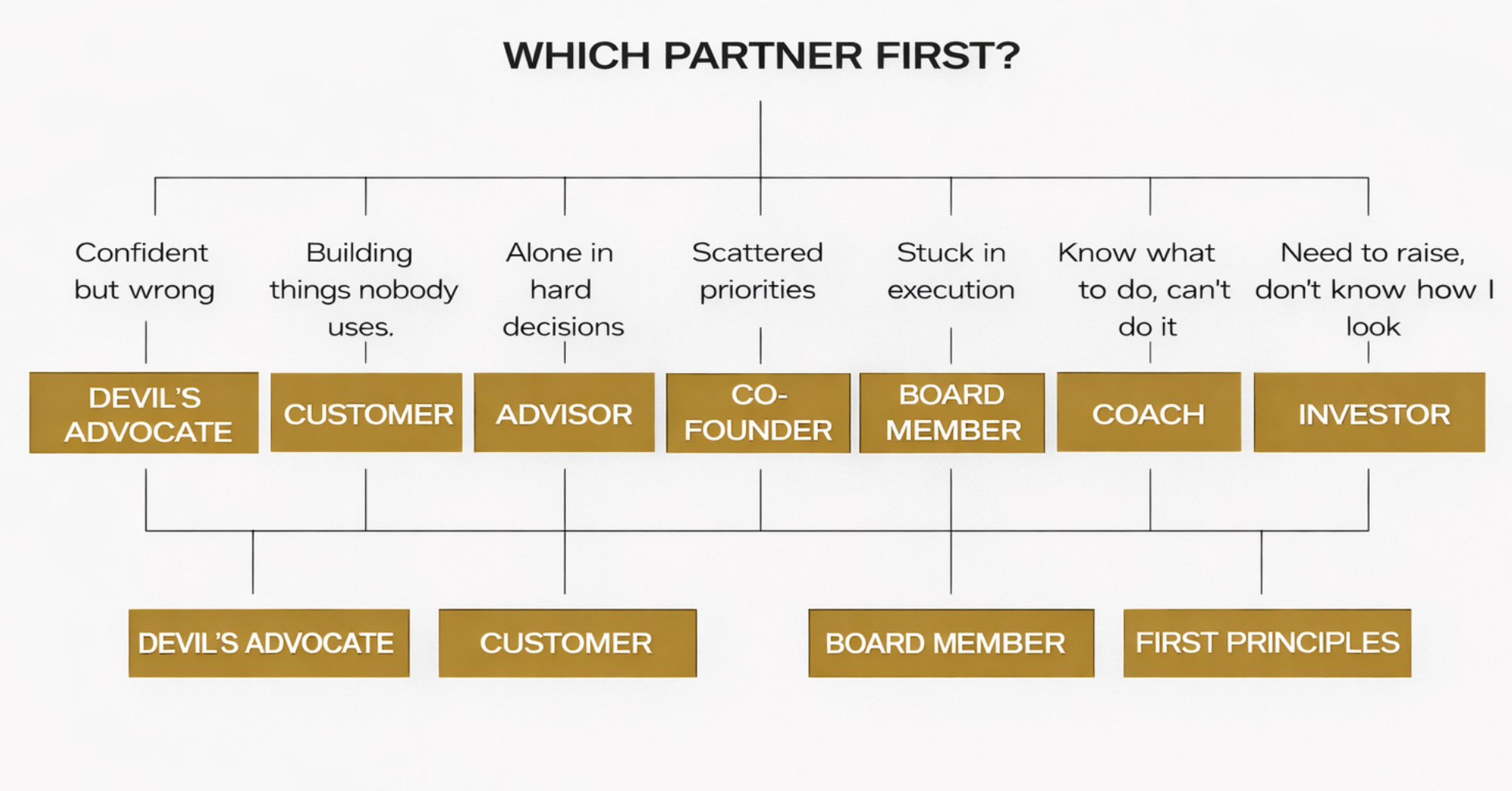
Which partner do you need first?
Answer honestly.
“I’m confident in my decisions, but they keep being wrong.” → Start with: Devil’s Advocate Partner
“I’m building things nobody uses.” → Start with: Customer Partner
“I feel alone in the hard decisions.” → Start with: Advisor Partner
“I’m scattered across too many priorities.” → Start with: Co-founder Partner
“I’m stuck in execution and never think strategically.” → Start with: Board Member Partner
“I know what to do but can’t make myself do it.” → Start with: Coach Partner
“I’m following ‘best practices’ that aren’t working.” → Start with: First Principles Partner
“I need to raise money and don’t know how I look to investors.” → Start with: Investor Partner
“I’m about to make a big bet and I’m nervous.” → Start with: Devil’s Advocate + Investor Partner (in that order)
Your move
You have two options.
Option 1: Save this for “later”
Option 1 costs you the next decision you make alone.
Option 2: Build one partner in the next 24 hours
Here’s how:
Look at the Partner Picker above
Identify your biggest bottleneck
Copy that partner’s prompt
Open a new Claude or ChatGPT conversation
Paste it. Customize the [CONTEXT] sections with specifics — “$8K MRR, 2 founders, burning $12K/month” not “early stage startup”
Test with a real decision
Total time: 15 minutes.
Then reply to this email and tell me:
Which partner you built
What you tested it on
What it told you that surprised you
I read every reply. The best implementations get featured in future issues.
— Ayush
P.S. The founder who stress-tests their next pricing decision with the Investor Partner will catch something. The founder who saves this to “read later” won’t.
P.P.S. Want the complete system without copy-pasting prompts and the entire orchestration playbook? The AI Partners Council includes all 17 partners, 6 decision protocols (Pre-Mortem, Pitch Stress-Test, Pivot Check, Pricing Council, Launch Tribunal, Founder Check-In), and a full orchestration system that tells you which partners to use when.



I would not have been surprised if it was ChatGPT… Claude is more ethical. Besides that, an excellent article about partnership!