AI context system for operators: The context architecture that makes output hyper-specific to your business
This edition breaks down the Context Stack, a 3-layer system (Identity, Operational, Relationship) that turns scattered AI memory into structured business knowledge. Free builder prompts included.
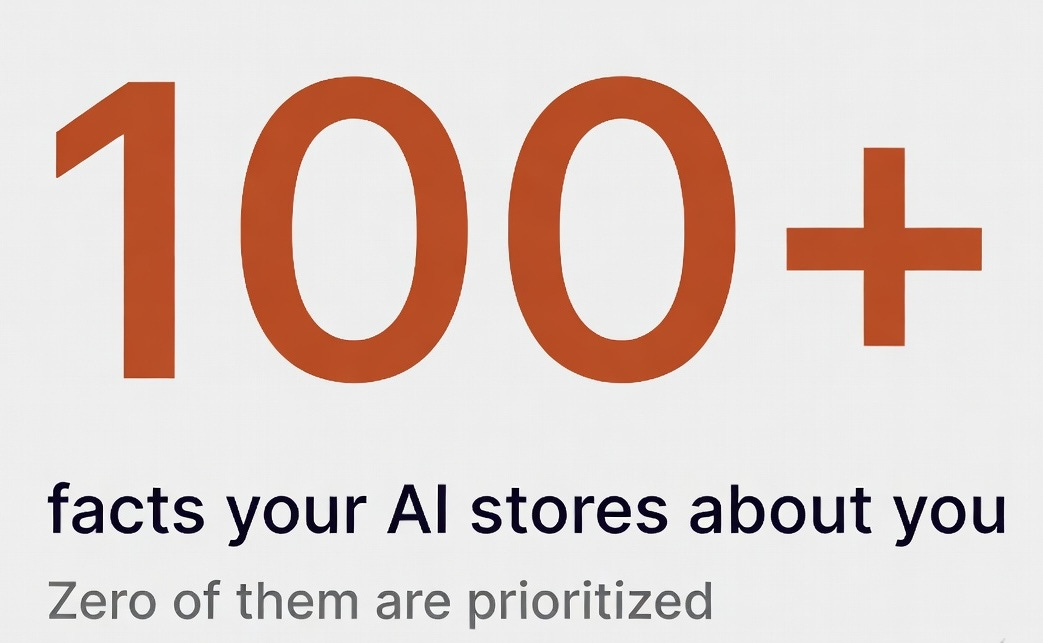
ChatGPT has memory now. Claude has a memory now. Both can reference your past conversations, store your preferences, and carry context forward.
Most of us assume that problem is solved. It’s not.
Platform memory captures fragments.
It picks up that you like Thai food from a dinner recommendation.
It remembers you’re building a SaaS product from a coding question last month.
It knows you have a team of four because you mentioned it in a conversation.
None of that is organized. None of it connects.
Your AI has a scattered pile of facts about you but no structured understanding of your business, your week, or how you actually want to be advised.
Reading for first time? Subscribe to get weekly “Growth and AI” strategies, tactics and prompts in your INBOX.
Here’s what happens:
You’re preparing for a board meeting and ask your AI to draft talking points on revenue growth. It references a blog post you wrote about growth frameworks six months ago instead of pulling from your actual ARR numbers. The memory is there but it’s not structured.
You ask for help with a cold outreach sequence targeting enterprise buyers. The AI remembers you sell to mid-market because that’s what you mentioned in a product positioning chat three months back. You pivoted to enterprise six weeks ago. The memory is not updated yet.
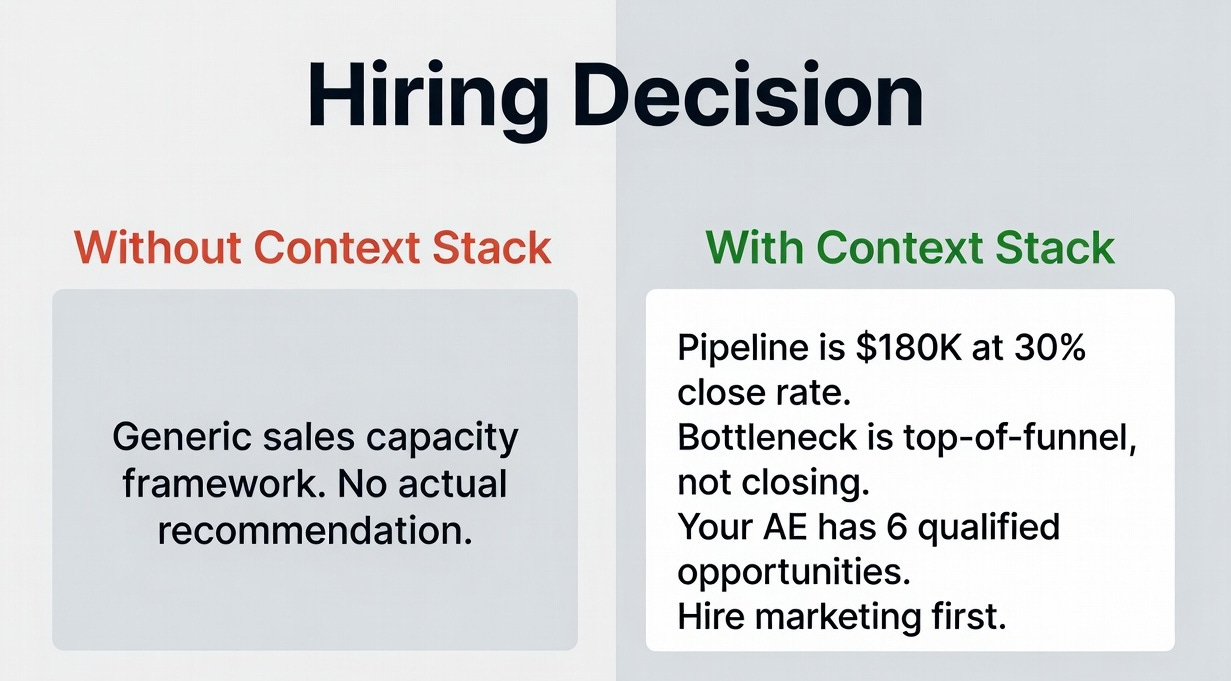
You’re evaluating whether to hire a second AE or invest in marketing. The AI gives you a generic framework about sales capacity models. It doesn’t know your current pipeline is $180K, that you close at 30%, or that your first AE ramps in 90 days.
All of that information exists across your past conversations and internal notes. None of it connects.
Memory solved one problem, but created a new one: context collapse.
Your AI knows things about you. It just can’t use them well.
There is a system fix. It starts with context architecture.
I built five prompts that fix this. They interview you, pull from your existing AI memory, and produce structured context files your AI reads before every response. Free to download, takes about 30 minutes to set up. Get the Context Stack Prompts (free) →
Why memory alone gives you generic output
Both ChatGPT and Claude now maintain persistent memory across conversations. ChatGPT keeps saved memories plus a running synthesis of your chat history. Claude builds a memory summary updated every 24 hours and keeps project-specific memory spaces separate from general conversations.
This is real progress. A year ago your AI started every session from scratch. That’s no longer true.
But here’s what platform memory still can’t do.
It can’t prioritize.
Your AI doesn’t know that your runway constraint matters more than your font preferences right now. Everything is at the same level.
Say you’re a SaaS founder with 8 months of runway trying to decide between doubling down on outbound or launching a product-led growth motion. Memory knows you’ve discussed both. It doesn’t know that cash conservation is the operating constraint this quarter.
Without that priority signal, it gives you a balanced pros-and-cons list when what you need is a decision framework weighted for capital efficiency.
It can’t structure.
Memory stores fragments in the order it encountered them, not in a hierarchy that maps to how you make decisions. Your revenue model, target customer, competitive positioning, and weekly priorities all exist as disconnected facts.
A founder I shared this system with asked his AI to review a partnership proposal. The AI remembered he sold to HR teams and that he’d once discussed API integrations. It didn’t connect those facts to realize the partnership would create channel conflict with his largest customer segment.
The information was there but the structure to reason across it wasn’t.
It can’t adapt its behavior.
Memory tells the AI what it knows about you. It doesn’t tell the AI how you want to be advised. Whether you want pushback or validation. Whether you want frameworks or direct answers. Whether you want it to challenge your assumptions or just execute.
This matters most when you’re switching between different types of work.
Writing a sales email? You want a clean copy with no pushback. Building a financial model? You want every assumption challenged. Prepping for a board meeting? You want the AI to play the skeptical investor.
Memory can’t switch modes. It applies everything it knows uniformly, regardless of what you’re trying to do.
Most founders hit this wall once memory has been running for a few months. The AI feels more familiar but the output is still generic. It knows you better but doesn’t think about your problems any differently.
The shift happens when you move from passive memory to active context architecture.
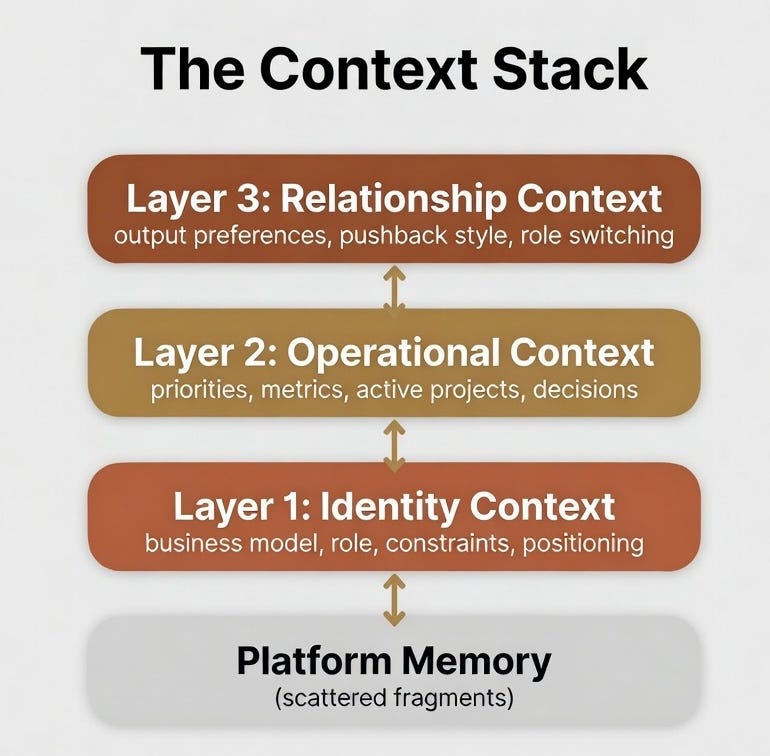
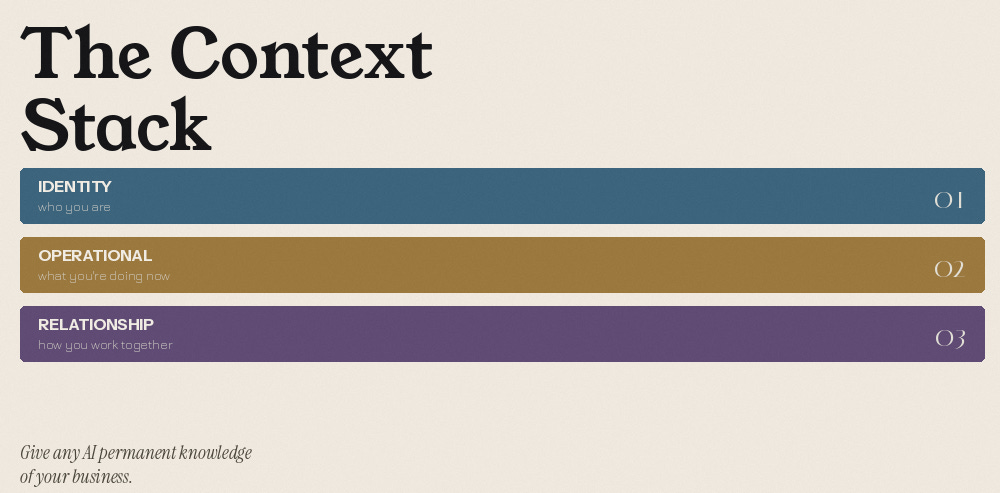
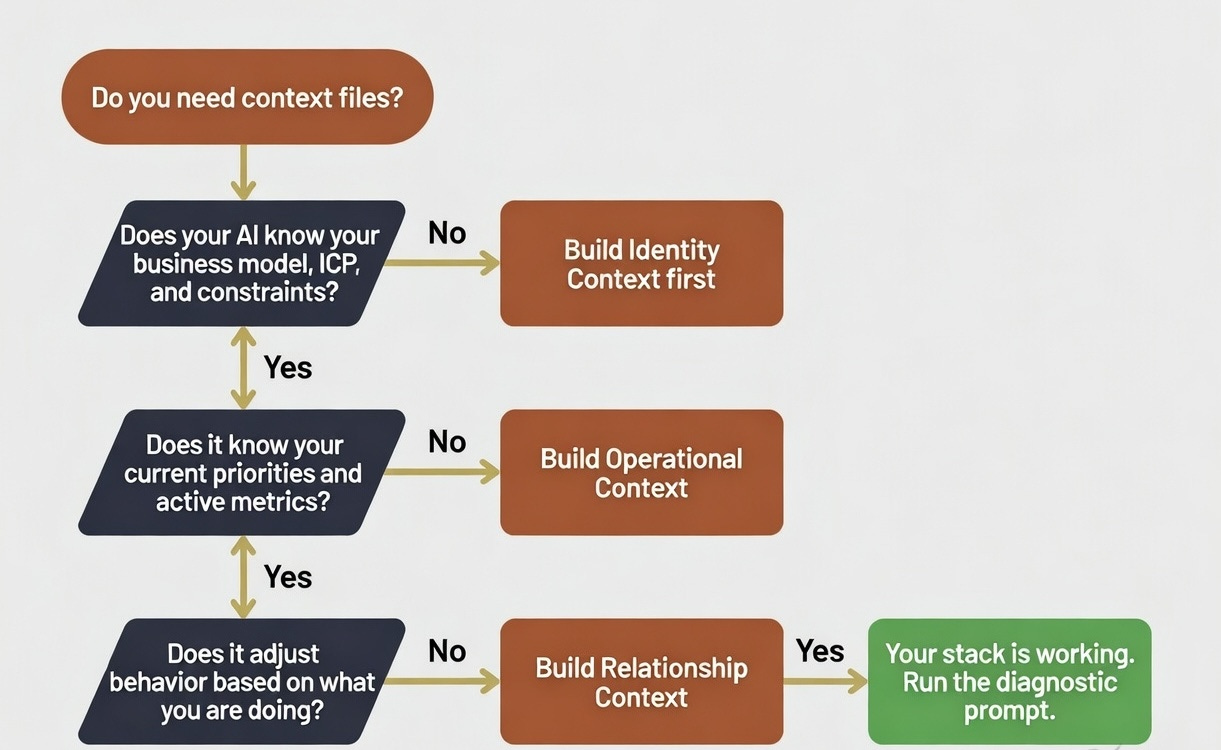
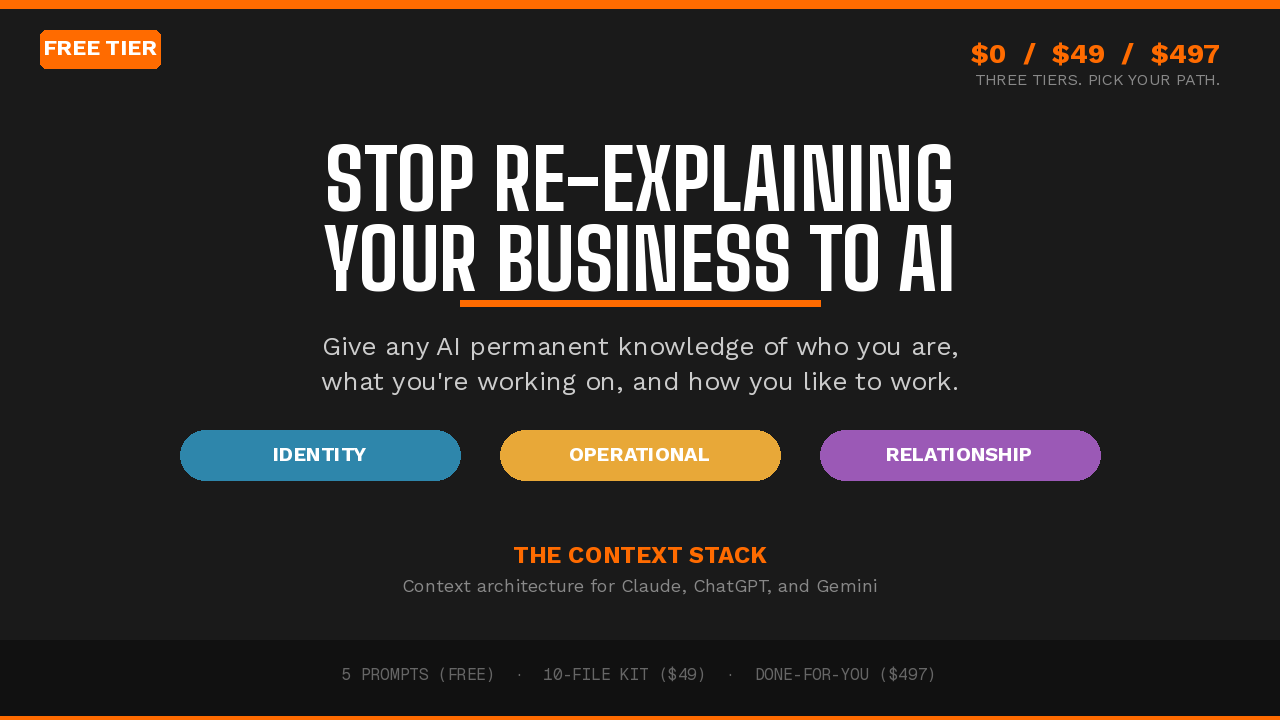
The Context Stack
The system has three layers. Each one adds a dimension of knowledge that platform memory can’t replicate on its own.
Layer 1: Identity context (who you are)
This is the foundation. It tells your AI what business it’s advising, structured and prioritized in a way that scattered memory never will be.
What goes in: your business model, your role, your positioning, your constraints (budget, team size, runway, time), and your voice.
Platform memory might have fragments of all this. But it stores them as disconnected facts, not as a structured reference that shapes every response. This file gives your AI a complete picture it can reason against, not just recall from.
Without identity context, you ask “How should I position against [competitor]?” and get a generic differentiation framework. With it, the AI already knows your ICP, your pricing tier, your distribution channels, and where you actually win deals. It tells you the specific angle that matters for your segment.
A founder running a vertical SaaS for property managers built her identity context file in 40 minutes. The next time she asked for a cold email draft, the AI wrote copy that referenced her specific buyer persona (regional property managers with 50-200 units) instead of generic “decision makers.” She didn’t have to re-explain her market once.
Layer 2: Operational context (what you’re working on)
Identity context tells the AI who you are. Operational context tells it what you’re doing right now.
What goes in: current priorities (this week, this month, this quarter), active projects and their status, key metrics you’re tracking, decisions in progress, recent wins and failures.
This is where platform memory falls hardest. Your AI might remember that you mentioned a product launch two weeks ago. It doesn’t know that launch is now your top priority, that you’re tracking three specific metrics, and that you have a pricing decision due Friday.
You’re deciding whether to attend a conference next month. Memory knows you’ve gone to SaaStr before. Operational context knows you’re mid-launch, burning cash on a new feature, and your top priority this month is converting three pilot customers to annual contracts. It tells you the conference doesn’t align with this quarter’s focus and suggests sending a recording instead.
Layer 3: Relationship context (how you work together)
Most people skip this layer entirely. Platform memory has no equivalent for it.
What goes in: what outputs you want (frameworks, direct answers, drafts, challenges), how you want to be pushed back on, what roles you want the AI to play, specific instructions per task type.
This is the layer that makes the same AI feel like a different partner depending on what you’re doing.
With a Strategy Partner context file loaded, when you say “I’m thinking of dropping our free tier,” the AI stress-tests the decision:
“Your free tier converts at 3.2% to paid. That’s 14 paying customers this quarter from free. What replaces that pipeline if you cut it?”
With a Content Partner context file loaded for the same business, when you say “Draft a LinkedIn post about dropping our free tier,” it writes in your voice, follows your formatting preferences, and doesn’t question the decision. It executes.
Same AI. Same memory. Same knowledge. Different behavior because the relationship layer told it what you need in each mode.
Build all three layers in under an hour. Five prompts. Each one interviews you and produces a finished context file. Works on ChatGPT, Claude, and Gemini. Download the Context Stack Prompts (free) →
This 3-layer system took me weeks to figure out through trial and error. Save it and skip straight to building yours.
The power isn’t in any single context file. It’s in how they stack on top of what memory already knows.
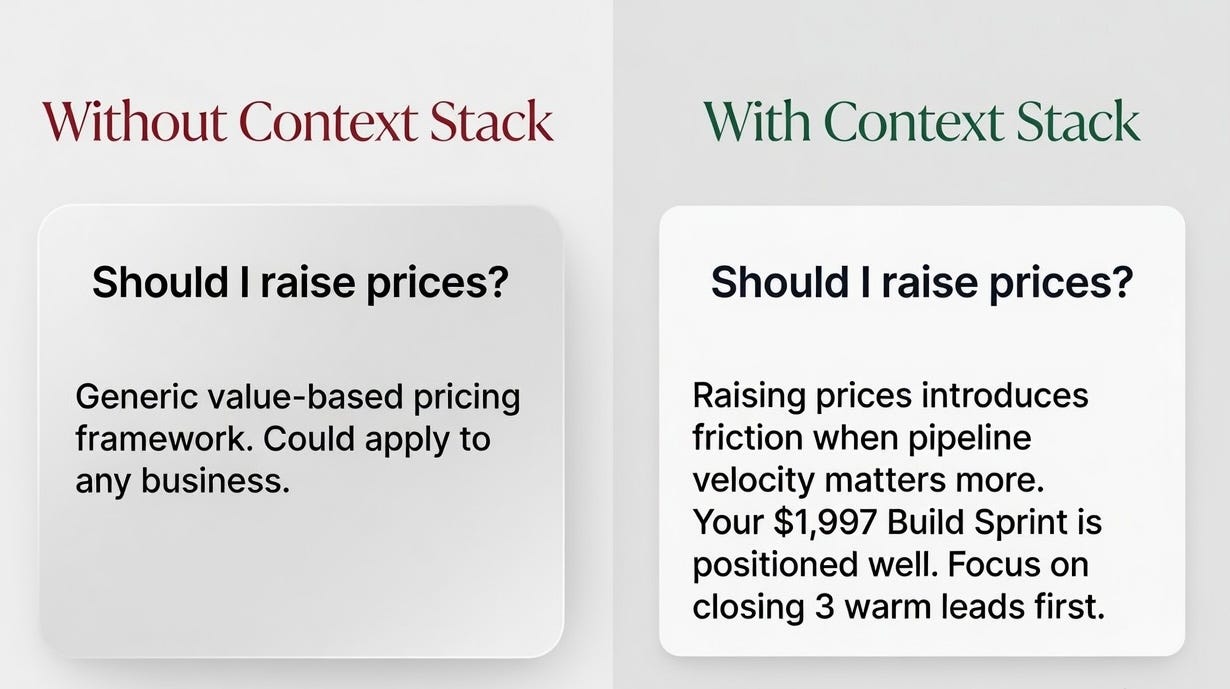
Pricing decisions
Without the stack, you ask “Should I raise my consulting prices?” and get generic value-based pricing advice with competitor benchmarking frameworks. Could apply to any consulting business at any stage.
With the stack:
“Raising prices now introduces friction when pipeline velocity matters more than margin. Your $1,997 Build Sprint is positioned well for your segment. At 3 warm leads, closing 2 at current pricing hits $4,000. Focus on closing, not repricing. Revisit after 5+ completed engagements.”
Hiring decisions
Without the stack, you ask “Should I hire a Head of Marketing or a second AE?” and get a framework about sales capacity models. No actual recommendation.
With the stack:
“Your pipeline is $180K with a 30% close rate. That’s $54K in projected revenue from what’s already in motion. A second AE won’t help because the bottleneck isn’t closing capacity, it’s top-of-funnel volume. Your first AE is closing at rate but only has 6 qualified opportunities this month. A marketing hire who can generate 15-20 qualified meetings per month changes that math. Hire marketing first.”
Content strategy
Without the stack, you ask “What should I write about this week?” and get trending topic suggestions.
With the stack:
“Your Q2 goal is converting 3 pilot customers to annual contracts. Two of those pilots cite ‘lack of integration clarity’ as their hesitation. Write a technical walkthrough showing your API integration with their specific stack. Post it on LinkedIn and send it directly to those pilot contacts. That’s higher leverage than any thought leadership piece this week.”
Same prompt in all three cases. The output changes because the system behind it has structured knowledge, not scattered fragments.
Want output like this from your AI? The difference is not the model or the prompt. It’s the context loaded before the prompt. Five files. 30 minutes of setup. Free. Get the Context Stack Prompts →
See it for yourself
Those examples were constructed to show the gap. Here’s how to test it in your own setup.
Paste this into your AI:
I’m going to give you a business task. Before you answer, tell me what information you wish you had about me, my business, and my current situation that would make your answer 10x more specific and useful.
You already have memory of our past conversations. Check that first.
Then tell me what’s still missing despite what you remember.
Don’t answer the task. Just list what’s missing.
Task: [insert any real task you’d normally ask AI]
Try it with any of these:
→ “Help me decide whether to hire a second AE or invest in content marketing”
→ “Write a cold outreach sequence for my top 10 target accounts”
→ “Build a 90-day plan for my next quarter”
→ “Review my pricing structure and suggest changes”
Even with memory enabled, your AI will list a dozen things it doesn’t know. That list is your building plan for context files.
Bookmark this diagnostic prompt. Every time your AI output feels off, paste it in before you blame the model. You'll find the gap in 60 seconds.
I packaged five builder prompts that create your context files through AI-guided interviews. Each one takes 10-15 minutes. You paste the prompt, share whatever materials you have, and the AI interviews you until it has enough to produce a structured context file.
Three prompts for building from scratch (Identity, Operational, Relationship). Two prompts for extracting context from existing conversation history (ChatGPT and Claude).
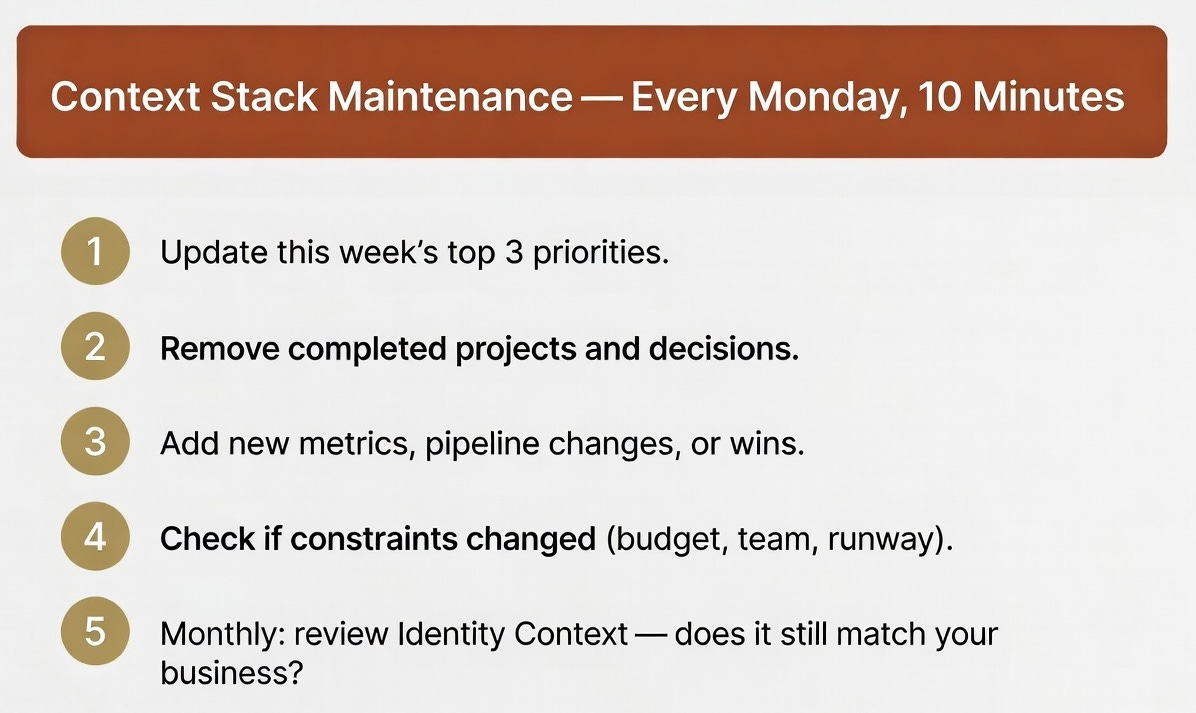
A context file you build once and never update is worse than no context file at all. It feeds the AI stale information and you won’t notice until the output starts feeling off.
If your context file says your top priority is product launch and memory picked up that you shifted to fundraising last week, the AI gets confused about which to trust. Stale context creates contradictions that make output worse, not better.
Every Monday, 10 minutes. Update priorities. Remove what’s done. Add what’s new. Once a month, check if your identity context still reflects reality.
If you use AI for one-off tasks like summarizing articles or fixing grammar, platform memory is probably enough. You don’t need context architecture for that.
This system is for founders using AI as a recurring thinking partner across strategy, planning, and execution. The more decisions you run through it, the more the structured context pays off over raw memory.
Simple rule: any time the AI gives advice that feels wrong, check your context files before blaming the model.
The difference between passable AI output and precise AI output is not the model. It’s not even the memory. It’s the system you built around both.
Context architecture is the operating layer that turns passive memory into active, structured knowledge your AI can actually reason with.
The free prompts build your Context Stack from scratch. If you want pre-built files, worked examples from real businesses, and relationship templates for six different partner roles, the AI Partner Kit has all of that assembled and ready to use.
The Context Stack Prompts (free) 5 prompts. 30 minutes. Your AI goes from “helpful stranger” to “business partner who knows your numbers.” Works on ChatGPT, Claude, and Gemini. No software to install. Just paste, answer, and load. Download free →
The AI Partner Kit ($49) Everything above, plus pre-built templates, two real business examples, 9 before-and-after comparisons, partner templates for Strategy/Content/Operations, compressed files for ChatGPT character limits, and a diagnostic system to test your setup. Get the full kit →
Set up your context stack and build your first AI business partner in 30 minutes.
The useful distinction here is that context is not just memory. A system can remember facts and still lose the thread of work. The harder layer is preserving enough operational state that the AI can resume with the same priorities, constraints, and definition of done across interruptions or even model swaps.
The three-layer framing nails something most people miss: memory and context are fundamentally different problems. Memory is recall. Context is reasoning infrastructure. Platform memory gives you "I remember you mentioned X" — context architecture gives you "given your runway, pipeline, and current priorities, here's what actually matters."
I've been building something similar — structured context files that my AI reads before every session. Identity, operational state, relationship rules. The difference is night and day. Without it, every conversation starts from a generic baseline. With it, the AI already knows what constraints matter and what advice is useless.
The maintenance point is critical though. The biggest failure mode isn't building the context stack — it's letting it go stale. A context file that says "priority: product launch" when you've moved to fundraising actively makes output worse because the AI trusts your structured context over its own memory. Weekly updates are the minimum. I'd argue any operational context older than a week should have an expiry flag.




The useful distinction here is that context is not just memory. A system can remember facts and still lose the thread of work. The harder layer is preserving enough operational state that the AI can resume with the same priorities, constraints, and definition of done across interruptions or even model swaps.
The three-layer framing nails something most people miss: memory and context are fundamentally different problems. Memory is recall. Context is reasoning infrastructure. Platform memory gives you "I remember you mentioned X" — context architecture gives you "given your runway, pipeline, and current priorities, here's what actually matters."
I've been building something similar — structured context files that my AI reads before every session. Identity, operational state, relationship rules. The difference is night and day. Without it, every conversation starts from a generic baseline. With it, the AI already knows what constraints matter and what advice is useless.
The maintenance point is critical though. The biggest failure mode isn't building the context stack — it's letting it go stale. A context file that says "priority: product launch" when you've moved to fundraising actively makes output worse because the AI trusts your structured context over its own memory. Weekly updates are the minimum. I'd argue any operational context older than a week should have an expiry flag.