

Build an ICP so specific your message gets reply - The Pressure Profile ICP System (with Prompts)
Most B2B outbound fails because the ICP behind it only has one layer: firmographics. Company size, job title, industry. That tells you who to email but nothing about why they would care right now.

Your ICP document is probably hurting your outbound more than it is helping it. Company size, job title, industry, funding stage. That is a targeting list, not a buying signal. It tells you who to email. It tells you nothing about why any of those people would take a meeting this month. There is a second layer almost nobody builds, and it is the difference between messages that get deleted and messages that get replies.
We are gonna understand and implement this second layer below.
AI agents are now sending thousands of “personalized” emails a day. Every inbox is filled with emails mentioning their activities online, as if the sender knows extremely well.
And the people you are trying to reach have gotten extremely good at ignoring anything that feels generic.
The only thing that still cuts through is when someone reads your message and thinks: “this person actually gets what I am dealing with right now.”
That is not a sales skill anymore. Whether you are a founder looking for your first 10 customers, a consultant trying to land your next client, or a sales leader rebuilding your outbound motion, the game is the same.
Understanding the real pains of the people you serve is how you stay relevant. Everything else is noise.
Most ICP documents have one layer: firmographic data. Company size, job title, industry. That layer tells you who to reach.
But there is a second layer almost nobody builds, and it is the one that decides whether your message gets read or deleted. I call it the Pressure Profile.
The problem
Here is what a typical ICP looks like: “VP of Sales. B2B SaaS. 50-200 employees. Series A to B. North America.”
That matches roughly 11,500 people on LinkedIn. And every competitor targeting the same list is writing the same “I noticed your company is growing” opener. No wonder the response rates are terrible.
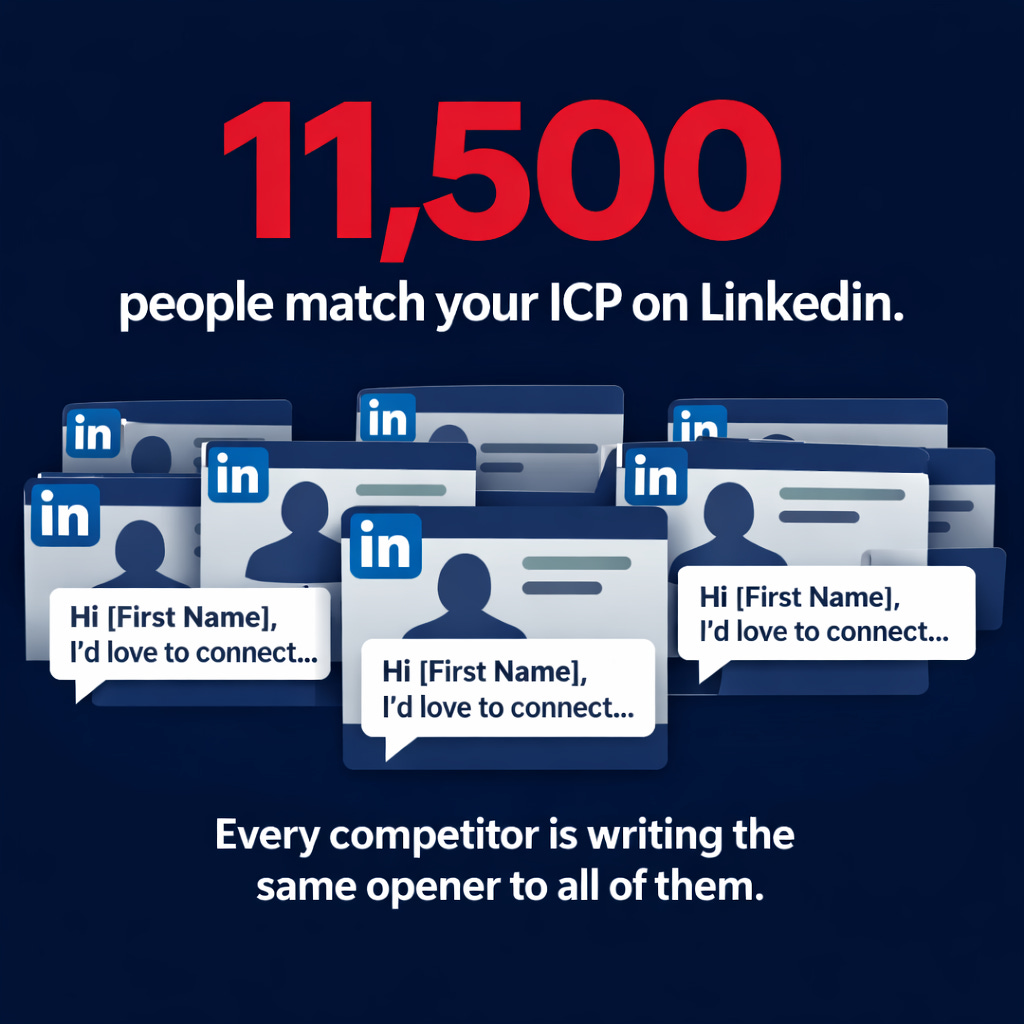
And there is an interesting observation: the same person at the same company will ignore your email in January and respond to it in March. Their job title did not change. Their company size did not change. What changed is the pressure they were under.
Your ICP tells you who to target. It says nothing about why they would care right now.
Who this is for and what would change after
If you are a solopreneur or consultant:
You are probably sending proposals to people who “seem like a fit” based on their title and company size. Some land, most do not, and you cannot figure out the pattern.
After building a pressure profile, you stop pitching your services and start naming the exact problem your prospect is losing sleep over. Your close rate goes up because you are no longer competing on credentials. You are competing on how well you understand their situation.
If you are an early-stage SaaS founder:
You have a product that works but you are struggling to figure out which segment to go after first. Every ICP conversation turns into a debate about company size and industry.
After building pressure profiles for 2-3 segments, you finally see which group has the most urgent, painful problem that your product solves right now.
That clarity kills the “should we target mid-market or enterprise?” debate and gives you a wedge to land your first 20-30 customers.
If you are a sales leader or CRO:
Your team has an ICP doc, a sequence tool, and decent volume, but reply rates are flat and every QBR turns into a conversation about “messaging.”
The real issue is that your reps are leading with product features instead of prospect pain. After rolling out pressure profiles, your SDRs stop writing generic openers and start writing messages that reference what the prospect is actually dealing with this quarter.
The messaging problem disappears because the targeting now carries the weight.
If you are a growth-stage founder or business leader:
You have product-market fit in one segment and you are trying to expand into adjacent ones. The risk is that what worked for Segment A does not transfer to Segment B because the pressures are different.
After building pressure profiles for each new segment, you test with messaging that is already calibrated to what those buyers care about instead of copying your old playbook and hoping it works.
The reframe: your ICP is not a persona, it is a pressure profile
A persona tells you someone is a VP of Sales at a mid-market SaaS company.
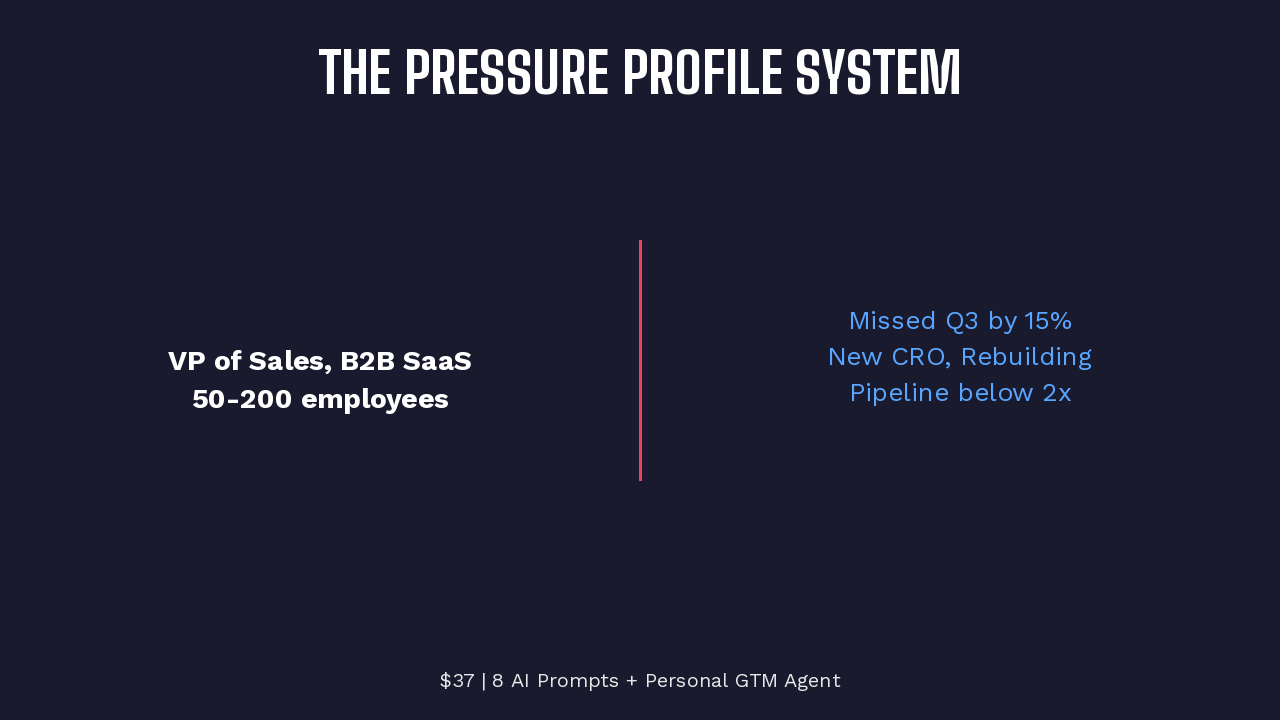
A pressure profile tells you that this VP just lost two senior AEs, their board wants 140% of last year’s number, their CRM implementation went sideways last quarter, and they are personally on the hook for pipeline because the team is too thin.
That is a buying moment. When I build pressure profiles, I map four layers to find it. Let me walk you through each one using this VP of Sales as the example.
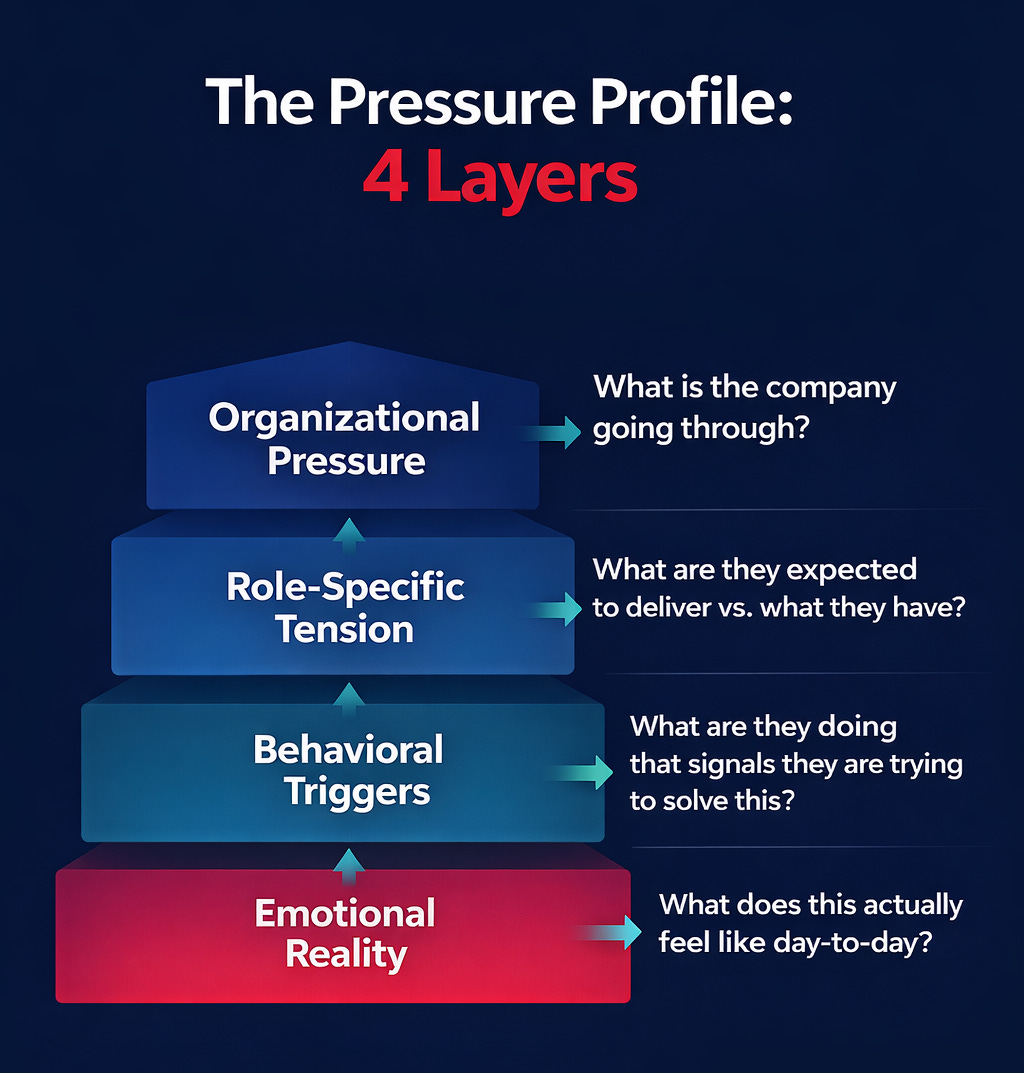
Layer 1: Organizational Pressure. What is the company going through?
The company missed revenue targets by 15%. The CEO announced a hiring freeze. Two competitors launched AI features last quarter and the board keeps asking why they have not.
These company-level forces create urgency. No organizational pressure, no urgency, no deal.
Layer 2: Role-Specific Tension. What is this person expected to deliver vs. what they actually have?
Our VP has been told to grow the pipeline 40%. They just lost their top AE to a competitor. They have 3 reps instead of 5, no budget to backfill until Q3. The mandate did not shrink when the team did.
That gap between what is expected and what is possible is where purchase decisions reside.
Layer 3: Behavioral Triggers. What are they doing right now that signals they are trying to solve this?
They posted on LinkedIn about “doing more with less.” They attended a webinar on AI-powered outbound. They have a Rev Ops job listing that has been open for 6 weeks.
These are public signals that tell you when to reach out, not just who.
Layer 4: Emotional Reality. What does this actually feel like?
On a Wednesday afternoon, this VP is toggling between a pipeline dashboard that is 30% behind target and a Slack thread from their CEO asking for a “pipeline update by EOD.” They know the real answer is “we do not have enough at-bats.” The answer they will give is “we are working on it.”
That gap between what they know privately and what they say out loud is exactly where your messaging needs to land. Name that feeling and people respond because they feel understood, not because your subject line was clever.
Before vs. After: Same target, completely different lens
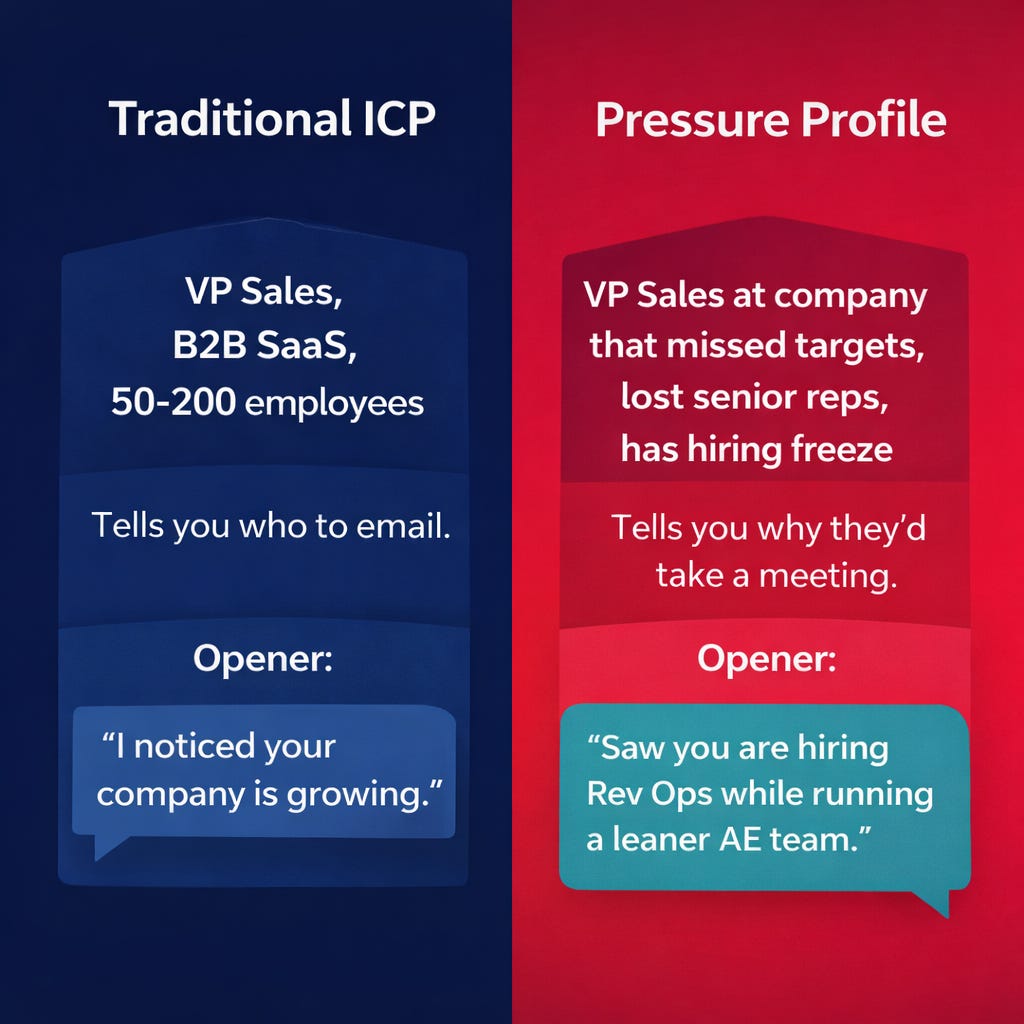
Traditional ICP vs. Pressure Profile
Targeting criteria
Traditional ICP: VP of Sales, B2B SaaS, 50-200 employees, Series A-B
Pressure Profile: VP of Sales at a company that missed revenue targets last quarter, lost senior reps, and has a hiring freeze
Tells you
Traditional ICP: Who to add to your list
Pressure Profile: Why they would take a meeting this month
Messaging angle
Traditional ICP: “I help sales teams improve pipeline”
Pressure Profile: “When your top AE leaves and the board still expects 140%, the math stops working without a system change”
Timing signal
Traditional ICP: None. Send whenever.
Pressure Profile: Job posting open 6+ weeks, LinkedIn post about “doing more with less,” attended outbound automation webinar
Outbound opener
Traditional ICP: “I noticed your company is growing and thought…”
Pressure Profile: “Saw you are hiring for Rev Ops while running a leaner AE team. Most VPs I talk to in that situation are rebuilding their outbound motion from scratch.”
The system: build your first pressure profile tonight
Here is where this gets practical. You can build a rough pressure profile for one segment tonight using these three prompts. I am giving you the full templates. Copy them, paste them into Claude or ChatGPT, and fill in your specifics.
Prompt 1: Organizational Pressure Discovery
Questions to ask yourself while reviewing the output:
Would my target buyer recognize this pressure if I described it in a cold email?
Is this pressure happening right now or has it been a vague industry trend for years?
Can I find evidence of this pressure in earnings calls, job postings, or LinkedIn posts?
Would this pressure create enough urgency for someone to take a meeting this month?
Is this specific to my segment or could it apply to basically any company?
You are a B2B revenue strategist who has spent 15 years in the room where buying decisions happen. You have sat on both sides: as the person selling and as the VP evaluating vendors. You think in terms of organizational pressure, not features or benefits.


Your job is to map the specific pressures that would cause someone to take a meeting, request a demo, or sign a contract in the next 90 days. Not vague industry trends. Not perennial challenges. Pressures that have a trigger, a timeline, and a person who feels them personally.


---


ABOUT ME AND MY BUSINESS:


I sell [YOUR PRODUCT/SERVICE] to [TARGET ROLE] at [COMPANY TYPE].


Here is additional context about my buyers (include as much as you have):

- What problem does my product/service solve? [DESCRIBE THE CORE PROBLEM]

- What do buyers typically use before finding me? [CURRENT ALTERNATIVES OR STATUS QUO]

- What is my price range or engagement model? [PRICING/MODEL IF RELEVANT]


---


INSTRUCTIONS:


Step 1: Parse my input. If my product/service description is too vague to generate specific pressures (for example, if I just said "marketing services" with no detail about the type, audience, or delivery), ask me 2-3 targeted questions before proceeding. Do not guess.


Step 2: Identify 5 organizational pressures that companies matching this profile are likely experiencing right now. "Right now" means pressures that have intensified or emerged within the last 6-12 months due to specific market shifts, not challenges that have existed unchanged for years.


For each pressure, use this format:


PRESSURE [NUMBER]: [SPECIFIC NAME - 5-8 WORDS]


Triggering event: What happened externally or internally that made this pressure acute? Be specific. "The market shifted" is not specific. "Three major competitors shipped AI features in Q3-Q4 2024 and buyer expectations changed overnight" is specific.


How it shows up for [TARGET ROLE]: Describe what this pressure looks like in their daily work. What meeting are they dreading? What metric is red on their dashboard? What conversation are they avoiding with their boss? Write this as if you have watched them work for a week.


What they have already tried: Name 2-3 things this person has likely done to address this pressure and explain why those attempts fell short. This matters because your messaging needs to acknowledge their effort before offering something new.


Why it connects to what I sell: Draw a direct line between this pressure and my product/service. If the connection is weak or requires a stretch, say so. I would rather have 3 pressures with strong product fit than 5 with two that are forced.


Purchase readiness score: Rate this pressure from 1-5 on each of these dimensions, then give a total score out of 20:

- Urgency (1 = can wait a year, 5 = needs resolution this quarter)

- Budget likelihood (1 = no budget exists, 5 = budget is already allocated for this type of solution)

- Failed alternatives (1 = have not tried anything yet, 5 = have tried multiple things that did not work)

- Emotional weight (1 = mild annoyance, 5 = career risk or personal stress)


Publicly verifiable? [YES/PARTIALLY/NO] - Could I find evidence of this pressure through earnings calls, job postings, LinkedIn activity, news coverage, or industry reports? If NO, flag it and explain why I should still consider it.


Step 3: After listing all 5 pressures, rank them by total purchase readiness score. Then write a 2-sentence summary at the end answering: "If I could only build messaging around ONE of these pressures, which one would give me the highest response rate and why?"


---


WHAT GOOD OUTPUT LOOKS LIKE:

- Every pressure is specific enough that a real person in this role would read it and think "that is exactly what is happening to me right now"

- The triggering events reference real market dynamics, not hypothetical scenarios

- The "what they have already tried" section shows you understand their world, not just their problem

- The product connection is honest. If a pressure does not connect well to what I sell, you say so rather than forcing it


WHAT BAD OUTPUT LOOKS LIKE:

- Generic pressures like "increasing competition" or "need for digital transformation" that could apply to any company in any industry

- Pressures that have been true for a decade with no recent intensifier

- Consultant-speak like "optimize operational efficiency" instead of plain language like "their team is doing the work of two teams and the good people are starting to leave"

- Forced connections between a pressure and my product that require three logical leaps
How different readers would fill this in:
Solopreneur/Consultant: “I sell fractional CMO services to Series A SaaS founders who just lost their head of marketing and need someone to own the GTM motion for 3-6 months.”
SaaS Founder (early stage): “I sell an AI code review tool to VP of Engineering at companies with 20-50 developers who are drowning in manual QA and shipping too slowly.”
Sales Head (growth stage): “I sell sales engagement software to CROs at mid-market companies doing $10-50M ARR who missed quota last quarter and are restructuring outbound.”
Agency/Service provider: “I sell performance marketing retainers to DTC brand founders doing $2-10M revenue who just cut their in-house marketing team to save burn.”
Prompt 2: Behavioral Trigger Mapping
Questions to ask yourself while reviewing the output:
Can I actually observe these signals without insider access using LinkedIn, job boards, and press releases?
If I saw this signal for a specific company tomorrow, would I feel confident enough to mention it in my outreach?
Are these leading indicators (they will buy soon) or lagging indicators (they already bought from someone else)?
Which three signals would I prioritize if I could only track three?
How would I set up monitoring for these signals with tools I already have?
You are a sales intelligence analyst who has built signal-based prospecting systems for B2B sales teams. You think in terms of observable behavior, not assumptions. Your job is to identify the public signals that tell a seller when to reach out, not just who to target.


A signal is only useful if it meets three criteria: I can observe it without insider access, it indicates active problem-solving behavior (not just awareness), and it gives me a timing advantage (I can reach out before they have already made a decision).


---


CONTEXT:


I am targeting [TARGET ROLE] at [COMPANY TYPE].


Here are the top 3 organizational pressures from my pressure mapping (paste from Prompt 1):


[PASTE PRESSURE 1 - NAME AND SUMMARY]


[PASTE PRESSURE 2 - NAME AND SUMMARY]


[PASTE PRESSURE 3 - NAME AND SUMMARY]


My monitoring resources: [SELECT WHAT APPLIES]

- LinkedIn (free or Sales Navigator)

- Job boards (Indeed, LinkedIn Jobs, Greenhouse, Lever)

- Google Alerts / news monitoring

- Industry Slack communities or forums

- Sales intelligence tools (if any, name them: ZoomInfo, Apollo, etc.)

- Other: [SPECIFY]


---


INSTRUCTIONS:


For each of the 3 pressures, identify behavioral signals organized by confidence level:


### PRESSURE [NUMBER]: [NAME]


**HIGH CONFIDENCE SIGNALS (this person is actively trying to solve this problem):**


For each signal, provide:

- Signal: What specifically would I observe? Be concrete. Not "they are hiring" but "they posted a [specific title] role with [specific keywords] in the job description that indicate [specific pressure]."

- Where to find it: Exact platform and search approach

- What it means: Why this signal connects to this pressure specifically

- Timing window: Once I see this signal, how long do I have before the buying window closes? (Days, weeks, or months)

- Monitoring difficulty: [EASY: 5 min/day manual check] [MODERATE: requires Sales Navigator or equivalent] [ADVANCED: requires dedicated tool or automation]


**MEDIUM CONFIDENCE SIGNALS (likely feeling this pressure, but could be coincidental):**

Same format as above, plus:

- What would upgrade this to HIGH CONFIDENCE: What additional signal, combined with this one, would confirm buying intent?


**DEAD SIGNALS (looks like intent but the window may have closed):**

- Signal: What it looks like

- Why it might be too late: What this could indicate about where they are in their buying process

- How to check: What I can do to verify whether there is still an opportunity


---


After mapping signals for all 3 pressures, provide:


**SIGNAL CLUSTERS (combinations that indicate the strongest buying intent):**


Describe 2-3 specific combinations of signals across categories that, when they appear together within a 30-day window, represent the highest probability buying moment. Format each as:


"When you see [SIGNAL A] + [SIGNAL B] + [SIGNAL C] within the same month, this person is almost certainly [WHAT THEY ARE DOING] and the best outreach window is [WHEN]."


**YOUR WEEKLY MONITORING CHECKLIST:**


Based on my monitoring resources, give me a realistic weekly routine I can follow in [15 minutes/30 minutes/1 hour] per day (pick the time based on the resources I listed). Structure it by day of the week with specific actions.


---


WHAT GOOD OUTPUT LOOKS LIKE:

- Signals are specific enough that I could write a Boolean search query or set up a Google Alert based on them

- Each signal has a clear connection back to a specific pressure, not just general "this company is active"

- The timing windows are realistic and differentiated (not everything is "reach out immediately")

- The monitoring checklist is something I would actually follow, not a wish list that requires 4 hours a day


WHAT BAD OUTPUT LOOKS LIKE:

- Vague signals like "they are active on LinkedIn" or "they are growing"

- Signals that require insider access or tools I do not have

- Treating all signals as equally urgent

- A monitoring plan that assumes I have a full-time SDR team when I am a solo operator
How different readers would fill this in:
Solopreneur/Consultant: Paste the pressures you found for Series A founders losing marketing leadership. Focus on LinkedIn activity and hiring patterns since these are your highest-signal channels as a solo operator.
SaaS Founder (early stage): Paste engineering team pressures. Pay extra attention to tech stack signals and job postings since engineering leaders signal pain through tool changes before they signal it publicly.
Sales Head (growth stage): Paste the CRO-level pressures. Prioritize organizational signals (restructuring, new leadership) since these create vendor evaluation windows.
Agency/Service provider: Paste the DTC brand pressures. Watch for content signals (founders posting about “focusing on core product”) since this often precedes outsourcing decisions.
Prompt 3: Pressure-to-Messaging Bridge
Questions to ask yourself while reviewing the output:
Does the opening line reference a specific pressure or could it be sent to anyone in my industry?
Would this message feel relevant to someone who is having a bad week at work?
Does the proof point name a real result or is it vague (”helped companies improve...”)?
If I received this message in my own inbox, would I reply or delete it?
Can I personalize this for a specific company in under 2 minutes using public information?
You are a B2B copywriter who has written outbound campaigns that averaged 15-25% reply rates. You achieved those numbers not through clever subject lines or tricks, but because your messages made readers feel understood before you asked for anything.


You write like a peer sharing information, not a seller requesting time. The difference is in the very first sentence: a seller talks about themselves or their product. A peer talks about what the reader is dealing with.


---


CONTEXT:


I sell [YOUR PRODUCT/SERVICE] to [TARGET ROLE] at [COMPANY TYPE].


Organizational pressures mapped (paste your top 3 from Prompt 1):


[PASTE PRESSURE 1 - FULL DETAILS INCLUDING TRIGGERING EVENT AND DAILY IMPACT]


[PASTE PRESSURE 2 - FULL DETAILS]


[PASTE PRESSURE 3 - FULL DETAILS]


Behavioral triggers identified (paste your highest-confidence signals from Prompt 2):


[PASTE TOP 3-5 SIGNALS WITH THEIR TIMING WINDOWS]


My proof points (use whichever tier applies to you):


TIER 1 - REAL RESULTS: "I helped [COMPANY/ROLE TYPE] who was dealing with [PRESSURE] achieve [SPECIFIC OUTCOME] in [TIMEFRAME]."


TIER 2 - BORROWED AUTHORITY: "According to [INDUSTRY REPORT/BENCHMARK], companies facing [PRESSURE] typically see [NEGATIVE OUTCOME] if they do not address it within [TIMEFRAME]." (Use this if you do not have your own case studies yet. Industry data and benchmarks from credible sources work.)


TIER 3 - LOGICAL INEVITABILITY: "When [PRESSURE CONDITION A] is true and [CONDITION B] is also true, [NEGATIVE OUTCOME] follows. Here is what changes that math." (Use this if you are pre-revenue or entering a new market. Build the argument from first principles.)


Indicate which tier you are using: [1 / 2 / 3]


---


INSTRUCTIONS:


For each of the 3 pressures, create a complete messaging package:


### PRESSURE [NUMBER]: [NAME]


**OPENING LINE:**

One sentence that names their specific pressure. This sentence should make the reader stop scrolling because it describes something they are currently experiencing.


Test: Could this opening line be sent to anyone in my industry, or does it reference a specific pressure that only some people in this role are feeling right now? If it could go to anyone, rewrite it.


**PROBLEM ARTICULATION (2-3 sentences):**

Describe what this pressure feels like on a random Wednesday afternoon. Use the language this person would use when complaining to a trusted colleague, not the language they would use in a board presentation. Avoid consultant-speak, jargon, and abstraction.


Example of what I want: "You are running a pipeline review and half the deals are stalled because your reps do not have enough at-bats. The board expects 140% of last year but you are working with 60% of last year's team."


Example of what I do NOT want: "In today's challenging B2B landscape, sales leaders face mounting pressure to optimize pipeline generation while managing resource constraints."


**BRIDGE STATEMENT (1 sentence):**

Connect their pressure to what I offer without making it sound like a pitch. The structure is: "That is why [TYPE OF COMPANIES/PEOPLE] are [DOING SOMETHING DIFFERENT] instead of [WHAT MOST PEOPLE DO]."


**PROOF POINT:**

Using whichever tier I indicated, write a proof point that matches the pressure. Make sure the "similar company/role" in the proof point matches the prospect's stage and pressure, not just their industry.


**TOP 3 OBJECTIONS (ranked by likelihood):**


For each objection:

1. The objection: What they are thinking but will not say

2. Why it is reasonable: Acknowledge it without being dismissive

3. Preemptive phrase: A single sentence I can include in my message or follow-up that addresses this before they raise it


**CHANNEL-SPECIFIC MESSAGES:**


COLD EMAIL (under 90 words, no subject line needed yet):

- Structure: Opening line + problem articulation + bridge + proof point + one clear ask

- [PERSONALIZE HERE] markers showing exactly where to insert company-specific detail and what kind of detail to insert

- The ask should be low-friction (not "let me show you a demo" but something like "worth comparing notes?" or "want me to send over the playbook we used?")


LINKEDIN CONNECTION REQUEST (under 280 characters):

- Reference one signal from Prompt 2 that I could actually see on their profile

- [PERSONALIZE HERE] marker


WARM INTRO REQUEST (what I would send to a mutual connection asking them to introduce me, under 60 words):

- Explain why this specific person would want to hear from me right now based on the pressure they are under

- Make it easy for the connector to forward


---


After generating all messaging packages, run this self-test on each cold email:


MESSAGE QUALITY CHECK:

1. First sentence test: Does the opening reference a specific pressure, or could it be sent to any VP in this industry? [PASS/REWRITE]

2. Wednesday afternoon test: Would this message feel relevant to someone having a bad week? [PASS/REWRITE]

3. Delete test: If I received this in my inbox from someone I do not know, would I reply or delete? [PASS/REWRITE]

4. Personalization test: Can I customize this for a specific company in under 2 minutes using publicly available information? [PASS/REWRITE]

5. Peer test: Does this read like a peer sharing useful information or a seller who wants something? [PASS/REWRITE]


If any message fails 2+ checks, rewrite it before presenting the final version.


---


TONE CALIBRATION:


Write like this:

"Saw you are hiring for Rev Ops while running a leaner AE team. Most VPs I talk to in that situation are rebuilding their outbound motion from scratch. We just helped a similar team at [COMPANY SIZE] go from 3 reps covering 4 territories to a system that generates 40% more qualified pipeline without adding headcount. Worth comparing notes?"


Do NOT write like this:

"I hope this message finds you well. I wanted to reach out because I believe our solution could be a great fit for your organization. We help sales teams improve their pipeline generation through our innovative platform. I would love to schedule a quick 15-minute call to discuss how we can help you achieve your goals."


The difference: the first message talks about the reader's situation. The second message talks about the sender's product. Every sentence in your output should be about the reader until the proof point.
How different readers would fill this in:
Solopreneur/Consultant: Your proof point is your own client work. “A Series A founder I worked with last quarter was in the same spot, no marketing leader, burning $40K/month on paid with no attribution. We rebuilt their GTM in 6 weeks and cut CAC by 35%.”
SaaS Founder (early stage): Your proof point comes from beta customers or design partners. Even “3 engineering teams in our pilot reduced code review time by 60%” works if the number is real.
Sales Head (growth stage): Your proof points are customer case studies. Make sure the “similar company” in the proof point matches the prospect’s stage and pressure, not just their industry.
Agency/Service provider: Lead with the cost comparison. “Your last agency probably charged $15K/month and reported on vanity metrics. Here is what we do differently.”
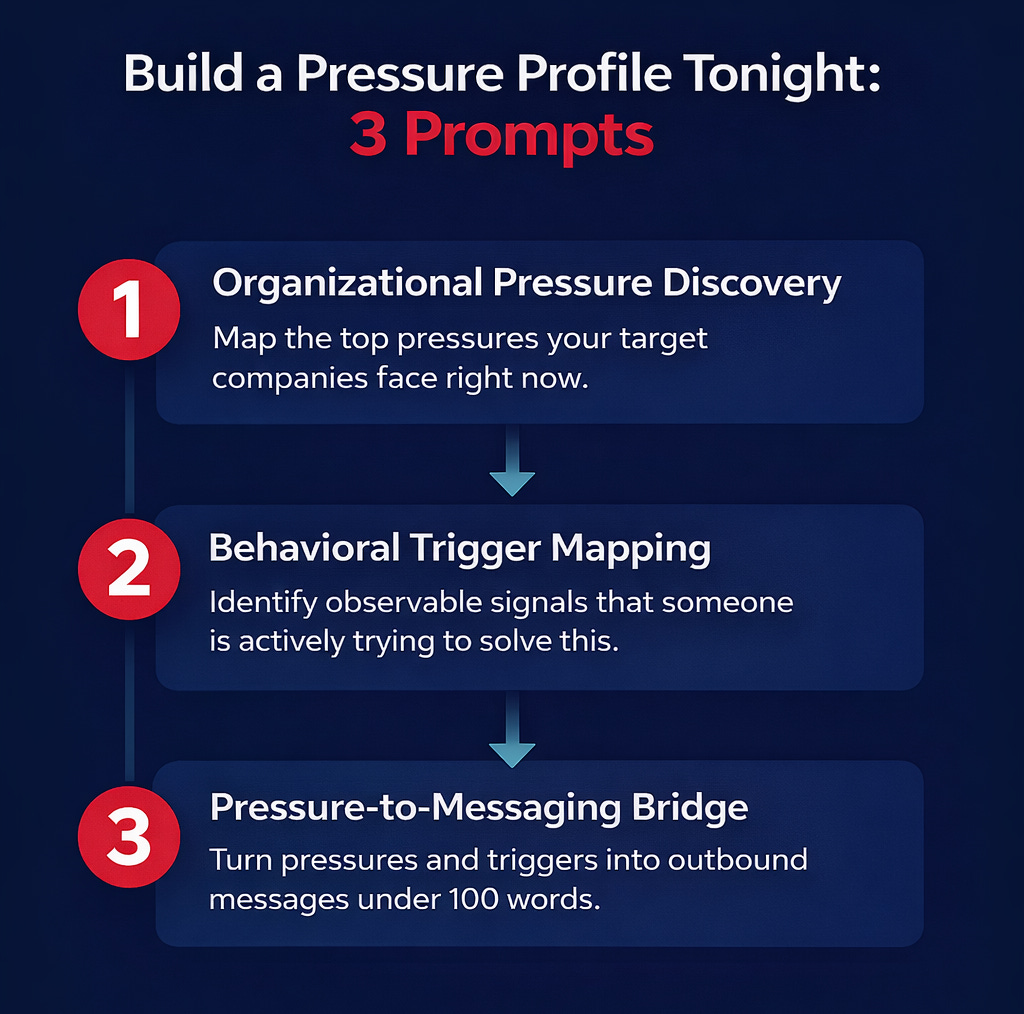
These three prompts give you the raw ingredients for a pressure profile that drives real decisions.
Run them in sequence. Prompt 1 feeds into Prompt 2, both feed into Prompt 3.
By the end, you will have messaging that sounds nothing like what your competitors are sending because it is built on a completely different foundation.
The rough version you build tonight will already be better than most ICP documents I have reviewed across dozens of startups. And it will keep getting sharper every time you run the cycle.
Where you are changes how you use this
The prompts work the same regardless of your stage. But what you do with the output depends on where you are.
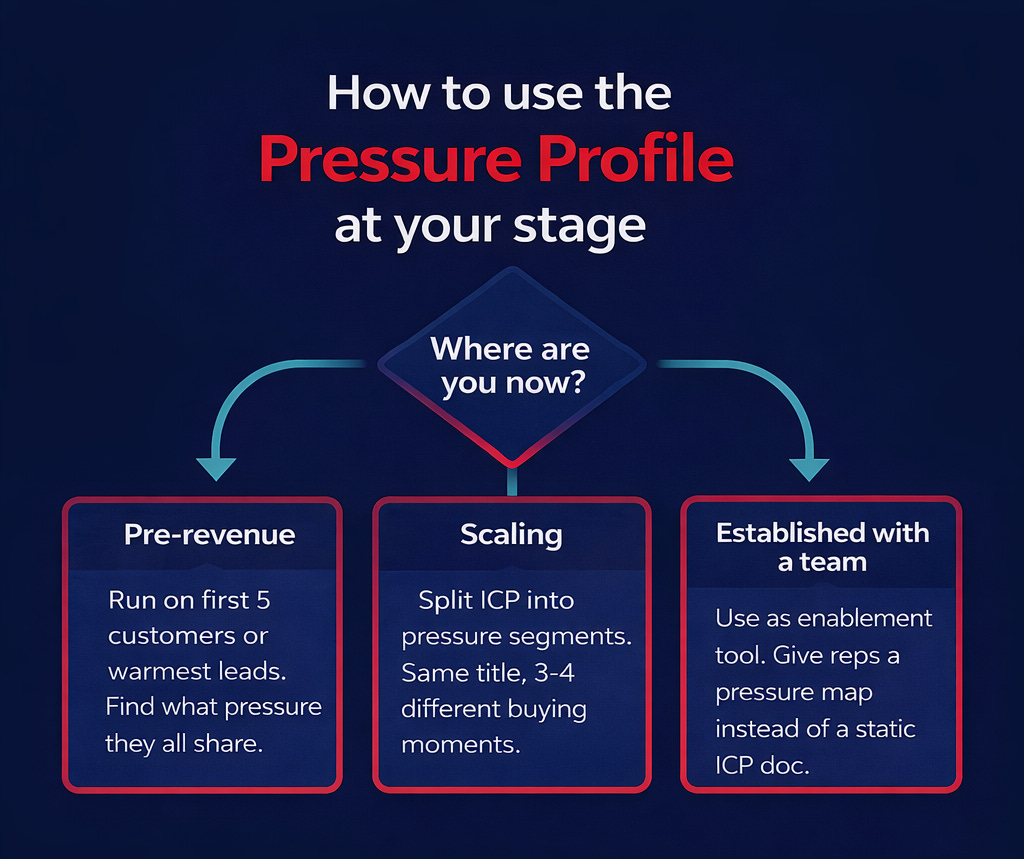
Pre-revenue or early stage: Run this on your first 5 paying customers. You are not building a hypothetical profile. You are reverse-engineering why the people who already said yes actually said yes. The pressures they were under when they bought are your targeting foundation. If you do not have paying customers yet, run it on the 5 people who showed the most interest and figure out what pressure they all had in common.
Scaling with traction: Use this to split your ICP into pressure segments. You will probably find that “VP of Sales at mid-market SaaS” contains 3-4 completely different buying moments. Each needs different messaging. Running the same campaign to all of them is why conversion rates flatten.
Established with a team: This becomes your enablement tool. Instead of handing reps a static ICP doc and saying “figure out what to say,” you are giving them a pressure map that tells them which nerve to touch for each segment and when.
Build the full system (Link here)
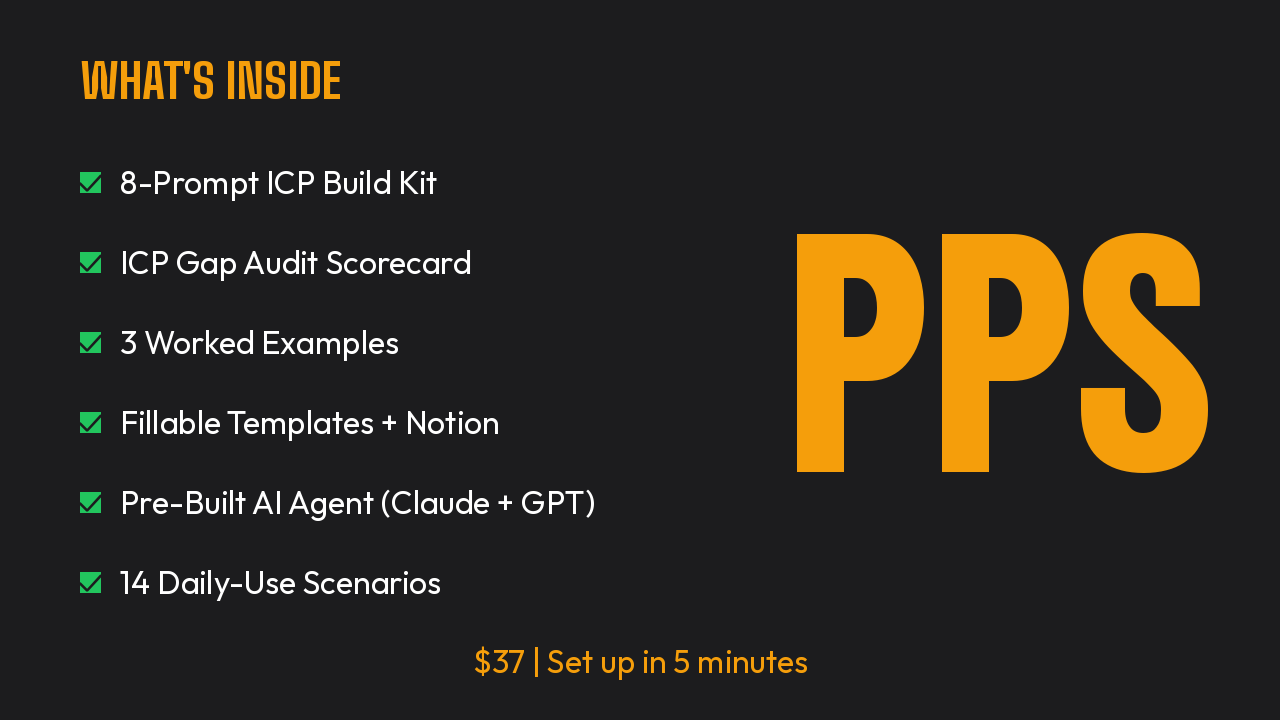
The three prompts above give you a working pressure profile for one segment. They are the foundation.
The complete Pressure Profile System includes 5 additional prompts that take you from rough profile to a complete messaging playbook you can hand to your team or run yourself:
Competitive pressure mapping so you know how your prospects’ alternatives are failing them
Objection modeling that anticipates pushback before you hear it on a call
Content strategy extraction that turns your pressure profile into LinkedIn posts, email sequences, and landing page copy
Multi-channel sequencing that tells you which message goes where and in what order
Quarterly refresh workflow that keeps your profiles current as markets shift under you
[Get the complete 8-prompt Pressure Profile System]
You can run the full system in one evening and have campaign-ready messaging by the next morning. No consultants. No two-week research sprints. Just you, AI, and a framework that works because it is built on how people actually make buying decisions.
If this helped you rethink how you approach ICP, forward it to someone on your team who writes outbound, or to a founder friend who is still sending the same message to every prospect on their list.
Loved this?
And subscribe to “Prompts Daily Newsletter” as well…
If you’re not a subscriber, here’s what you missed earlier:
I get 3x more inbound from comments than posts - My entire prompt system
The AI Partner Stack: 8 Roles as My Advisory Board (Part 2 of 2)
How You Should Actually Plan 2026: [Implementation Guide with Prompts]
Find trends before others: Frameworks, Techniques, Sources and Prompts
The Market Entry Timing Equation: When Being Early Wins and When It Kills You
The Viral LinkedIn GTM Playbook: Frameworks That Drove Engagement and Leads
The Offer Testing Matrix: 6 B2B Hooks That Convert Cold Prospects into Pipeline
Subscribe to get access to the latest marketing, strategy and go-to-market techniques . Follow me on Linkedin and Twitter.
