

The AI networking system: relationship memory template, decision gates, and self-evolving agents - Part 1 of 2
Get the complete AI networking workflow inside one edition. Includes a people-file template, the not-yet gate checklist, a five-block Claude prompt, and a worked example you can copy today.

Quick heads up before you dive in. Part 2 of this system drops next week, but if you share this on LinkedIn and tag me, I'll send you the full thing for free. No paywall, no catch. Just share it before next week.
You should not ask an AI to write a DM for networking and relationship building.
It should automatically read the relationship memory, check the trust state, and decide whether the next move is earned.
This may be sounding a slower approach... but it’s the whole point.
This networking system is AI-driven and is focused on relationship outcomes.
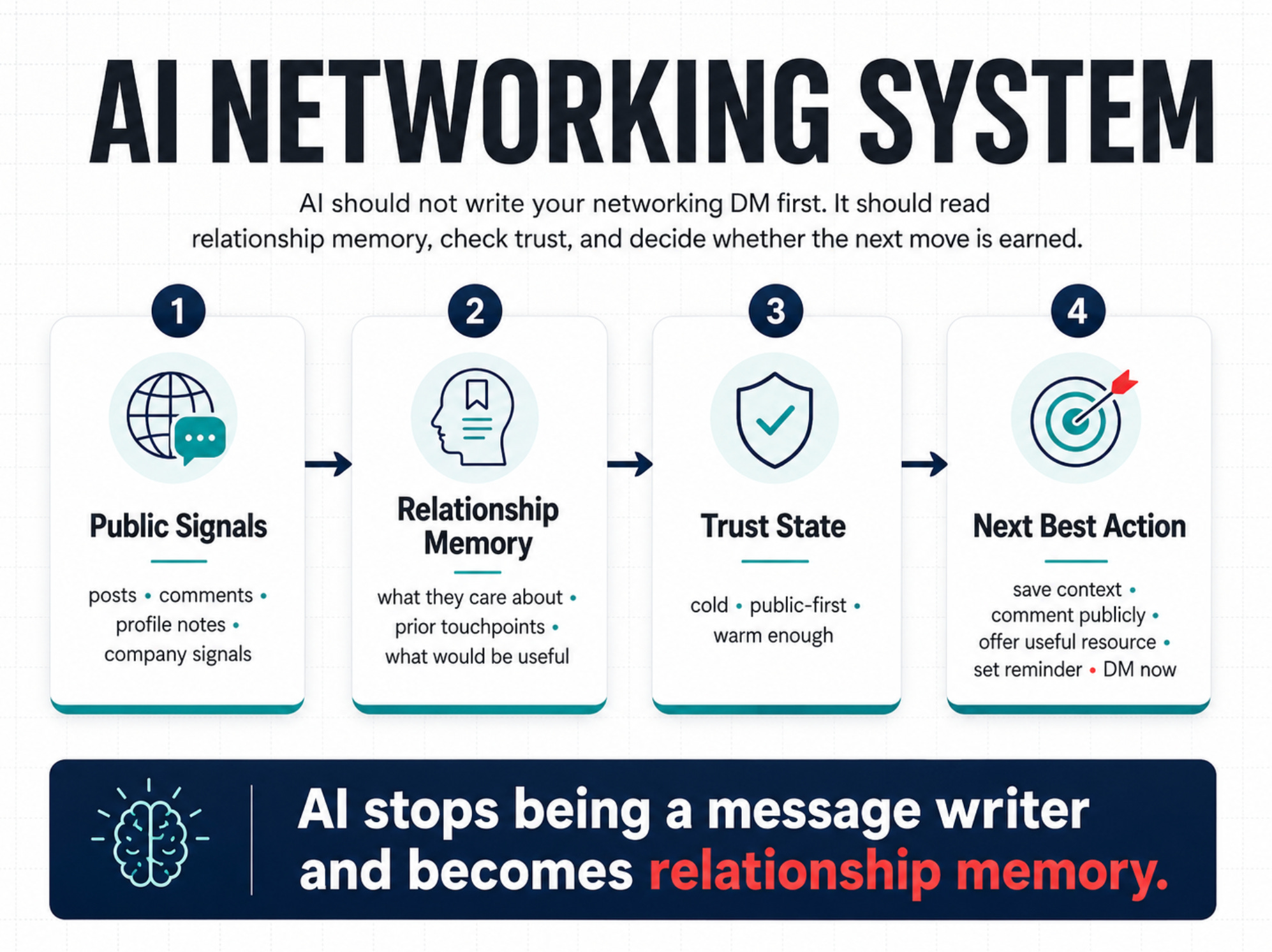
In this issue
The failure mode: relationship context debt
The smallest useful relationship system
Copy this person file
Public context is useful only with a boundary
Run the not-yet decision before private outreach
A filled miniature example
The Agent Instructions
Before and after
What to do now
Most AI-led outreach is spammy. You have a list of founder, operator, buyer, sponsor, or creator you want to build relation with. You paste a post into Chatgpt or Claude and ask for a thoughtful message.
The output usually misses the part that matters most:
what you already know about the person
whether you have ever interacted before
what they publicly care about right now
what would actually be useful to them
whether a private message would feel earned
what should be saved instead of sent
The DM should be the last step... The system lays down the path for getting replies for each relationship outreach... whether for job hunting, promotions, partners, vendors, clients and investo
The failure mode: relationship context debt
The problem is not weak copy.
The problem is relationship context debt.
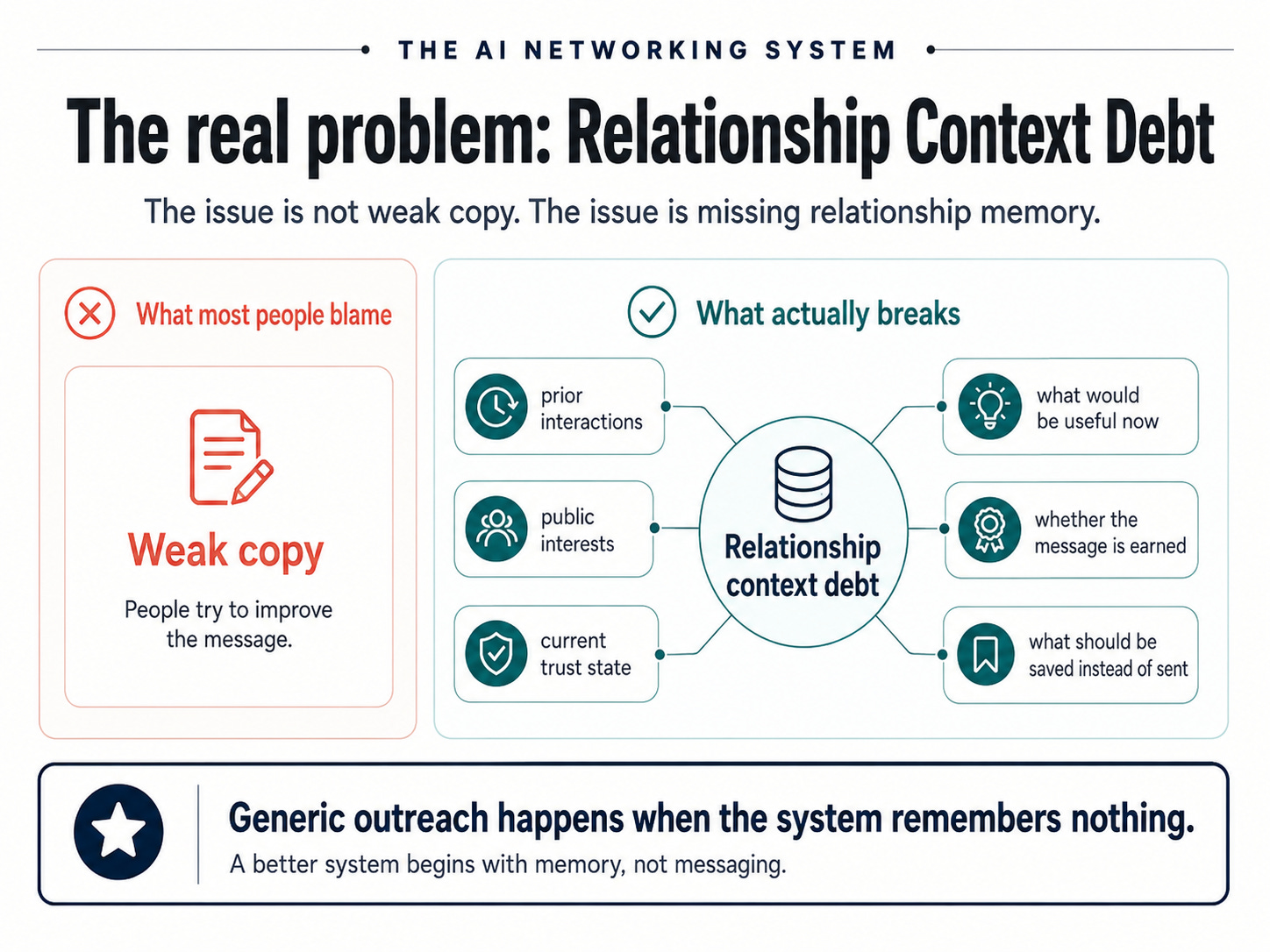
The agent does not remember the comment you left in someone’s post. It does not know whether the person has replied, ignored, or posted something that is also critical for further building repo.
So it writes the plain cold generic message:
Hey [Name], loved your recent post about AI workflows. I'm also building in this space and would love to connect.
Nothing about that is offensive and that is the main issue.
“It is meaningless, and indistinguishable from every other AI-written message that they receive.”
A better system begins with memory.
The smallest useful relationship system
You do not need a CRM to test this.
You do not need a LinkedIn automation tool.
You do not need to install OpenClaw, Hermes, or a local agent stack.
Those systems are useful as inspiration because they point to the real pattern.... but context should stay beyond the session and your actions should generate an outcome.
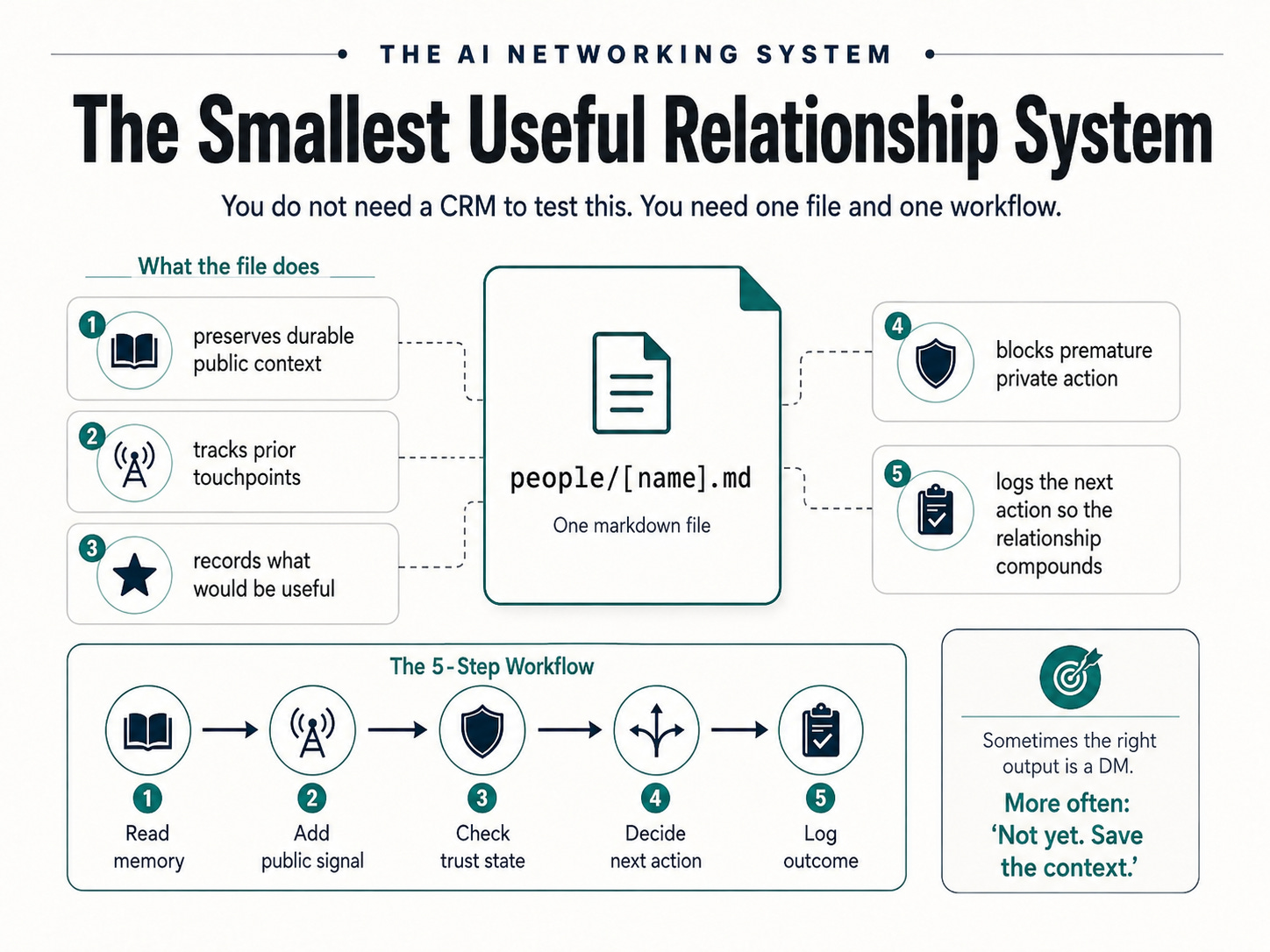
The smallest version is one markdown file:
people/[name].md
That file does five jobs:
preserves durable public context
tracks prior touchpoints
records what would be useful to the person
blocks premature private action
logs the next action so the relationship compounds
The workflow is simple:
read memory → add public signal → check trust state → decide next action → log outcome
Sometimes the right output is sending a DM.
More often, the right output is:
Not yet. Save the context. Be useful in public first.Copy this person file
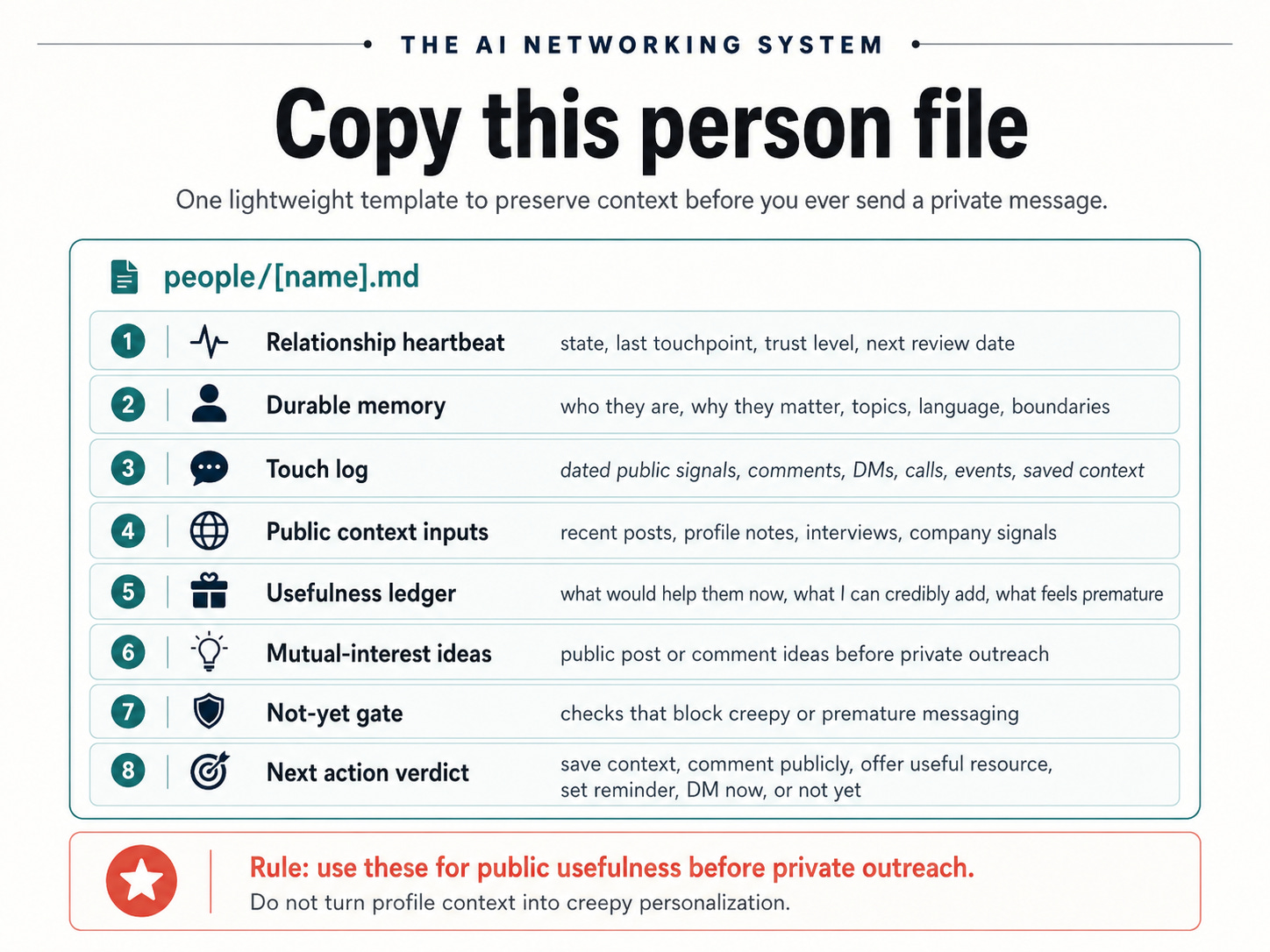
Create one file before your next private message.
# people/[name].md

## Relationship heartbeat
Current relationship state:
Last meaningful touchpoint:
Current trust level:
Next review date:

## Durable memory
Who they are:
Why they matter:
Topics they care about:
Language they use:
Public work worth remembering:
Boundaries or things to avoid:

## Touch log
- YYYY-MM-DD: [public signal, comment, DM, call, event, intro, or saved context]

## Public context inputs
Recent public post:
LinkedIn profile PDF notes:
Podcast/interview notes:
Company/news signal:
Prior comments or public exchanges:

## Usefulness ledger
What would be useful to them now:
What I can credibly add:
What would feel premature:
What I should not ask yet:

## Mutual-interest content ideas
Post/comment idea 1:
Post/comment idea 2:
Post/comment idea 3:
Post/comment idea 4:

Rule: use these for public usefulness before private outreach. Do not turn profile context into creepy personalization.

## Not-yet gate
Have they seen enough useful context from me?
Is there a real reason to message now?
Would a public reply be better?
Am I asking before giving?
Would this feel thoughtful or surveilled?
What should I save instead of sending?

## Next action verdict
Verdict: Save context / Comment publicly / Offer useful resource / Set reminder / DM now / Not yet
Next action:
Why:
Review date:
The file is there to help you decide when to do what for building the relationship... rather than getting ignored.
NOTE - I'm releasing the complete system in Part 2 next week. But if you share this on LinkedIn and tag me before then, you get the whole thing for free today.
Public context is useful only with a boundary
One practical input: if the person has a public LinkedIn profile, you can download the profile as a PDF and use it as context.
Keep this small.
Do not use it to manufacture a hyper-personalized DM. Do not infer private details. Do not pretend you know someone because you read their public profile.
Use public context to find:
topics they repeatedly care about
language they use in public
work they have done openly
company or market signals worth remembering
public post or comment ideas that would still be useful if no DM happens
A good test:
If the person would feel uncomfortable seeing the context you used, do not use it in the message.
It’s brutal yet important to watch out your spammy behaviors.
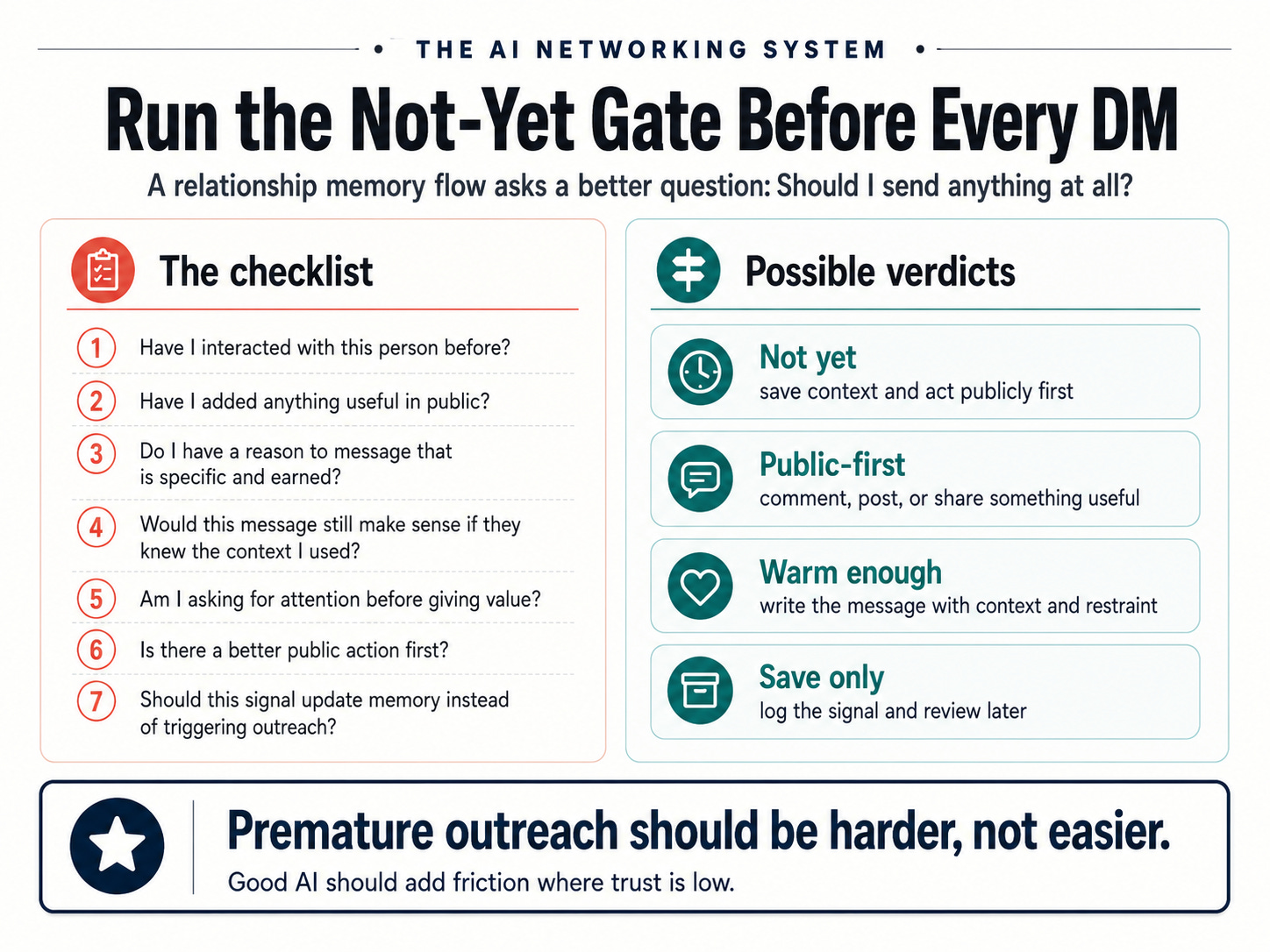
Run the not-yet decision before private outreach
Put this checklist inside the person file.
## Too early to DM?

- Have I interacted with this person before?
- Have I added anything useful in public?
- Do I have a reason to message that is specific and earned?
- Would this message still make sense if they knew exactly what context I used?
- Am I asking for attention before giving value?
- Is there a better public action first?
- Should this signal update memory instead of triggering outreach?

Verdict:
- Not yet: save context and act publicly first.
- Public-first: comment, post, or share something useful.
- Warm enough: write the message with context and restraint.
- Save only: log the signal and review later.
This is where the workflow changes.
A normal AI writing flow asks:
How can I make this message better?
A relationship memory flow asks:
Should I send anything at all?
A filled miniature example
Scenario:
You follow a senior operator on LinkedIn. They posted about AI workflows breaking because teams added tools before defining the workflow. You have no private relationship yet. Your goal is to build context over time instead of pitching today.
Here is the person file after one pass:
# people/maya-operator.md

## Relationship heartbeat
Current relationship state: Public follower, no private relationship yet
Last meaningful touchpoint: Saved public post on AI workflow failures
Current trust level: Low
Next review date: 2026-05-21

## Durable memory
Who they are: Senior operator writing about AI workflows and team execution
Why they matter: Strong overlap with agent systems, workflow memory, and operator-grade AI use
Topics they care about: AI workflows, team adoption, tool sprawl, operating cadence
Language they use: "workflow before tool", "adoption tax", "systems that survive handoff"
Public work worth remembering: LinkedIn post on teams adding AI tools without changing the operating loop
Boundaries or things to avoid: Do not pitch. Do not imply familiarity.

## Touch log
- 2026-05-07: Saved public post about AI workflows breaking when tools come before workflow design

## Public context inputs
Recent public post: AI tools fail when teams skip workflow design
LinkedIn profile PDF notes: Operations leadership, AI adoption, team systems
Podcast/interview notes: None yet
Company/news signal: None yet
Prior comments or public exchanges: None

## Usefulness ledger
What would be useful to them now: A concrete example of where AI memory breaks in a weekly operating loop
What I can credibly add: Experience building context systems and agent workflows
What would feel premature: Asking for a call or partnership
What I should not ask yet: Anything private before a useful public touchpoint

## Mutual-interest content ideas
Post/comment idea 1: Comment with an example of agents remembering tasks but losing relationship context
Post/comment idea 2: Write a short post on why workflow memory beats tool adoption speed
Post/comment idea 3: Save their phrase "workflow before tool" as language to understand, not copy
Post/comment idea 4: Build a small checklist for deciding whether a workflow needs memory, tool access, or just better instructions

## Not-yet gate
Have they seen enough useful context from me? No
Is there a real reason to message now? No
Would a public reply be better? Yes
Am I asking before giving? Yes, if I DM now
Would this feel thoughtful or surveilled? It could feel surveilled if profile context appears in the message
What should I save instead of sending? The post, language, topic overlap, and a public-first comment idea

## Next action verdict
Verdict: Not yet
Next action: Leave a public comment with one operator-grade example about workflow memory breaking after handoff
Why: It adds context without asking for attention
Review date: 2026-05-21
Notice what happened --> The system did not block relationship-building. It blocked the eager private ask in a DM.
That is the correct kind of friction.
The Agent Prompts Daily system
Use this as the agent-ready prompt system.
1. Context block
You are helping me build relationship memory for one person.

The goal is not to automate outreach.
The goal is to preserve context, evaluate trust state, and recommend the next useful action.

Use only the context I provide and public information I paste in.
Do not infer private details.
Do not write a DM unless the not-yet gate passes.
Prefer public usefulness before private asks.
2. Role block
Act as a relationship memory operator.

You are good at:
- extracting durable context from public signals
- separating useful actions from premature asks
- identifying mutual-interest post and comment ideas
- deciding whether a private message is earned
- maintaining a touch log and next-action verdict

You are not a cold outbound copywriter.
You do not optimize for volume.
You optimize for trust, timing, and usefulness.
3. Tools block
Available tools or inputs:
- people/[name].md relationship memory file
- recent public post or comment
- LinkedIn profile PDF from the person's public profile
- prior public exchanges
- prior DM/email notes, if I provide them
- company/news signal
- my reason for building context with this person

If tool access exists:
- read the person file before recommending action
- update the touch log after every action
- save next review date

If tool access does not exist:
- produce the updated markdown file for me to paste into my vault
4. Instruction block
Update the relationship memory file for this person.

Input:
[Paste person context, public signal, profile PDF notes, prior touchpoint, and relationship goal]

Do this:
1. Extract durable memory.
2. Add or update the touch log.
3. Identify what would be useful to them now.
4. Generate mutual-interest public post or comment ideas.
5. Run the not-yet gate.
6. Decide the next action.
7. Return the updated people/[name].md file.

Rules:
- Do not write a DM unless the gate passes.
- If the signal is weak, recommend saving context or public-first action.
- Do not invent familiarity.
- Do not mention private assumptions.
- Keep the recommendation specific and restrained.
5. Eval block
Evaluate the output before I act:

- Did it preserve context I can reuse later?
- Did it separate public information from assumptions?
- Did it recommend a next action, not just content?
- Did it explain why the timing is or is not right?
- Would the target person feel respected if they saw this workflow?
- Is the action useful even if no private message is sent?
- Did it avoid generic "loved your post" outreach?

Pass condition:
The output gives me a concrete next action and makes premature outreach harder, not easier.
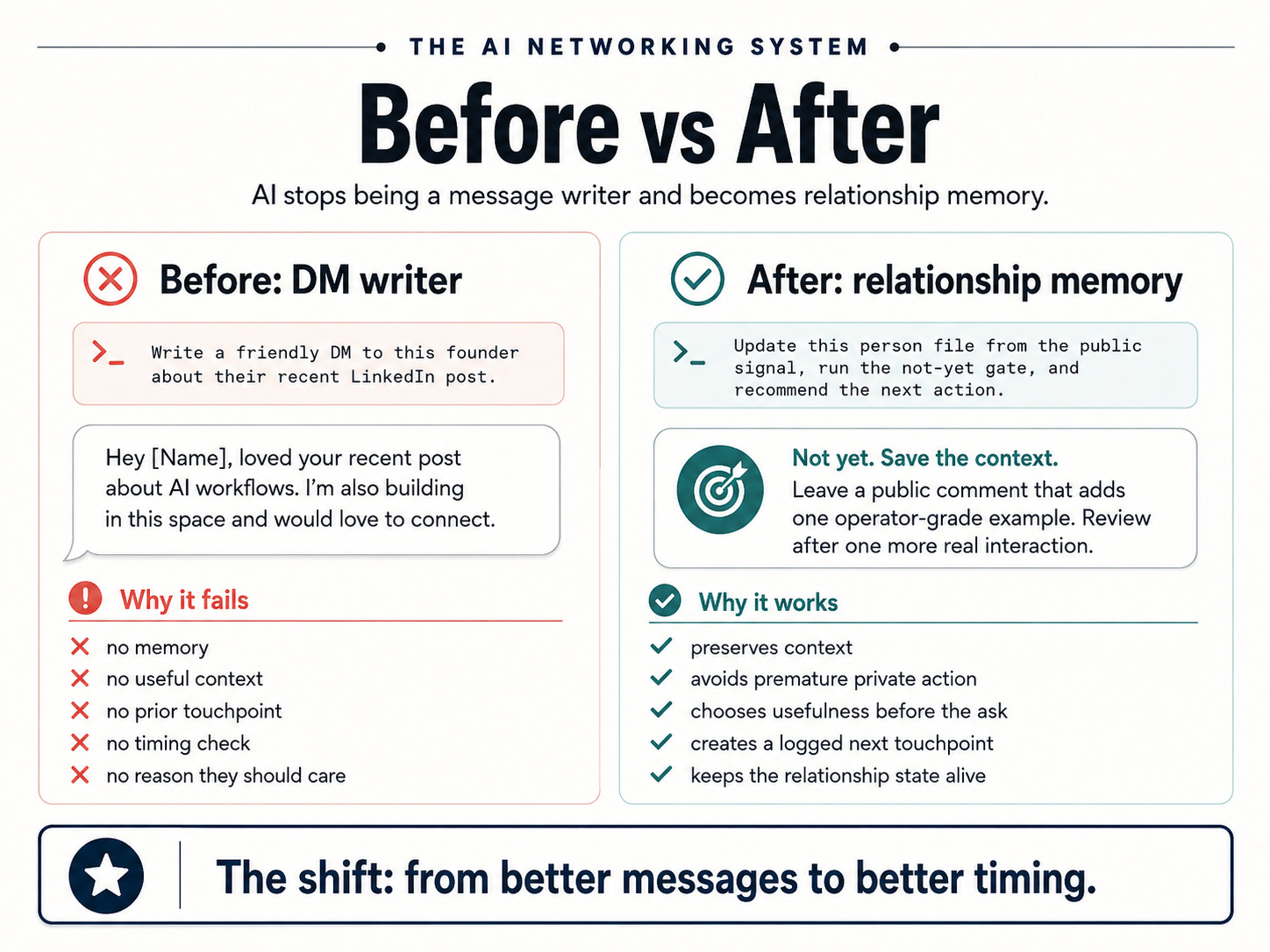
Before and after
Before:
Prompt: Write a friendly DM to this founder about their recent LinkedIn post.

Output: Hey [Name], loved your recent post about AI workflows. I'm also building in this space and would love to connect.
Why it fails:
no memory
no useful context
no prior touchpoint
no timing check
no reason the person should care
After:
Prompt: Update this person file from the public signal, run the not-yet gate, and recommend the next action.

Output: Not yet. Save the context. Leave a public comment that adds one operator-grade example. Review after one more real interaction.
Why it works:
it preserves context
it avoids premature private action
it chooses usefulness before the ask
it creates a logged next touchpoint
it keeps the relationship state alive for the next session
That is the shift.
AI stops being a message writer and becomes relationship memory.
What to do now
Pick one person before your next DM.
Create the people/[name].md file.
Paste in one public signal, one reason they matter, and one thing that would be useful to them.
Then run the not-yet gate.
If the gate says not yet, do not send the message.
Save the context. Add something useful in public. Review after one more real interaction.
If this was useful, here's how to get the rest of it for free. The full system comes out in Part 2 next week. Share this on LinkedIn, tag me, and I'll get it to you before the public release. That's the whole deal.
And subscribe to “Prompts Daily Newsletter” as well…
If you’re not a subscriber, here’s what you missed earlier:
Demand generation best practices for 2026 (AI-native OS, frameworks, AI agents and full-stack GTM)
Build Karpathy’s Self-Updating AI Knowledge Base in Just 90 Minutes
The CXO Newsletter Playbook: Why 95% Fail (And the 5-Prompt Strategy System)- Part 1 of 2
Your Head of Growth Toolkit (with Context, Prompts and Agents)
Analyze your Content for Trust and Revenue Goals with Claude (using Content Trust System)
Build an ICP so specific your message gets reply - The Pressure Profile ICP System (with Prompts)
I get 3x more inbound from comments than posts - My entire prompt system
The AI Partner Stack: 8 Roles as My Advisory Board (Part 2 of 2)
How You Should Actually Plan 2026: [Implementation Guide with Prompts]
Find trends before others: Frameworks, Techniques, Sources and Prompts
The Market Entry Timing Equation: When Being Early Wins and When It Kills You
Subscribe to get access to the latest marketing, strategy and go-to-market techniques . Follow me on Linkedin and Twitter.
