

Agents, Skills, Tool kits, Prompt packs - How to grow an audience with AI lead magnets
A practical guide for founders and operators on building a prompt / skill / agen pack that does one narrow job, delivers a real result, and turns readers into subscribers.

This newsletter reaches 3,000+ readers across 95 countries.
A lot of you found me through this one post that got saved a few hundred times.
Build Karpathy’s Self-Updating AI Knowledge Base in Just 90 Minutes

🚀 FREE DOWNLOAD: Karpathy’s Complete AI Knowledge Compiler System
If you have been looking forward to build a list of followers and subscribers who keeps waiting for your email or a social post, this one is for you.
It does not matter who you are or what your designation is.... whether you are
The founder who makes sharp pricing and ICP calls.
The operator who fixes the one or other process every single week.
The builder whose prompts and skills stay buried in private chats.
The consultant whose frameworks are the entire business.
Whether you are early stage or already big, the challenges are identical.
You give the knowledge away.... hoping for people to follow, subscribe and trust you...
The shift this whole issue is about: stop chasing an audience with more content, and start creating one with assets that already worked for you.
Same knowledge you were going to post anyway... But in a different way.
In this issue
How creators and startups are quietly winning with this
How to think about your asset before you build anything
How to build it, test it, then evolve it with a plan
Quick reasoning prompts to get better answers from any AI
Mental model prompts to use starting today
Two power prompts: build context first, then grill yourself
Prompts to kickstart your first asset, no prerequisites
Prompts to brainstorm value-maxxing cases
Level up: turn these prompts into a system that mostly runs itself
Get the full system access
All my Agent Page Links for You
Want early access to The Value-Maxxing Asset System? It goes live next week.
Just DM me and share this with your network, and I will give you exclusive access.
How creators and startups are quietly winning with this
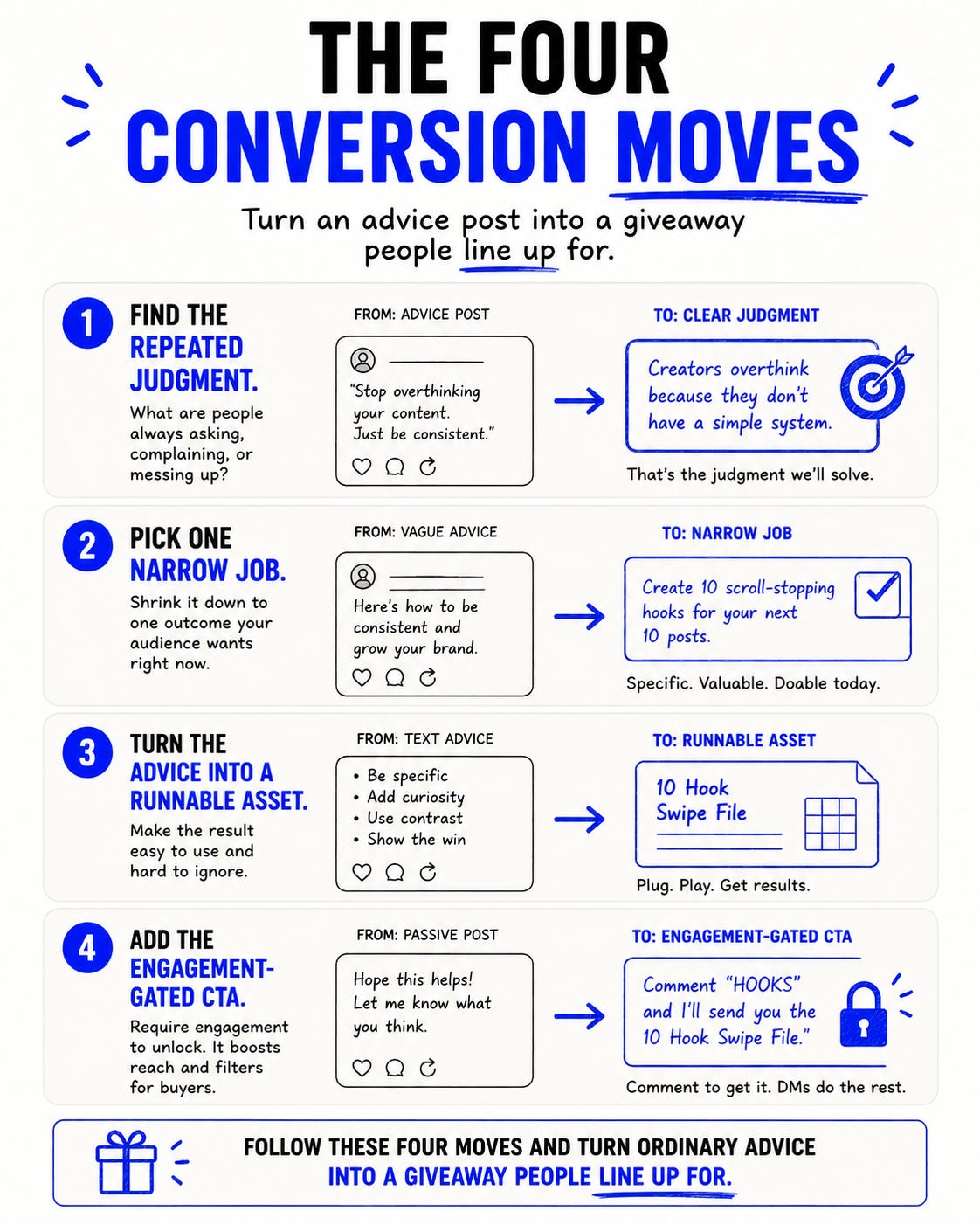
One creator posted a 60-plus prompt vault mapped to real business decisions and live dashboards.
The ask was - Like the post, drop a comment, follow for access.
It got tens of thousands of views and hundreds of replies within few days.
Apart from the view counts and tons of replies, I noticed folks resharing and also commenting their experience “ran it and have now customized it....”
Another builder earned couple of thousand dollars in sales from claude-code courses.
A third creator published the packaged version: the agent guide, the examples, and skill files.
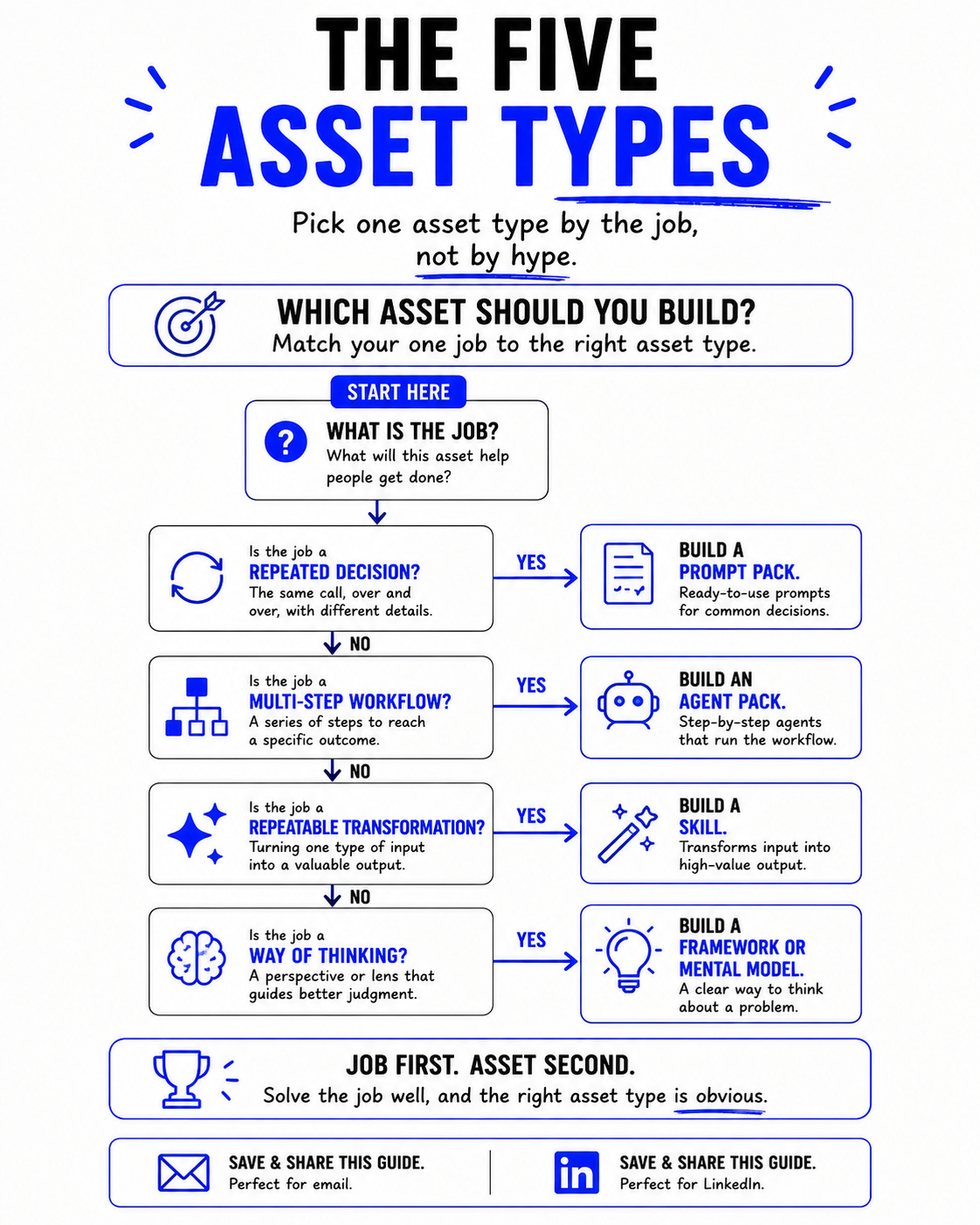
These assets are usually of these types --> A prompt pack, an agent pack, a skill pack, a guide, a framework, or a mental model.
Nugget for your AI → Paste one of the post that got viral and ask: “Reverse-engineer why this worked. Name the one narrow job it did for the reader and the proof it handed over.” You get a step-by-step on whose structure you can reuse, without copying the content.
How to think about your asset before you build anything
Most of the folks I have coached earlier... jump straight to “which prompts, skill files, and frameworks should I create.” That is the wrong starting point.
The asset is the last thing you figure out, not the first.
Start with three questions, in this order.
Where does your reader sit on the awareness curve?
Some people scrolling past your post do not even know they have the problem you solve. Others already feel the pain and are hunting for someone exactly like you. You cannot write one asset for both.
The assets that went viral were built for people already facing the problem
So build for the reader who is itching, not the one you still have to convince.
What is the judgment you already carry? People undervalue this part, because to them it feels obvious.
The decisions you make faster than everyone in the room.
The question people keep bringing back to you.
The fix you have run so many times it bores you.
Being a creator is being a meta-thinker and investigative journalist of your own mind. What’s obvious to you may be gold for them, because they have never done it.
Where is the gap opening up right now?
The best assets sit on a fresh pain. A tool nobody has wrapped into a real workflow yet, or a job that got 10x more easier the day AI showed up.
Find the spot where the old advice stopped working and nobody has written the new playbook. That gap is your unfair window, and remember windows are short.
Run the three together and the you will get your asset idea.
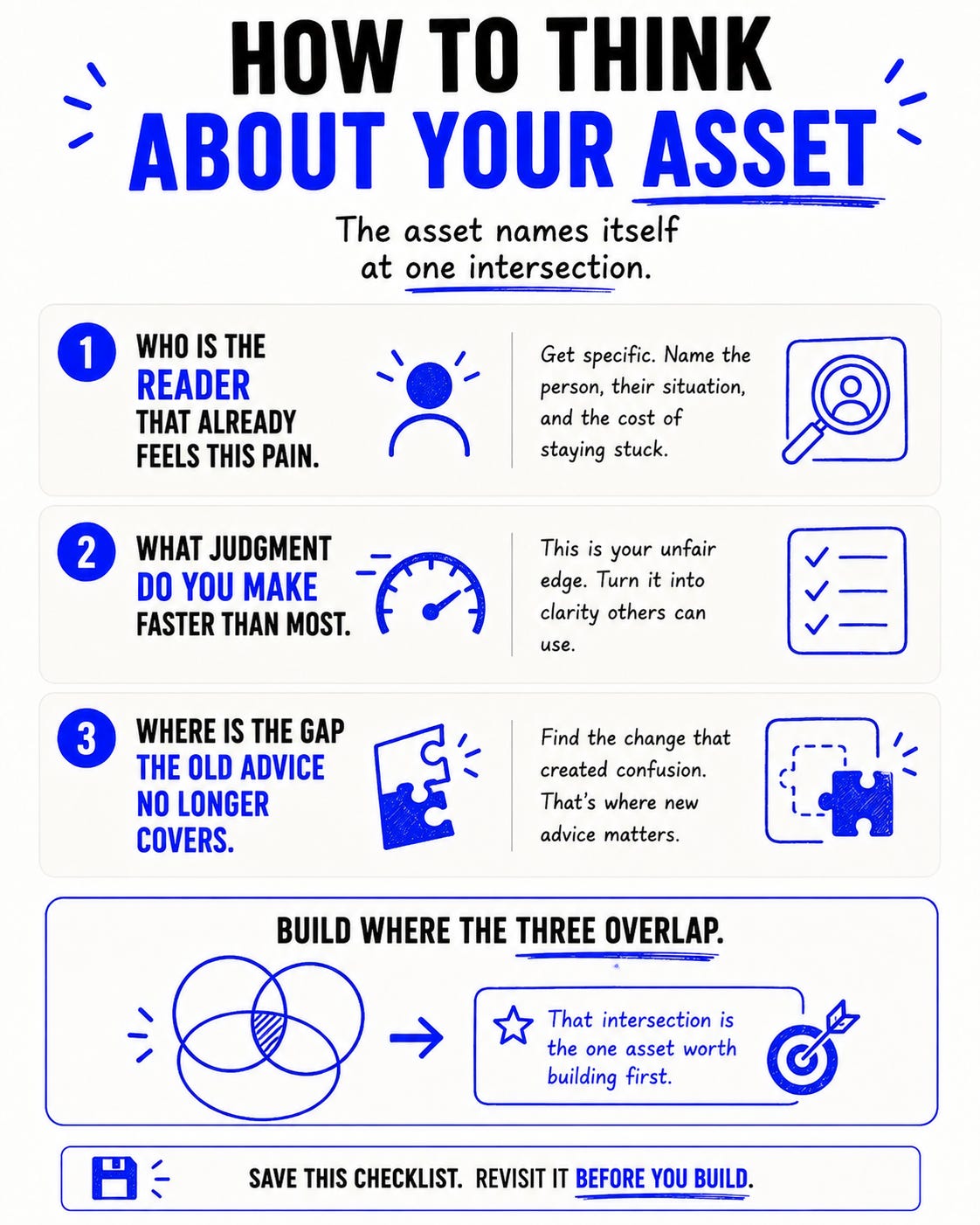
The best thing to package first is where your audience struggles and you have an answer.
Nugget for your AI → Ask: “Cross-question me on my niche until you can name the one reader who already feels this pain, and do not stop at my first answer.” You walk out with a sharper reader than the vague one you started with.
How to build it, test it, then evolve it with a plan
Build the dumbest first version that works first... and test it across scenarios.
Before launching to everyone, test it with three real people.
Most often, it’s one of two problems:
Either they don’t know how to start or what to do next.
Or the output starts drifting.
A simple decision tree fixes the first.
A “state your assumptions first” rule fixes the second.
That solves most of the problem.
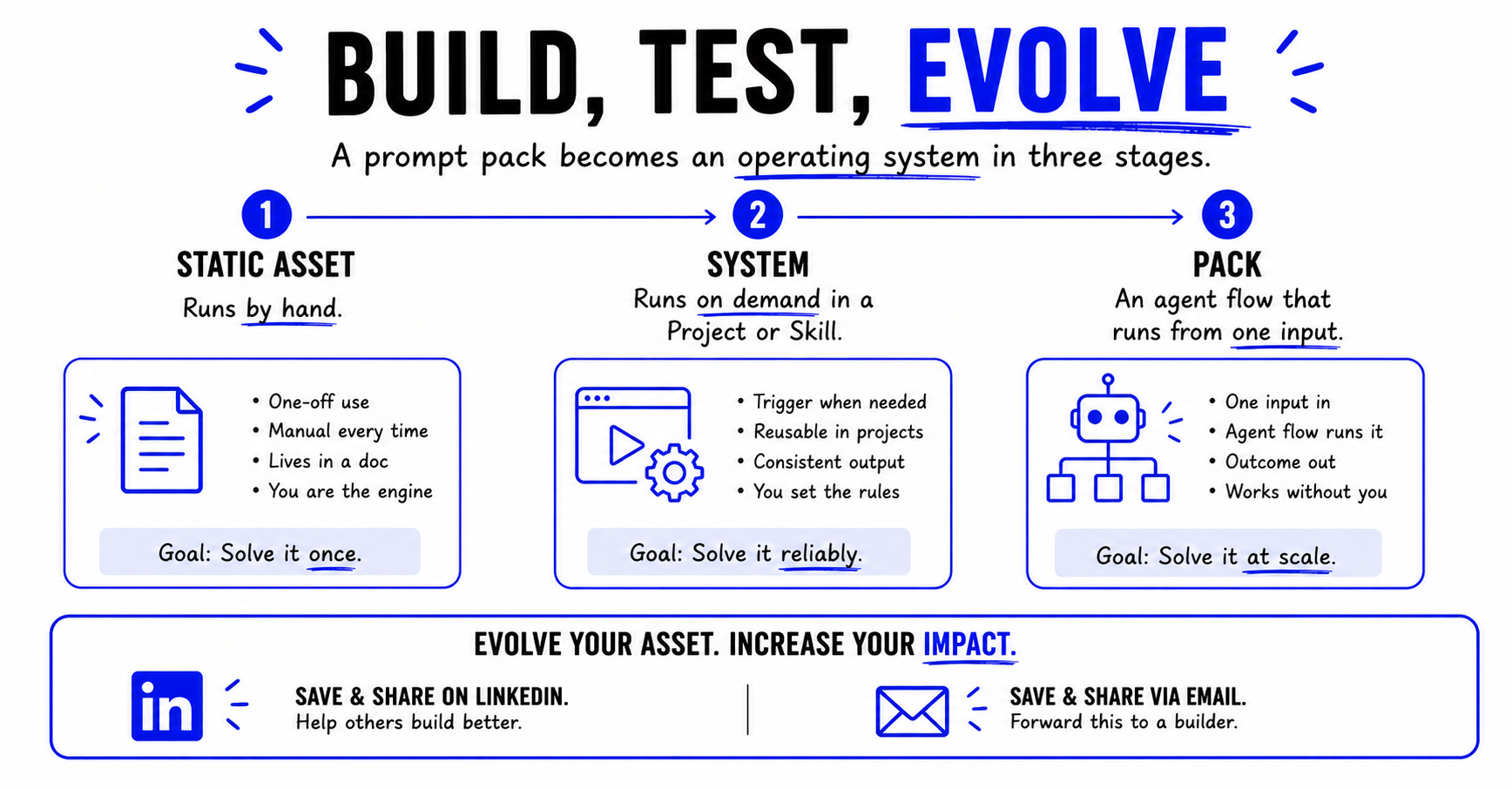
Now evolve it by stages.
Stage one is the static asset.
The asset is a simple prompt, skill or framework and produces a real result. Ship it and start collecting proof.
Stage two is the system. You build the asset as a system to drop into a Claude Project or a Skill so it runs on demand.
Stage three is the pack. You combine the pieces into a small agent flow where each step hands off to the next, so the whole motion runs from a single input. This is where your asset becomes an operating system.
You reach this stage only after one and two actually work.
Nugget for your AI → Ask: “Break my asset into a build plan I can finish this weekend, with the riskiest part scheduled first.” You get an ordered plan instead of a vague pile of to-dos.
Free Access to 3 AI and GTM Products
GTM AI Knowledge Builder Kit — your scattered GTM docs become an AI knowledge base your tools pull from. - Link
Context Stack — the context layer that makes any LLM answer like it knows your business. - Link
Content Pillar System — turn one idea into a month of content that compounds. - Link
Quick reasoning prompts to get better answers from any AI
Before the build prompts, here is a smaller set you can paste into any chat.
Use them mid-conversation when an answer feels generic or too broad.
Each one pulls the model toward the way these assets actually get built, so the thinking above becomes something you can trigger on demand.
Force one narrow job
Before you answer, name the single narrow job this is really about, and solve only that one. If I am secretly asking for several jobs at once, tell me and make me pick.
Make it runnable, not explained
Do not explain the idea back to me. Turn it into something I can run on my own inputs in about ten minutes, and give me that runnable version.
Aim at the right reader
Who is the reader here, and where do they sit on the awareness curve? Write for the one who already feels this problem, not the one I would still have to convince it exists.
Dig out the judgment worth packaging
Look at what I just described and name the repeated judgment buried inside it. Point to the call I make faster than most people, because that is the thing worth packaging.
Demand proof, kill thin ideas
What real result would the receiver get in their own context, and what proof would they tie back to me? If there is no real result, tell me the idea is too thin and exactly why.
Argue with yourself first
Argue against your own answer as someone who has never heard it. Then give me only the version that survives the objection.
Stack two or three of these in a single message, and the quality jumps fast.
Mental model prompts to use starting today
Drop one of these into any conversation when you want the AI to think, not just answer. Each one forces a different lens on the same problem.
Inversion
Do not tell me how this works. Tell me how it fails. Work backward from the worst outcome and name what causes it.
First principles
Strip this down to first principles. What is actually true here if I ignore how everyone normally does it? Rebuild the answer from there.
Second-order effects
Walk past the obvious result. What happens next, and after that? Name the second and third-order effects I am not seeing yet.
Opportunity cost
If I commit to this, what am I giving up? Name the best thing I am choosing not to do, and tell me whether the trade is worth it.
Customer voice
Answer as my actual customer would, in their own words and their own priorities, not as a consultant describing them from the outside.
10x not 10 percent
Tell me whether this is a 10 percent better version of the same thing or a 10x rethink. Then push me toward the 10x framing.
Two power prompts: build context first, then grill yourself
These two do more work than the rest. Each tells the AI to build real context first, then turn that context into a hard interrogation. Run them before a launch, a pitch, or any call you cannot afford to get wrong.
From this chat or a call transcript
First, read back through our entire conversation [or the call transcript I am pasting below]. Pull the key facts, decisions, goals, and constraints into a short context brief, and show me that brief first.
Then, using only that context, ask me the 10 hardest questions a sharp operator would ask about my plan. For each question, give the rebuttal a skeptic would throw back, argue the devil's advocate case against me, reason it from first principles instead of best practice, and phrase it in my actual customer's voice.
Do not soften them. I want the questions that expose what I have been avoiding. Rank them hardest first.
From memory and past conversations
Pull everything you know about me and my work from your memory and our past conversations. Build a short context brief: who I am, what I am building, my goals, and my likely blind spots. Show me the brief first.
Then ask me 10 difficult questions grounded in that history. Each one needs a strong rebuttal, a devil's advocate angle, a first-principles breakdown, and the question phrased the way my customer would actually say it.
Rank them hardest first, and tell me which one I have clearly been avoiding.
Prompts to kickstart your first asset, no prerequisites
These are built on a simple instruction skeleton: who the model is, what it knows, the task, how to approach it, the output shape, the quality bar, the guardrails, and what success looks like. Each one also checks your input first and asks a question instead of guessing when something is thin, so they hold up even on messy or unusual cases. Drop each into a fresh chat. Run the first prompt right now, before you read another section.
Prompt 1: Asset Excavator
ROLE: You are a product strategist with 10+ years turning operators' tacit judgment into shippable products. You think in narrow jobs, not broad topics, and you spot a thin idea fast.

CONTEXT: I keep answering the same questions and making the same calls. The asset I should build is hiding inside that repetition. I want you to find it.

TASK: Interview me, then propose. Ask three questions one at a time, waiting for each answer: (1) the work I do most weeks, (2) the questions people bring me most, (3) the decisions I make faster than people around me.

THINKING (do this before proposing anything):
- Judge each answer for substance. If one is vague or generic ("I help people do better"), ask one sharpening follow-up before moving on. Do not build on mush.
- Test for real repeated judgment. If after follow-ups there is no recurring call I actually own, say so plainly and do not manufacture assets. Instead, tell me whether to borrow a narrow job from past work or go run more reps first, and why.
- Only once at least one genuine repeated judgment is on the table, propose candidates.

OUTPUT (when inputs are sufficient): three asset candidates, one each as a prompt pack, an agent pack, and a framework or mental model, in a table. Columns: Asset name, Type, The one narrow job, Who already feels the pain, Why it would spread, Rough build time.

QUALITY STANDARDS: Each candidate maps to one narrow job and one real reader, and traces to something I actually said. Build time is honest for a first version, not aspirational.

CONSTRAINTS: No "1,000 prompts" bundles, no generic vault. Never invent expertise I did not show. If inputs are thin or there is no real judgment, ask or tell me, do not guess.

SUCCESS CRITERIA: Either at least one row makes me think "that one is obvious," or you have told me honestly that I am not ready to package yet and what to do first.
Prompt 2: One Job Picker
ROLE: You are a sharp GTM advisor who is allergic to scope creep and refuses to say "it depends."

CONTEXT: I have a few asset ideas [paste the table from Prompt 1]. I can build only one well right now, and I want the one most likely to spread and pull toward my paid offer.

THINKING (before scoring): if an idea is missing a clear one-job or a named reader, ask me for that one thing before scoring. Do not score blanks. If I pasted fewer than two real options, tell me there is nothing to compare and ask for more.

TASK: Score each idea 1 to 5 on real demand, proof I can show fast, speed to ship, and pull toward my paid next step. Weight speed and proof highest for a first asset. Then commit to one.

OUTPUT FORMAT: A scored table with a total column, then the single pick and a three-sentence reason tied to the scores.

QUALITY STANDARDS: One clear winner. Every score traces to something in my inputs.

CONSTRAINTS: No hedging, no co-winners. Tie-break cascade when totals match: highest speed to ship, then strongest proof, then pull toward the paid offer. If still tied after all three, pick the lower-risk build and say why.

SUCCESS CRITERIA: I leave knowing exactly what to build first and why, with no second-guessing.
Prompt 3: First Ten
ROLE: You are an expert prompt and workflow designer who ships assets people run correctly on the first try.

CONTEXT: The asset I am building is [name + the one narrow job]. My reader is [one line]. A messy real input from them looks like [one example].

THINKING (before drafting):
- Scope check: if what I gave you is really two or more jobs, stop and ask me to pick one. Ten components for a blurry job is ten weak components.
- Stakes check: if this asset touches regulated, legal, medical, financial, or security decisions, switch to extraction-only mode. Use only what the input states, flag every missing piece, and never invent a fact, number, control, or claim.
- If the example input is missing, ask for one before drafting, or state the assumed input you are designing against.

TASK: Draft the first ten components of this asset, fully written, ready to run today, ordered so a first-time user moves from setup to result without getting lost. Each component names its own input and output.

OUTPUT FORMAT: A numbered list. Each item has a title and the actual content, not a description of the content.

QUALITY STANDARDS: A stranger could run any single item right now and get a usable result.

CONSTRAINTS: No empty placeholders, no vague advice dressed up as a prompt, no step that needs me to explain it in person. Never fabricate facts to fill a component; mark any assumption in brackets.

SUCCESS CRITERIA: I can paste the ten into a doc and call it a rough version one with zero further writing.
Prompt 4: Stress Test
ROLE: You are a skeptical first user and a senior QA reviewer in one. You want this asset to fail in front of you, not in front of a real customer.

CONTEXT: Here is my draft asset [paste it]. My reader is [one line]. A realistic messy input is [paste or describe it]. My pass bar is [one line of what "good enough to ship" means]; if I leave it blank, set a sensible bar and state it before you start.

TASK: Run the asset end to end as that reader, using the messy input. Report where it breaks, then judge it against the pass bar.

APPROACH: Walk each step. Find the first place you got confused, the first place the output drifted from the intent, and the first place a real user would quit. Then name the single highest-impact fix.

OUTPUT FORMAT: Three labeled blocks (Where I stalled, What is missing, The one fix that matters most), then a verdict: SHIP, PATCH, or REBUILD, with one line on why.

LOOP MODE (only if I ask you to iterate): apply the one fix, re-run, and re-score against the pass bar. Stop the moment the verdict is SHIP, or after 3 passes, whichever comes first. Never declare SHIP without meeting the stated bar. If 3 passes do not get there, stop and tell me the asset needs a rebuild, not another patch.

QUALITY STANDARDS: Point to the exact step and quote the exact line that fails. No general praise, no wishlist.

CONSTRAINTS: One highest-impact fix per pass. If nothing breaks, say so plainly and tell me what to test next.

SUCCESS CRITERIA: I know the single change that moves this asset forward, and in loop mode the asset either clears the bar or is honestly flagged for rebuild.
Six systems that make your AI agents reliable.
Memory that sticks across sessions.
A self-updating knowledge base.
Context that makes any model answer like it knows your business.
A 17-advisor council that stress-tests your highest-stakes calls.
Plus two bonuses for your visibility and your job search.
Prompts to brainstorm value-maxxing cases
The same engine bends across industries and business stages, and it works inside teams too. These two prompts help you spot where it fits beyond your obvious first idea.
Prompt 5: Cross-Industry Mapper
ROLE: You are a strategist who has watched the same playbook win across a dozen industries and can port it cleanly.

CONTEXT: The value-maxxing method: take a repeated judgment, narrow it to one job, package it as a runnable asset (prompt pack, agent pack, Skill, framework, or mental model), and give it away in the way that fits my goal. My background is [one line]. My goal is [audience / leads / internal enablement / other].

THINKING (before listing):
- Breadth or depth? If my background points to one tight niche or local market, ask whether I want ideas across other industries or deeper ideas inside my own niche, then map accordingly. Do not fan out across industries when I clearly want depth in one.
- Goal fit: adapt "give it away with proof" to my goal. For audience, proof spreads publicly. For internal enablement, "spread" means adoption across teams, not followers. Frame each idea's payoff in my goal's terms.

TASK: Map eight concrete asset ideas where this method would win, matched to the breadth-or-depth choice above.

OUTPUT FORMAT: A table. Columns: Context (industry or niche), Stage or team, The reader who already hurts, The one job, Best asset type, How it pays off toward my goal.

QUALITY STANDARDS: Each row is specific enough to start building tomorrow. No generic "marketing" or "sales."

CONSTRAINTS: No row that could apply to any business. Tie each one to a named situation. If I asked for breadth, still cover at least one early-stage, one scaling, and one team-lead case.

SUCCESS CRITERIA: At least three rows feel like ideas I could steal this week, in the frame that matches my actual goal.
Prompt 6: Team Use-Case Finder
ROLE: You are an operator who finds internal uses for an asset that others only see as audience-facing.

CONTEXT: My asset is [name + the one job]. The teams in my company or my client are [list, e.g. sales, RevOps, CS, product, founders].

THINKING (before answering): if I did not list teams, ask for them, or use a sensible default set for my context and state it. If I listed only one team, skip the "fastest to spread" pick and instead find three distinct uses inside that one team.

TASK: For each team, find one way this asset (or a close variant) saves real time or sharpens a real decision. Then pick the single team where it spreads internally fastest.

APPROACH: Tie each use to a recurring task that team already owns, never a hypothetical one. Judge internal spread by how often the task repeats and how visible the win is.

OUTPUT FORMAT: A table by team (Team, The recurring task, How the asset helps, Decision it improves), then the one-line pick for the fastest internal win and why.

QUALITY STANDARDS: Every row names a real task and a real decision.

CONSTRAINTS: No vague "improves efficiency." No team gets a generic answer.

SUCCESS CRITERIA: I can walk into one team tomorrow and hand them something they will actually use.
Level up: turn these prompts into a system that mostly runs itself
The six above are the manual version. Run them manually first, because that is how you learn where your asset really breaks.
Once they work, four moves turn a stack of single chats into something closer to an engine.
Skip this part if you only want your first asset shipped. Come back when you want the next ten to take an afternoon instead of a week.
Nugget for your AI → Ask: “Find the part of this asset only I could have built, the piece that would be hardest for anyone to copy.” You surface the moat hiding inside your own judgment.
Meta prompting: a prompt that builds your prompts. Instead of writing each component manually, write one prompt whose only job is to produce and grade the others. You hand it the one job and the quality bar, and it drafts the components, scores its own work, and rewrites the weak ones. You stop writing prompts and start directing them. Here is the seed:
ROLE: You are a prompt director. You do not answer the task yourself. You build and grade the prompts that will.

CONTEXT: My asset is [name + the one job]. My quality bar is [one line of what good output looks like].

THINKING (before drafting): if the quality bar is missing or vague, ask me for it in one question before you build anything. You cannot grade against a bar that does not exist.

TASK: Draft three candidate prompts, each meant to produce one component of this asset. Then score each against my quality bar 1 to 5, keep the best, and rewrite it once to push it higher.

OUTPUT FORMAT: The three drafts, the scores with one-line reasons, the winner, and the improved final version.

QUALITY STANDARDS: The final prompt is sharper than anything I would have written by hand.

CONSTRAINTS: Do not solve the underlying task. Only produce prompts that solve it. If you catch yourself answering the task, stop and convert that answer into a prompt instead.

SUCCESS CRITERIA: I walk away with a prompt I would not have thought to write.
Agentic loops: run, critique, fix, repeat. Prompt 4 is the seed for this. Wire it so the model runs your asset, scores the result against a fixed bar, applies the top fix, then runs again, stopping only when it passes or after three passes.
Sub-agents: one big brain becomes a small team. Break the asset build process into specialists sub-agents that work in coherence.
An Excavator sub-agent finds the asset idea, a Drafter sub-agent writes it, a tester sub-agent tries to break it, a Packager sub-agent ships it.
The lead agent does two things people skip: it checks each handoff for gaps before the next agent runs, and it flags any step that still needs a human review.
That gap-check is what keeps a long chain from quietly drifting. This is exactly the eight-agent build system inside the “Asset Builder” product, and it is the cleanest proof of the agent-pack idea, because the builder itself is an agent pack.
Dynamic workflows: let the chain branch. Your path should not be fixed. After the One Job Picker names the asset type, the workflow forks on that answer. A prompt pack routes to prompt-pack builder, a framework routes to a framework builder, an agent pack routes to a spec. The routing rule is explicit, so the branch is decided by the named type, not left to chance.
The manual prompts get you proof. These four turn that proof into a machine that ships the next asset in a fraction of the time. The full wiring, the orchestrator, the shared state, the guardrails between steps, and the three ways to run it, lives in the product b.
Get exclusive early access before it launches next week
Everything above gets you to a first asset. The full build goes further. The decision guide for which of the five types to pick, the schemas and decision trees, the guardrails, a starter prompt library, two worked examples, the orchestrated eight-agent build system, and the launch flow that makes it spread.
That whole thing is The Value-Maxxing Asset System, and it goes live next week.
Want the entire product before anyone else? Just DM me and share this with your network, and I will give you exclusive access.
Loved this post?
And subscribe to “Agents Prompts Daily Newsletter” as well…
More from me: My Brevv Agents library
The stack above handles memory. These agents handle the work that runs on top of it. Each one is hosted on Brevv, free to run, built for B2B operators who like to think out loud before they ship.
B2B Demand Gen and the 4C trust framework
Trust is the real conversion gate in B2B. These 8 prompts find the gap, name it, and turn it into a calendar you can ship from.
Copy and content
When the asset is the bottleneck, not the strategy.
Comment Engine (each one ships with a walkthrough video)
Comments still pull more qualified pipeline than most posts. These five run my full comment workflow end to end.
Solo and newsletter
If you’re not a subscriber, here’s what you missed earlier:
Demand generation best practices for 2026 (AI-native OS, frameworks, AI agents and full-stack GTM)
Build Karpathy’s Self-Updating AI Knowledge Base in Just 90 Minutes
The CXO Newsletter Playbook: Why 95% Fail (And the 5-Prompt Strategy System)- Part 1 of 2
Your Head of Growth Toolkit (with Context, Prompts and Agents)
Analyze your Content for Trust and Revenue Goals with Claude (using Content Trust System)
Build an ICP so specific your message gets reply - The Pressure Profile ICP System (with Prompts)
I get 3x more inbound from comments than posts - My entire prompt system
The AI Partner Stack: 8 Roles as My Advisory Board (Part 2 of 2)
How You Should Actually Plan 2026: [Implementation Guide with Prompts]
Find trends before others: Frameworks, Techniques, Sources and Prompts
The Market Entry Timing Equation: When Being Early Wins and When It Kills You
Subscribe to get access to the latest marketing, strategy and go-to-market techniques . Follow me on Linkedin and Twitter.
