

The AI GTM System That Thinks Like 20 Growth Experts
A practical breakdown of an AI GTM mastermind built from 20 growth experts, reusable skills, prompts, agents, and shared memory across sales, marketing, outbound, inbound, and RevOps teams today.

🎁 Free this week: The Expert GTM Mastermind System.
It gives you the thinking of 20 growth experts, converted into reusable AI skills, prompts, agents, and one orchestrator that helps route your GTM problem to the right expert model.
If you are building with Claude Code, Cowork, ChatGPT, or any AI workspace, this helps you stop collecting random prompts and start working from one GTM brain.
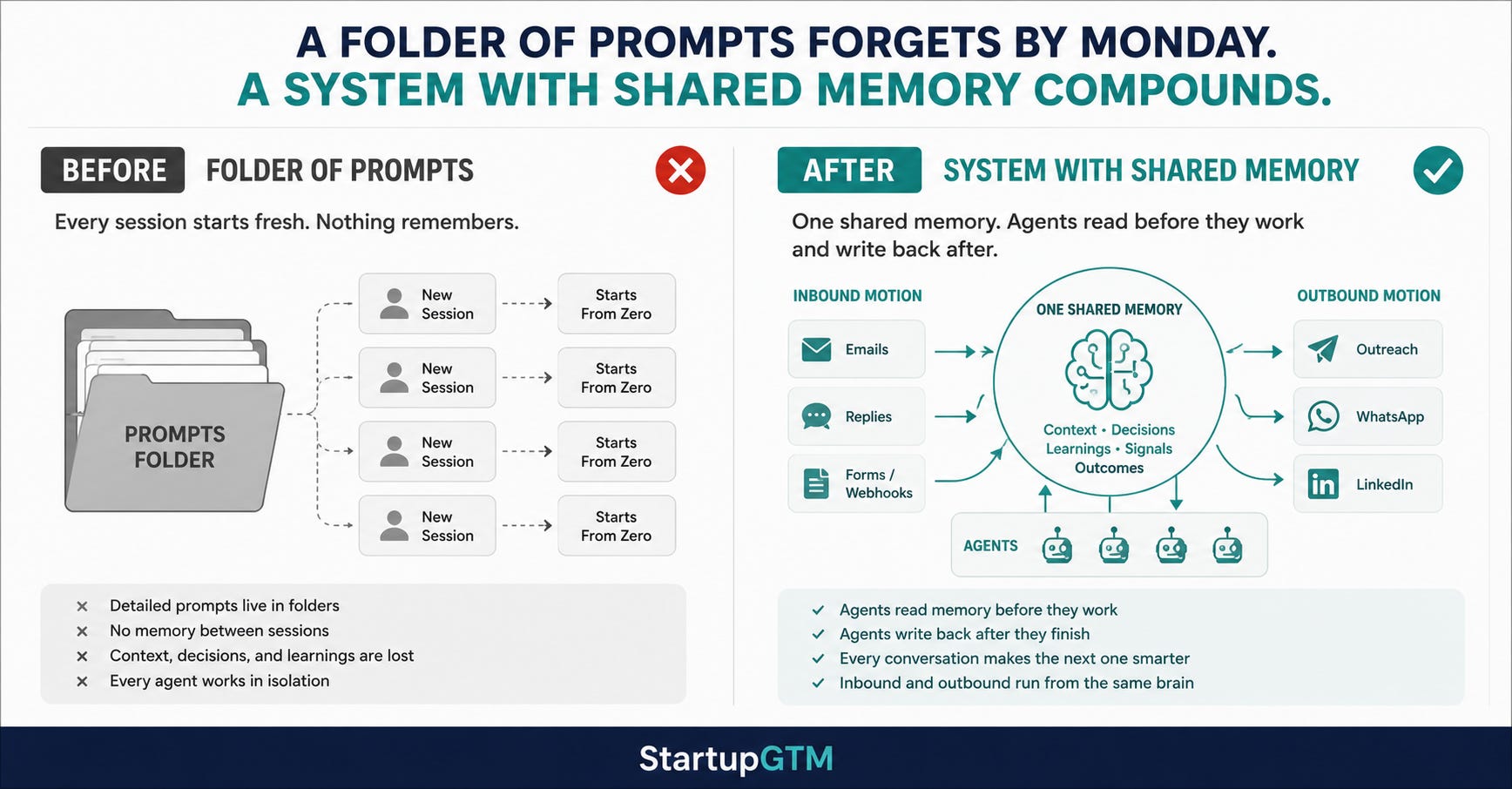
Your GTM system probably started the way mine did: a folder of prompts and skills that doesn’t get full context.
The fix to this problem wasn’t a better skill or prompt... but the system.
Every expert you follow is telling you to buy a different agent.
Very few of you who successfully built ai growth teams did the opposite. They taught their agents the way best growth operators think, gave it a memory and 2nd brain, and use it for both inbound and outbound motions.
That’s the whole shift, and most of the content about it misses it completely. You get a tactic with no map, a prompt or a skill with no system, another tool to evaluate.
I run a master-vault that does exactly this: one memory, second brain and agents. They optimally harness before every run and evolving with each inbound and outbound workflow execution.
So here’s the map first.
In this issue:
1/ the six-stage AI GTM arc
2/ what you’re doing wrong,
3/ build-test-evolve and value-maxxing agent instructions
4/ 20 growth experts giveaways, prompts and skills
5/ 100 reasoning instructions / mental models
5/ the composer that builds any workflow from their parts,
6/ the value vault, and how to start free.
Newsletters I published earlier and you might have missed…
How to build agent-loops? - Beginner to Expert Guide (with Free Kit)
Agents, Skills, Tool kits, Prompt packs - How to grow an audience with AI lead magnets
How to Stop AI Agents From Making Mistakes: A Practical Guide to Agent Evals
Why do you need to read this?
This is a working system, not a think-piece.
By the end of this newsletter, you’ll have a “growth mastermind”: the mental models of 20 growth experts... converted into skills, agents, and prompts, merged into one brain your AI can run across inbound and outbound.
It helps a specific set of people.
1/ The founder doing their own GTM who keeps re-explaining context to the AI every week.
2/ The growth lead whose inbound and outbound live in separate tools and separate heads.
3/ The RevOps or GTM engineer who has skills but no system.
4/ The solo operator competing with teams ten times their size.
Across SaaS, agencies, and services, early stage to scaling, the problem is same: the work doesn’t compound.
Trend — Growth experts are winning by front-loading value
Kieran Flanagan, SVP at HubSpot, publicly teaches how to turn any expert’s content into a reusable Claude skill, and built a whole content team out of chained skills with shared memory.
Sabrina Ramonov built a 1.4 million audience in under a year on repurposing chains and vibe-coded micro-apps that hand people value up front.
Kevin Indig gives away the citation research that tells you what AI engines actually quote.
Katelyn Bourgoin gives away the trigger technique that turns buyer stories into campaigns.
They’re handing you a way of thinking you can use immediately, and the relationship starts because the thing worked.
This GTM mastermind newsletter is itself a front-loaded value asset. You can run pieces of it in five minutes, before any product, any meeting, any spend.
More about this in my last newsletter — https://startupgtm.substack.com/p/ai-lead-magnets
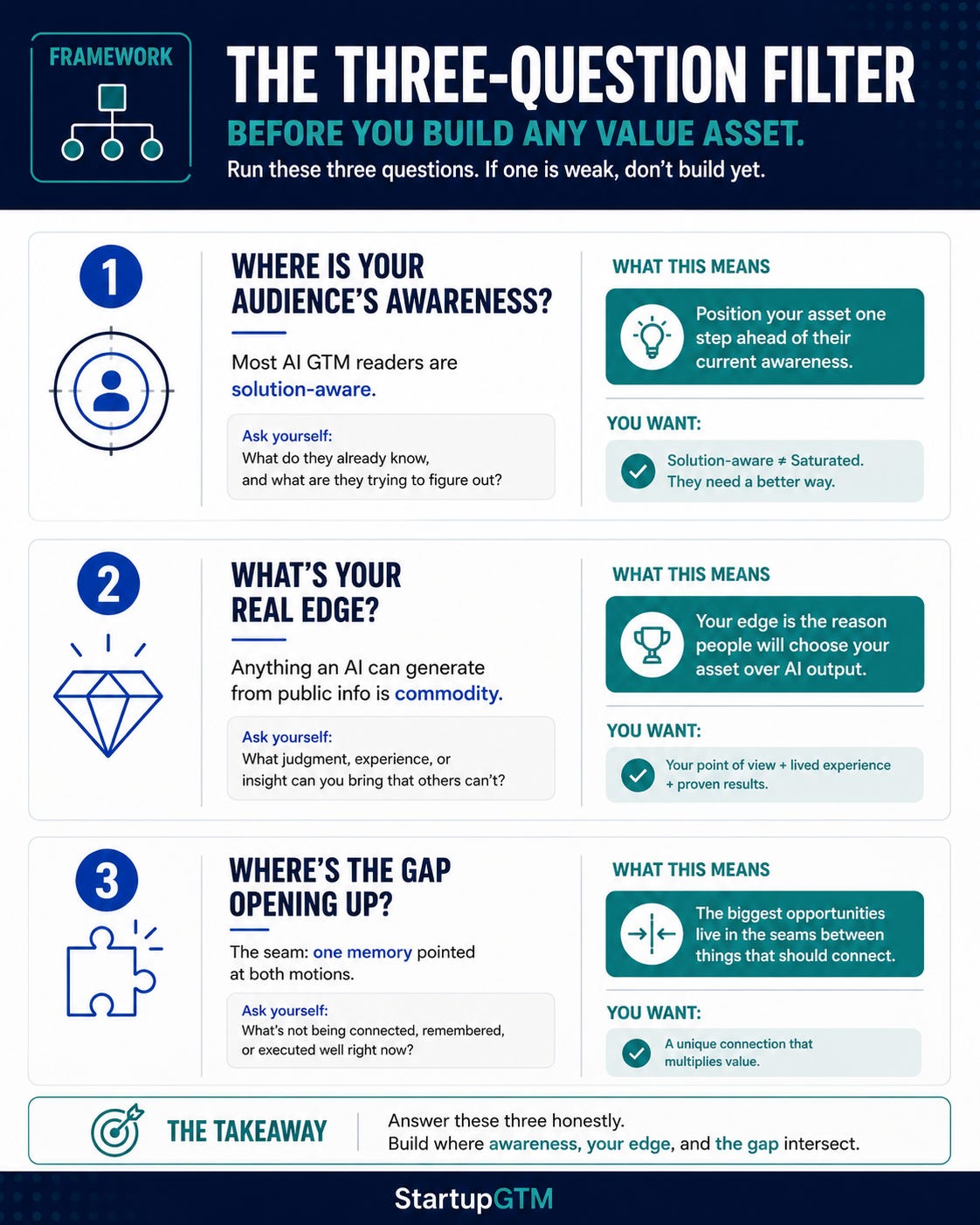
How to think about these assets (awareness, your edge, the gap)
Before you build a value asset, three questions.
First, where is your audience’s awareness?
Most operators reading about AI GTM are solution-aware. They know agents can do the work. They don’t believe the slop, and they’re tired of tool comparisons. So the asset can’t be “10 prompts to try.” It has to teach a system.
Second, what’s your real edge? The asset has to come from something you actually did, know, or believe. Anything an AI can generate from public information is commodity, and commodity assets don’t build trust.
Third, where’s the gap opening up? Example — Right now it’s the seam: almost everyone is sharing their techniques for having inbound or outbound as separate AI projects. Almost nobody focuses on one memory pointed at both.
What nobody is telling you?
To see why your current setup keeps disappointing you, look at how AI GTM actually evolved.
Stage 1, point tools. Apollo, ZoomInfo, an SEO suite. Operated by hand.
Stage 2, workflow glue. Clay, n8n, Zapier wiring tools together. Brittle, because each automation owns a slice and nothing owns the chain.
Stage 3, copilots. AI drafting inside a tool, then forgetting everything between sessions.
Stage 4, autonomous agents. AI SDRs running a whole task alone. The hype peak. It corrected hard.
Stage 5, skills plus memory. The next two stages are where this issue focuses on.
Stage 6, the orchestrated system. Many models, one memory, you set the objective.
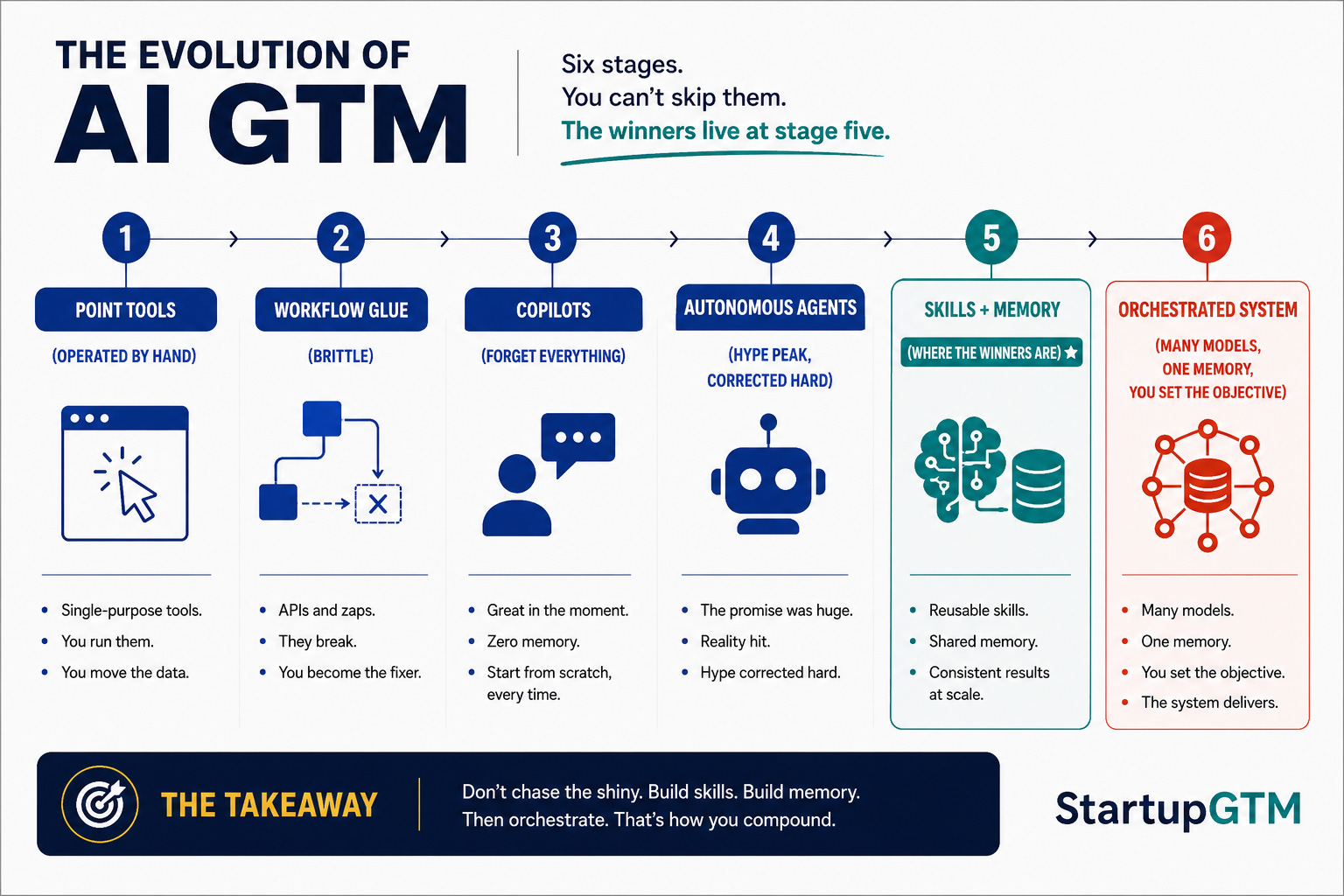
Stage five is where the people who are way ahead of you works: skills plus memory plus second brain.
You encode your judgment as skills and give the agent a memory and second brain that persists.
Anthropic shipped a memory tool and a scheduled pass that curates memory between runs.
Stage six is the orchestrated system, many expert models over one shared memory, you setting the objective and the system executing.
Cargo calls it the GTM control plane: context, then logic, then execution.
The rule — You can’t skip stages.
An agent only works fed by a stable system underneath it.
The AI Accelerator Institute watched an SDR team’s agent perform because it had six months of structured data to reason from; the same agent on an empty data layer at month one would have produced false-positive outputs.
Fewer than one in ten companies has scaled AI in any single function (McKinsey).
Here’s the unpopular version, and I’ll say it plainly:
most AI SDR deployments are architecturally wrong from month one... because it’s running on a foundation that just doesn’t work optimally... and the tool gets blamed for it.
What you’re probably doing wrong
Read this slowly.
You bought an AI SDR and it’s not working.
The pipeline growth has suddenly reduced and there is no way to bring back top SDRs who got fired because of AI SDR.
The cause is deliverability: fifteen hundred near-identical emails a day across aliases trips the bulk-sender rules Google and Yahoo set.
I have seen placement fell from 90% to 60%, replies drop under 1%, and cost per meeting jumped from around 35$ to around 200$.
You’re acting on intent data that’s mostly noise.
About half of companies using intent report too many false positives (Forrester, 2025).
Third-party intent data is just 30-40% matching against real behavior.
I saw in my pricing page visitors — CFO was scored same as Analyst.
Your AI content is invisible in AI search.
Half of online content is machine-generated. Search Engines are excluding non-relevant clickbaity content from appearing in search.
And one based on recent behavior: you collect tools and prompts... not a system.
Every session starts fresh without context. Just having skills isn’t having a system.
None of these are tool problems. You reached for stage four on a stage-two foundation, and the agent did what agents do well. Best probable output based on given input instructions and context.
Note — this system approach isn’t free, and it isn’t for everyone. If you’re pre-revenue and still hunting for who your buyer even is, you don’t need a mastermind yet, you need 10 real conversations.
(Stats above: AI SDR churn and deliverability from LeadGen Economy’s forensics; intent false positives from Forrester 2025)
🎁 Free this week: The Expert GTM Mastermind System.
If your AI GTM setup still resets every week, this is the missing layer: 20 expert models, paste-ready prompts, reusable skills, agent instructions, and a simple orchestrator to make them work together.
Useful if you are trying to fix outbound, content, account research, SEO, inbound, RevOps, or founder-led GTM with AI.
Build, test, and evolve your asset (with prompts to kickstart now)
You don’t need a prerequisite to start. You need one asset, built small, tested, then evolved on a plan.
Build the smallest version first. Take one mental model you trust and write it as a single skill: what it produces, how, when to use it, why it works.
[PROMPT: build-a-skill] Take this mental model: [paste yours, or use "observation-led
cold email"]. First, if you're missing what you need to make this specific to my business
(my ICP, my motion, my stage), ask me up to 3 questions before writing. Then write it as a
runnable skill with four parts: what it produces, the exact step-by-step how, the trigger
for when to use it, and the one-line why it works. Keep it under a page. Then show me one
worked example.
Test it before you trust it. Run the skill against a handful of real cases and watch where it breaks.
[PROMPT: stress-test] Run this skill against these 3 real cases: [paste]. For each, show the
output, then flag where it was generic, wrong, or missing context. Tell me the single change
that would fix the most cases at once.
Evolve it on a plan, not a whim. Decide what the next version needs before you touch it.
[PROMPT: evolve-plan] Here's my skill and its test gaps: [paste]. Propose v2: the 3 changes
that matter most, what each fixes, and what I should deliberately NOT add yet. Give me a
one-line success test for v2.
Power-up: run any of these as a self-critiquing loop, or tell it to interview you first before it writes. The full loop, workflow, meta-prompt, and sub-agent variations ship in the kit.
Value-maxxing across industries, stages, and teams
The same asset bends to many situations if you ask it to. These are the prompts that find the cases.
[PROMPT: cross-industry] Take this asset: [paste]. Show me how it changes for 4 different
contexts: a Series A SaaS, a 5-person agency, a services firm, and a solo operator. For each,
name the one tweak that makes it fit and the outcome it drives.
[PROMPT: by-team] Map this asset to 3 teams: sales, marketing, and founder-led GTM. For each,
what's the job it does, the input it needs, and the metric it should move?
[PROMPT: by-stage] How should this asset differ pre-product-market-fit vs scaling? What do I
cut at each stage, and what do I add?
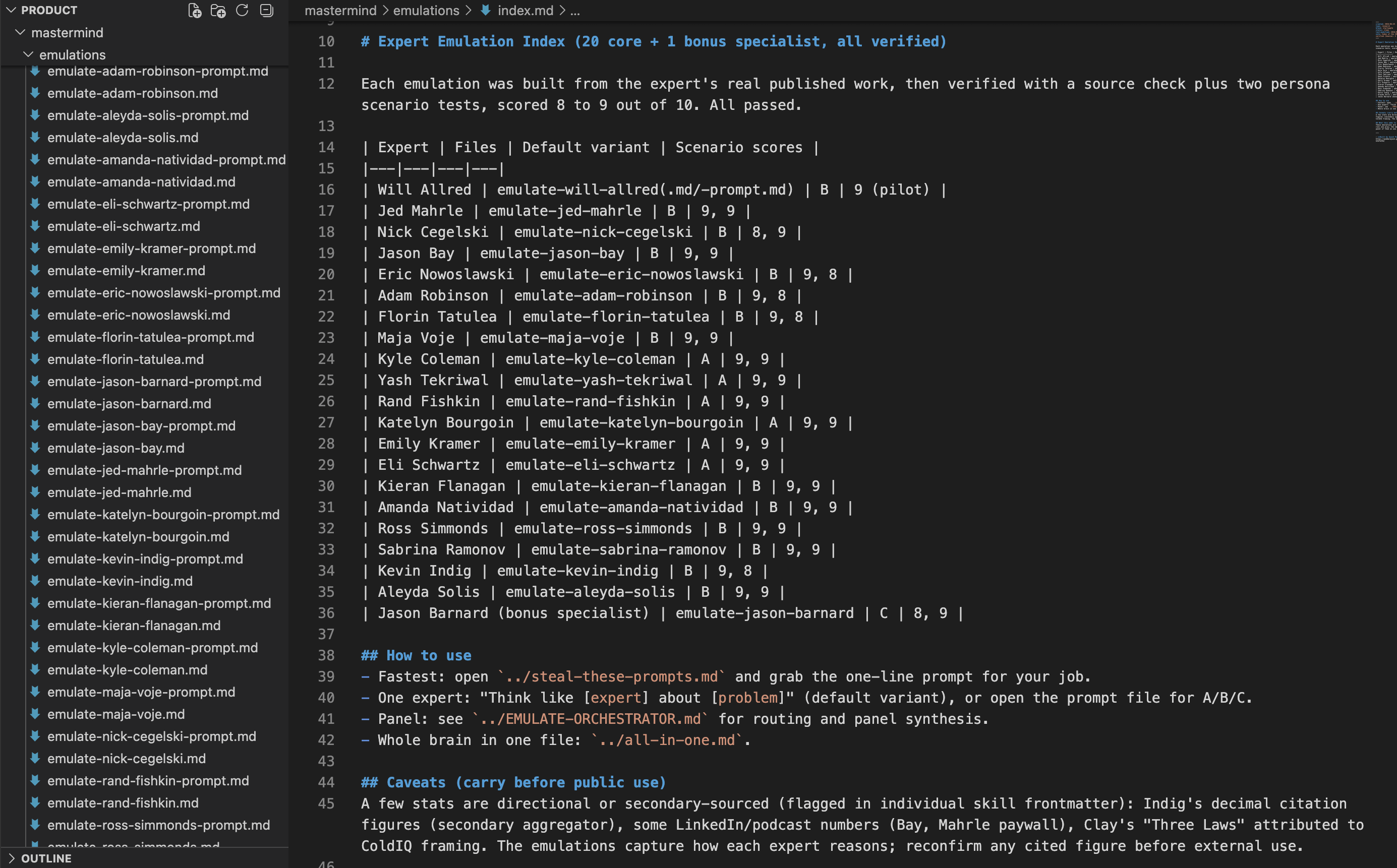
Mastermind from 20 growth experts
Download All Skills / Agent Prompts from Growth Experts
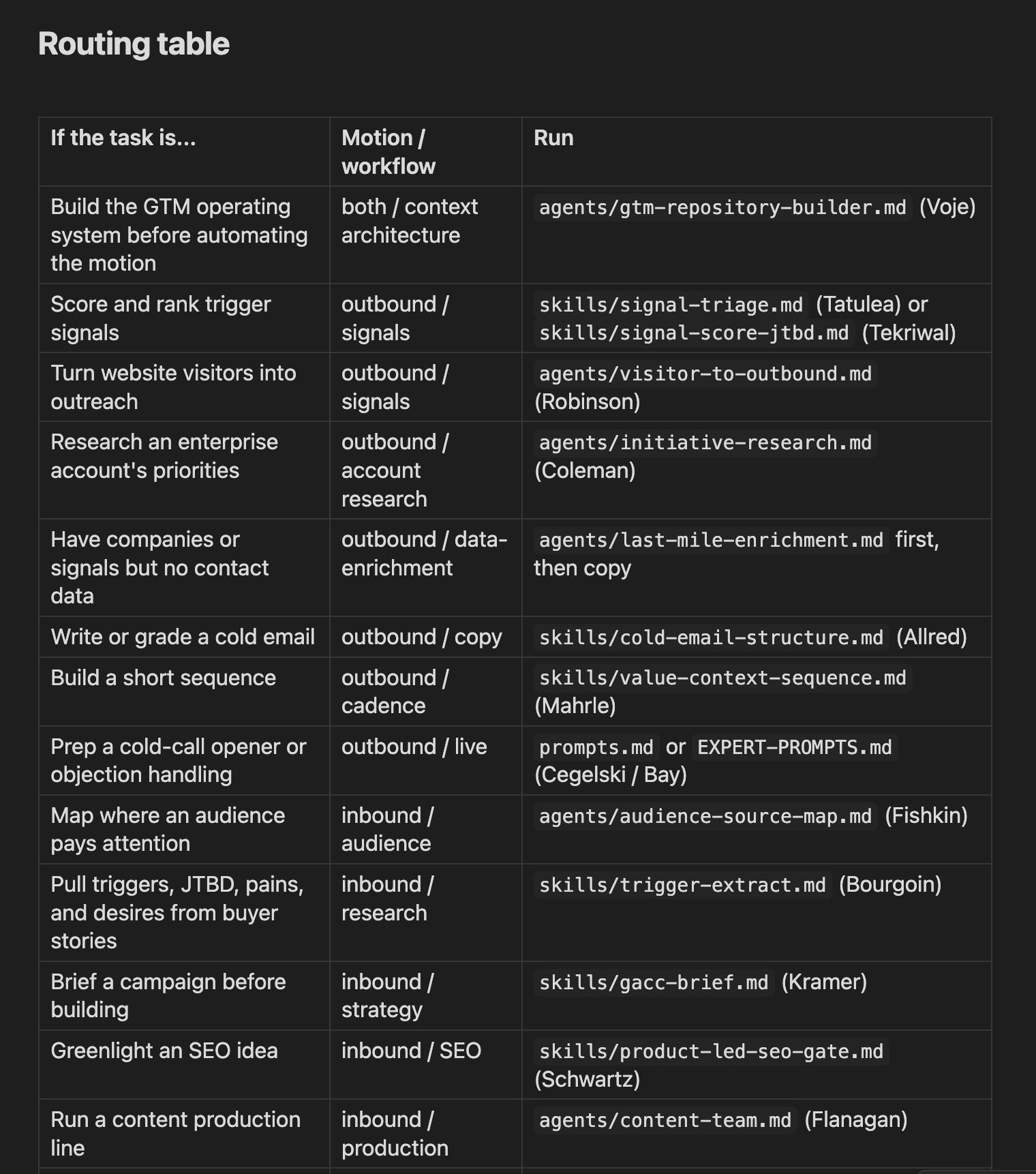
Find the workflow you’re weakest at, and you’ve got several experts’ thinking on it, each already turned into a skill, an agent, or a prompt you can run.
When I rebuilt my own outbound, I didn’t pick one guru and copy them. I took Florin Tatulea’s signal triage, Kyle Coleman’s account research, and Will Allred’s email structure, and ran them as one chain.
That’s the whole reason to hold them as a roster you can compose.
Every expert below has a downloadable “think like them” file in the free pack at the end: their mental models, their decision heuristics, and a paste-ready prompt/skill that loads them into any AI chat or your master AI vault where entire context is present.
So you can literally ask Allred to write the email and Tatulea to score the signal, in their own logic.
OUTBOUND
Outbound breaks into five jobs. Here’s who owns each, and the unit that runs their thinking.
Enrichment and data
Maja Voje — built the GTM operating system layer that gives Claude a persistent brain: repository, context files, signal logic, and weekly maintenance. Build the brain before you automate the motion. →
gtm-repository-builder(AGENT).
Steal this prompt: “Before you automate a motion, show me the exact GTM memory this system will read, update, and learn from. If it restarts from zero next week, it’s not a system yet.”Eric Nowoslawski (Growth Engine X) — runs one of the largest Clay agencies and treats cold email like paid ads: many small, sharp tests. Three pillars: problem-sniff, relevant proof, irresistible offer. →
enrich-to-campaign(AGENT).
Steal this prompt: “Write this cold email with exactly one researched problem, one hyper-relevant proof point, and one irresistible offer. Delete everything that isn’t one of those three.”
Signals and targeting
Florin Tatulea (Common Room) — the clearest voice on why timing beats volume: most of your market isn’t buying, so chase the few who just gave a signal. Signals vs intent. →
signal-triage(SKILL).
Steal this prompt: “Sort these prospects into ‘showing a trigger event this week’ versus ‘just fits the ICP.’ Only the trigger group gets reached today, within 24 hours.”Adam Robinson (RB2B) — pioneered working the people already on your site instead of a cold list. Inbound-led outbound. →
visitor-to-outbound(AGENT).
Steal this prompt: “Start from who already visited or engaged, not a cold list. Reach the warm ones first, and reference what they actually looked at.”Yash Tekriwal (Clay) — the GTM-engineering teacher: turn a signal into a score into a message about the buyer’s job, not your product. Signal to score to JTBD. →
signal-score-jtbd(SKILL).
Steal this prompt: “Take this signal, score how strong a buying indicator it really is, then write the message around the job they’re trying to get done, not my features.”
Account research
Kyle Coleman (ClickUp, ex-Clari) — built the playbook for relevance over personalization: research the priority, not the job title. Show me you know me. →
initiative-research(AGENT).
Steal this prompt: “Research this account’s actual strategic priority this quarter from real sources, then tie my outreach to that priority. Ignore their title.”
Cold email copy
Will Allred (Lavender) — analyzed billions of emails to find what the data says actually gets replies. Logic-based personalization: observation, problem, credibility, solution, CTA. →
cold-email-structure(SKILL).
Steal this prompt: “Open with a specific observation about them, imply the problem it creates, prove I can help in one line, then ask an interest question. Keep it under 50 words.”Jed Mahrle (Practical Prospecting) — cut the bloated cadence down to what works: two email types, four steps. Value and Context emails. →
value-context-sequence(SKILL).
Steal this prompt: “Build a 4-step sequence: two short value emails on different angles, two same-thread bumps that each add one new thing. No 20-step blast.”
Cold calling and live qualification
Nick Cegelski (30MPC) — co-built the most-followed modern cold-call school. Tailored permission opener: context, own the call, ask permission. →
permission-opener(PROMPT).
Steal this prompt: “Open the call by naming a real problem this person likely has, admit it’s a cold call, and ask permission before I pitch anything.”Jason Bay (Outbound Squad) — trains reps on relevance tiers and calm objection handling. Permission plus hierarchy of relevance. →
relevance-tiered-opener(SKILL).
Steal this prompt: “Lead with research framed as a question, not a pitch. For any objection, empathize, validate, then offer. Never argue.”
INBOUND
Inbound splits the same way, from finding the audience that trusts you to getting cited by the AI engines that now answer for them.
Audience and buyer research
Rand Fishkin (SparkToro, founder of Moz) — spent a career proving that traffic is the wrong goal; go where your audience already pays attention. Audience over keywords. →
audience-source-map(AGENT).
Steal this prompt: “Don’t tell me what keywords to target. Tell me where my exact audience already spends attention, and how to be genuinely useful there.”Katelyn Bourgoin (Why We Buy) — the buyer-psychology voice: every purchase starts with a trigger event, so market to that moment. Trigger technique. →
trigger-extract(SKILL).
Steal this prompt: “From these buyer stories, find the trigger event that made them start looking. Write to that exact moment, in their own words, not a generic persona.”
Demand-gen strategy
Emily Kramer (MKT1, built marketing at Asana and Carta) — brief before you build, or you’ll make pretty things nobody needed. GACC brief. →
gacc-brief(SKILL).
Steal this prompt: “Before creating anything, write the goal, the audience, the one unique creative angle, and the channels. If it fails the ‘does this actually add value’ test, don’t make it.”Eli Schwartz (author of Product-Led SEO) — stop chasing keywords; build around what the product solves and the intent behind the search. Product-led SEO. →
product-led-seo-gate(SKILL).
Steal this prompt: “Pressure-test this SEO idea: does it map to what my product actually solves and to real search intent, and will it still drive value in a year? If not, kill it.”
Content production and voice
Kieran Flanagan (HubSpot) — the definitive Claude-for-marketing builder: stop one-off prompting, build a self-improving skill team. Chained skills over shared memory. →
content-team(AGENT).
Steal this prompt: “Don’t write me a one-off prompt. Design a foundation file the AI reads first, then chain skills that read it and get sharper every run.”
Distribution and repurposing
Amanda Natividad (SparkToro) — coined the discipline of giving value without the click. Zero-click content. →
zero-click-rewrite(SKILL).
Steal this prompt: “Rewrite this so the value lands inside the post, no click required. Put the punchline first and reveal all but one item.”Ross Simmonds (Foundation) — the create-once-distribute-forever evangelist: distribution, not creation, is the ROI lever. →
distribute-forever(AGENT).
Steal this prompt: “Don’t make new content. Take this one piece and remix it into ten channel-native versions, then give me a reshare schedule for the next 18 months.”Sabrina Ramonov — vibe marketing: chains of small AI agents replace the agency retainer. →
repurpose-and-microapp(AGENT).
Steal this prompt: “Decompose this job into tasks, then chain small AI agents to run them. Add an adversarial check agent so quality holds before anything ships.”
Answer-engine optimization
Kevin Indig (Growth Memo) — his AI-citation research gave the exact scorecard for whether content gets quoted. Optimize for citation. →
citation-audit(SKILL).
Steal this prompt: “Score this draft on depth, comprehensiveness, and whether it makes a first-party claim an AI couldn’t invent. Front-load that claim so engines quote it.”Aleyda Solis (Orainti) — the international AI-search authority with a concrete readiness roadmap. AI search readiness. →
ai-search-audit(SKILL).
Steal this prompt: “Audit whether AI engines can crawl, understand, and cite this page. Tell me the weakest of those three and fix it first.”
Bench, sourced and swappable: Andy Crestodina (be the best answer), Tom Orbach (one unconventional tactic a week). Every model here traces to the operator’s own published work.
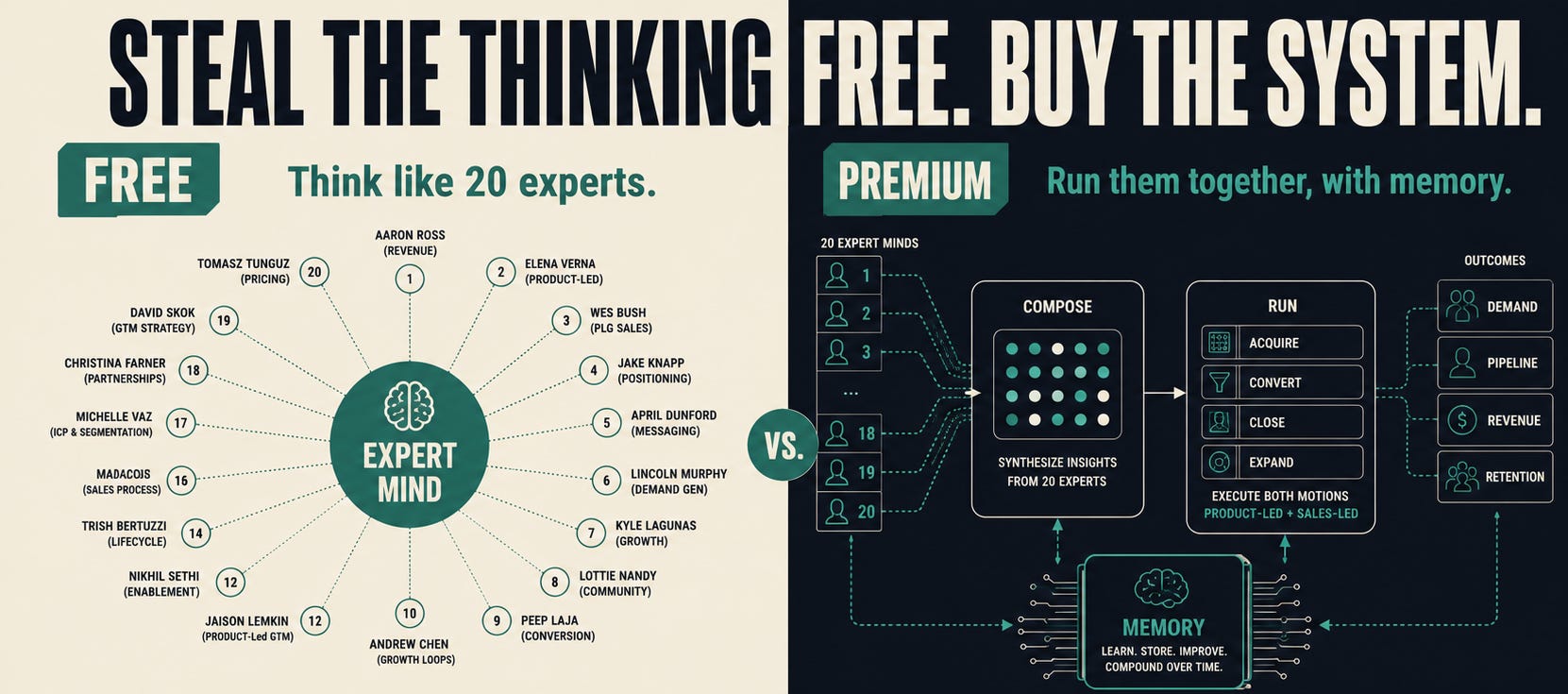
The point isn’t twenty tabs of advice. It’s twenty models in one brain, so when you hit a job, the right one runs without you remembering which guru said what.
🎁 Free this week: The Expert GTM Mastermind System.
The full pack gives you the 20 expert models behind this issue. Each one is turned into a “think like them” file with mental models, decision rules, prompts, and workflow instructions you can run inside your AI.
If you want your AI to think like a growth panel instead of giving generic advice, grab this.
100 reasoning prompts/instructions for your AI or agent to think deeply
Use these inside Claude, ChatGPT, Cowork, Claude Code, or your own GTM vault.
5 mental-model instructions from each of 20 experts ...on diagnosis, strategy, creation, critique, evolution.
1. Maja Voje — build the GTM brain before the motion
1/ “Before we automate this GTM workflow, map the memory it needs. What context should the AI read before every run, what should it update after every run, and what should never reset?”
2/ “Turn this messy GTM process into a repository structure. Give me the folders, files, naming rules, and update rhythm that would let an AI run it repeatedly without re-briefing.”
3/ “Audit this workflow for context debt. Where am I asking the AI to guess because the system has not stored the right customer, market, offer, or campaign memory?”
4/ “Show me the difference between a prompt, a skill, an agent, and a GTM system for this use case. Tell me what I should build first and what I should not build yet.”
5/ “Design the weekly maintenance loop for this GTM brain. What should be reviewed, compressed, archived, promoted to memory, or deleted so the system gets sharper?”
2. Eric Nowoslawski — cold email as small, sharp market tests
1/ “Look at this cold email campaign like a paid ads test. What is the hypothesis, what is the segment, what is the offer, and what would make this test invalid?”
2/ “Rewrite this email around one researched problem, one relevant proof point, and one offer the prospect would find hard to ignore. Delete everything else.”
3/ “Find the hidden objection that would stop this prospect from replying. Then rewrite the offer so that objection is answered before they think it.”
4/ “Turn this campaign into three small tests. Each test should change only one variable: audience, problem, proof, or offer.”
5/ “Score this outbound idea on risk, relevance, proof, and reply potential. Tell me whether to send, revise, or kill it.”
3. Florin Tatulea — signal beats fit
1/ “Separate this list into three groups: real buying signal, weak intent, and ICP-only. Only recommend outreach for the first group.”
2/ “For each signal, tell me what probably changed inside the account, who likely cares, and why this creates urgency now.”
3/ “Rewrite this outbound angle so it references the trigger event, not just the company profile.”
4/ “Audit this signal for false positives. What else could this behavior mean besides buying intent?”
5/ “Build a 24-hour action plan for this signal. Who should we contact, what should we say, and what should we avoid saying?”
4. Adam Robinson — inbound-led outbound
1/ “Start with the people already showing interest. From these visitors, profile views, signups, or content engagers, rank who deserves outbound first.”
2/ “For each warm visitor, infer what they were probably trying to understand based on the page or content they touched.”
3/ “Write a first-touch message that feels like a continuation of their behavior, not a random cold email.”
4/ “Design a follow-up path for website visitors: what gets enriched, what goes to CRM, what goes to sales, and what becomes nurture.”
5/ “Audit this inbound-led outbound motion. Where does it feel helpful, and where does it feel creepy or over-personalized?”
5. Yash Tekriwal — signal to score to JTBD
1/ “Take this signal and score it from 1 to 5 as a buying indicator. Explain what makes it strong, weak, or misleading.”
2/ “Translate this signal into the buyer’s job-to-be-done. What are they trying to accomplish, reduce, avoid, prove, or unlock?”
3/ “Design the Clay-style workflow for this motion: data source, enrichment, scoring logic, message logic, and routing rule.”
4/ “Rewrite this message around the buyer’s job, not our product features.”
5/ “Audit this GTM automation. What is manual but safe to automate, and what is important enough to keep human-reviewed?”
6. Kyle Coleman — account priority over personalization
1/ “Research this account like a seller who needs a real point of view. What are the 1 to 3 strategic priorities that matter right now?”
2/ “Ignore shallow personalization. Tell me what is happening inside this company that would make our offer relevant.”
3/ “Connect the dots between the account’s priority and our value prop. Make the logic specific enough that a senior buyer would not dismiss it.”
4/ “Critique this outreach for fake personalization. What sounds researched but does not actually matter?”
5/ “Turn this account research into a sales-ready POV: what changed, why it matters, where they may be stuck, and why now is a good time to talk.”
7. Will Allred — observation, problem, credibility, CTA
1/ “Write this email using four moves: specific observation, related problem, one-line credibility, and a soft interest question.”
2/ “Cut this email under 50 words without losing the logic.”
3/ “Check whether the observation actually connects to the problem. If it does not, rewrite it.”
4/ “Replace the meeting ask with a conversation-starting CTA.”
5/ “Score this email for clarity, relevance, length, and reply friction. Then rewrite the weakest part.”
8. Jed Mahrle — value and context emails
1/ “Turn this outbound idea into a four-step sequence: two value emails and two same-thread bumps.”
2/ “Write one value email that teaches something useful even if the prospect never books a call.”
3/ “Write one context email that ties our offer to a specific company event, role pressure, or market change.”
4/ “Audit this sequence for bloat. Remove any step that does not add a new angle.”
5/ “Give me two follow-up bumps that add value instead of saying ‘just checking in.’”
9. Nick Cegelski — tailored permission opener
1/ “Write a cold call opener that answers three questions fast: who is calling, why this person, and how long this will take.”
2/ “Add context to this opener so it does not sound like a generic permission-based opener.”
3/ “Rewrite this opener to own the interruption without sounding apologetic.”
4/ “Build the next 30 seconds after the opener: problem proposition, proof, and permission to continue.”
5/ “Critique this cold call script for the first seven seconds. Where would the prospect mentally hang up?”
10. Jason Bay — relevance and calm objection handling
1/ “Write a cold call opener that starts with a relevant observation framed as a question, not a pitch.”
2/ “Create three relevance tiers for this account: company-level, persona-level, and trigger-level.”
3/ “For each objection, respond with empathy, validation, and a clean next offer. Do not argue.”
4/ “Rewrite this call flow so the seller sounds calm, specific, and useful.”
5/ “Audit this script for salesy energy. Remove anything that creates resistance before curiosity.”
11. Rand Fishkin — audience over traffic
1/ “Do not start with keywords. Tell me where this exact audience already pays attention, who they trust, and what they already consume.”
2/ “Map this audience by sources of influence: podcasts, newsletters, communities, creators, search terms, events, and tools.”
3/ “Tell me which channel is most likely to create trust, not just traffic.”
4/ “Audit this strategy for vanity metrics. What are we measuring because it is easy, not because it proves demand?”
5/ “Design a zero-click-aware audience plan. How do we win even if fewer people click through to our site?”
12. Katelyn Bourgoin — trigger technique
1/ “From these customer stories, extract the trigger event that made the buyer start looking.”
2/ “Separate the buyer’s trigger, job-to-be-done, pain with old solutions, and selfish desire.”
3/ “Rewrite this campaign so it speaks to the moment the buyer starts caring, not the persona on a slide.”
4/ “Find the customer’s own language in these notes and use it to rewrite the headline.”
5/ “Audit this message for invented pain. What are we assuming that the buyer never actually said?”
13. Emily Kramer — GACC brief before creation
1/ “Before making anything, write the GACC brief: goal, audience, creative angle, and channels.”
2/ “Tell me whether this campaign has a real unique take or just a topic.”
3/ “Pressure-test this idea against the goal. If it does not move the goal, tell me what to cut.”
4/ “Rewrite this brief so the audience, channel, and creative angle fit together.”
5/ “Turn this rough idea into a campaign brief that a designer, writer, and founder could all execute without confusion.”
14. Eli Schwartz — product-led SEO
1/ “Evaluate this SEO idea from first principles. Does it map to what the product actually solves?”
2/ “Separate search volume from business value. Which topics can create revenue, not just traffic?”
3/ “Tell me the intent behind this query and whether our product has a natural right to answer it.”
4/ “Kill or keep these SEO topics. For each one, explain whether it supports product discovery, education, comparison, or conversion.”
5/ “Rewrite this content plan so it is product-led, not keyword-led.”
15. Kieran Flanagan — chained skills over one-off prompting
1/ “Do not give me a one-off prompt. Design the foundation file this AI should read before doing the work.”
2/ “Break this marketing workflow into chained skills. What does each skill read, produce, verify, and pass forward?”
3/ “Turn this expert article into a reusable Claude skill with trigger, steps, rules, and output format.”
4/ “Add memory to this workflow. What should the system learn after each run?”
5/ “Critique this AI workflow. Where is it pretending to be a system but actually resetting every time?”
16. Amanda Natividad — zero-click content
1/ “Rewrite this so the value lands inside the post. The reader should benefit even if they never click.”
2/ “Put the punchline first. Then give enough detail to make the post useful on-platform.”
3/ “Turn this article into a zero-click LinkedIn post, a short thread, and an email intro. Keep each native to the channel.”
4/ “Audit this post for clickbait. What promise does it make that the post itself does not fulfill?”
5/ “Create a version that gives away 80 percent of the value and makes the click feel like a bonus, not a requirement.”
17. Ross Simmonds — create once, distribute forever
1/ “Take this one asset and turn it into ten channel-native pieces without repeating the same format.”
2/ “Build a distribution plan before creating more content. Where should this go, when should it resurface, and who should see it?”
3/ “Find the evergreen parts of this asset that can be reused for the next 18 months.”
4/ “Rewrite this content for five formats: LinkedIn post, newsletter section, carousel, founder thread, and sales enablement note.”
5/ “Audit our content library. Which assets are under-distributed, and what new lives can they have?”
18. Sabrina Ramonov — repurpose plus micro-app
1/ “Decompose this content idea into a workflow of small AI agents: research, write, adapt, design, publish, and check.”
2/ “Turn this idea into a simple interactive lead magnet: quiz, calculator, checklist, teardown, or scorecard.”
3/ “Show me the smallest vibe-coded app that would make this insight useful immediately.”
4/ “Repurpose this one high-quality idea across eight platforms while keeping the same voice.”
5/ “Add an adversarial check agent before publishing. What would make this output wrong, generic, off-brand, or not useful?”
19. Kevin Indig — optimize for citation
1/ “Score this content for AI citation potential: depth, focus, originality, first-party data, and answer clarity.”
2/ “Find the claim in this draft that an AI engine would be most likely to quote.”
3/ “Rewrite the intro so the strongest first-party insight appears early.”
4/ “Compare this page against the likely consensus answer. What do we add that is meaningfully better or more specific?”
5/ “Audit this content for citation weakness. Is it too thin, too generic, too broad, or missing evidence?”
20. Aleyda Solis — AI search readiness
1/ “Audit this page for AI search readiness: can engines crawl it, understand it, trust it, and cite it?”
2/ “Tell me the weakest layer first: technical accessibility, content clarity, entity signals, structured data, or authority.”
3/ “Rewrite this page section so an AI answer engine can extract the answer cleanly.”
4/ “Create an AI search checklist for this content before publishing.”
5/ “Compare this page to the questions buyers ask in AI tools. What should we add, simplify, or structure differently?”
The part that makes it a system: club any experts into one workflow
These above are for direct use.
What’s 100x? A system built on these actually composes the output you desire...as growth experts panel.
We pulled roughly two hundred atomic units from these experts’ real articles, then tagged each one by type: a mental model, a scenario, a service, an agent, a prompt, or a skill.
Will Allred’s email structure is a skill. Florin Tatulea’s signal-versus-intent is a mental model. Adam Robinson’s visitor play is an agent.
On top sits an orchestrator cum composer. You name a goal, and it clubs the right units across experts into one workflow.
Say the goal is “book demos with Series A SaaS that just raised.” The composer assembles it: Tatulea triages the funding signal, Clay enriches, Coleman researches what the raise is actually for, Allred writes the email, Mahrle sequences it, and a reply step routes the replies back into memory.
Six experts, one workflow, built on demand.
Flip to inbound and it pulls a different set: Fishkin finds where your audience trusts, Bourgoin gives you their language, Kramer briefs it, Indig checks it’ll get cited, Barnard fixes how AI describes your brand.
And it grows itself. Point Kieran Flanagan’s expert-content-to-skill move at any new article, and it mints a new unit into the library. The system gets bigger every time you read something good.
That’s the whole idea. Twenty experts as panel and a machine that builds you the workflow you need from whichever ones fit.
Who this is for, and what you’ll walk away with
If you’re a founder running your own GTM, this gives you a growth panel you can call before every decision. Instead of asking one AI for generic advice, you can have Coleman research the account, Allred shape the email, Tatulea check the signal, Kramer brief the campaign, and Indig pressure-test the content. You stop re-briefing from scratch and start working from one GTM brain that remembers.
If you’re a growth or RevOps lead, this gives your inbound and outbound the same source of truth. The same memory that captures objections from sales can feed content ideas, landing-page angles, nurture emails, and account plays. Instead of two motions fighting in two tools, the 20 expert models help both sides learn from the same signals.
If you’re a solo operator, this gives you the leverage of a small GTM team without hiring one. You can use one expert to find the audience, another to shape the offer, another to write the message, another to build the sequence, and another to critique before anything ships. It does not replace judgment. It gives your judgment more range.
If you’re a GTM engineer, this gives you reusable logic, not another pile of automations. Each expert becomes a skill, prompt, agent, or decision rule inside the system. That means your workflows are not just moving data from one tool to another. They are running encoded GTM judgment at each step.
The real output is not 20 experts in a folder. It is one brain that knows which expert to call, which motion to run, and what to learn from the result.
Reasoning prompts to use in any AI chat
Drop these into any conversation with Claude or ChatGPT. They pull the thesis into your daily work.
“Before you answer, tell me what you’d need to know to be right instead of plausible. Ask me that first.”
“Argue the opposite of your last answer. If the opposite is stronger, switch.”
“What would a skeptical buyer say to this? Rewrite it so it survives them.”
“Strip this to first principles. What’s actually true here versus inherited from how everyone does it?”
Nuggets: for your agent, ask this next
Small moves that turn a chat into a system. Drop them in where they fit.
For your agent (build context from history): “Read this whole chat and these call transcripts: [paste]. Build a context brief on this account. Then ask me 10 hard questions about the deal, each with a rebuttal, a devil’s-advocate take, a first-principles angle, and the customer’s own voice.”
For your agent (pull from memory): “Pull everything you already hold from our past conversations and memory about this customer and motion. Show me what you know, flag what’s stale, and tell me the one thing you’re missing.”
For your agent (mental model on tap): “From today on, before any GTM task, name the one expert mental model that fits it and run that, not a generic answer.”
The value vault (take these with you) {#the-value-vault}
Three assets pulled from the kit, ready to use. Each one tells you what it is, why it helps, who it’s for, an example, and the prompt to make your own.
1. The AI GTM maturity checklist.
What: a 6-line self-check, one per stage, to place your motion. Why: you can’t fix the stage you can’t see. Who: any operator unsure where they’re stuck. Example: “Stage 4 if you run an AI SDR but it has no memory of past replies.” Adapt it:
“Turn the 6-stage AI GTM arc into a 1-line yes/no checklist I can score myself on in 60 seconds. Add a one-line ‘what to do next’ per stage.”
2. The deliverability guardrail.
What: the rule that keeps outbound from dying. Why: most AI SDR failures are deliverability, not copy. Who: anyone scaling sends. Example: “Agent owns research, scoring, copy, routing. The sending platform owns the send. Never bulk-send across aliases.” Adapt it:
“Audit my outbound setup against deliverability best practice. Flag anything that risks sender reputation, and give me the safe version of each.”
3. The seam worksheet.
What: the loop that makes both motions feed each other. Why: it’s the moat nobody builds. Who: teams running inbound and outbound separately. Example: “This week’s top outbound objection becomes next week’s landing-page section.” Adapt it:
“Look at my last 10 outbound replies and my last 5 content pieces. Tell me one inbound angle each objection should become, and one outbound opener each content POV should become.”
The free pack: think like all 20 experts
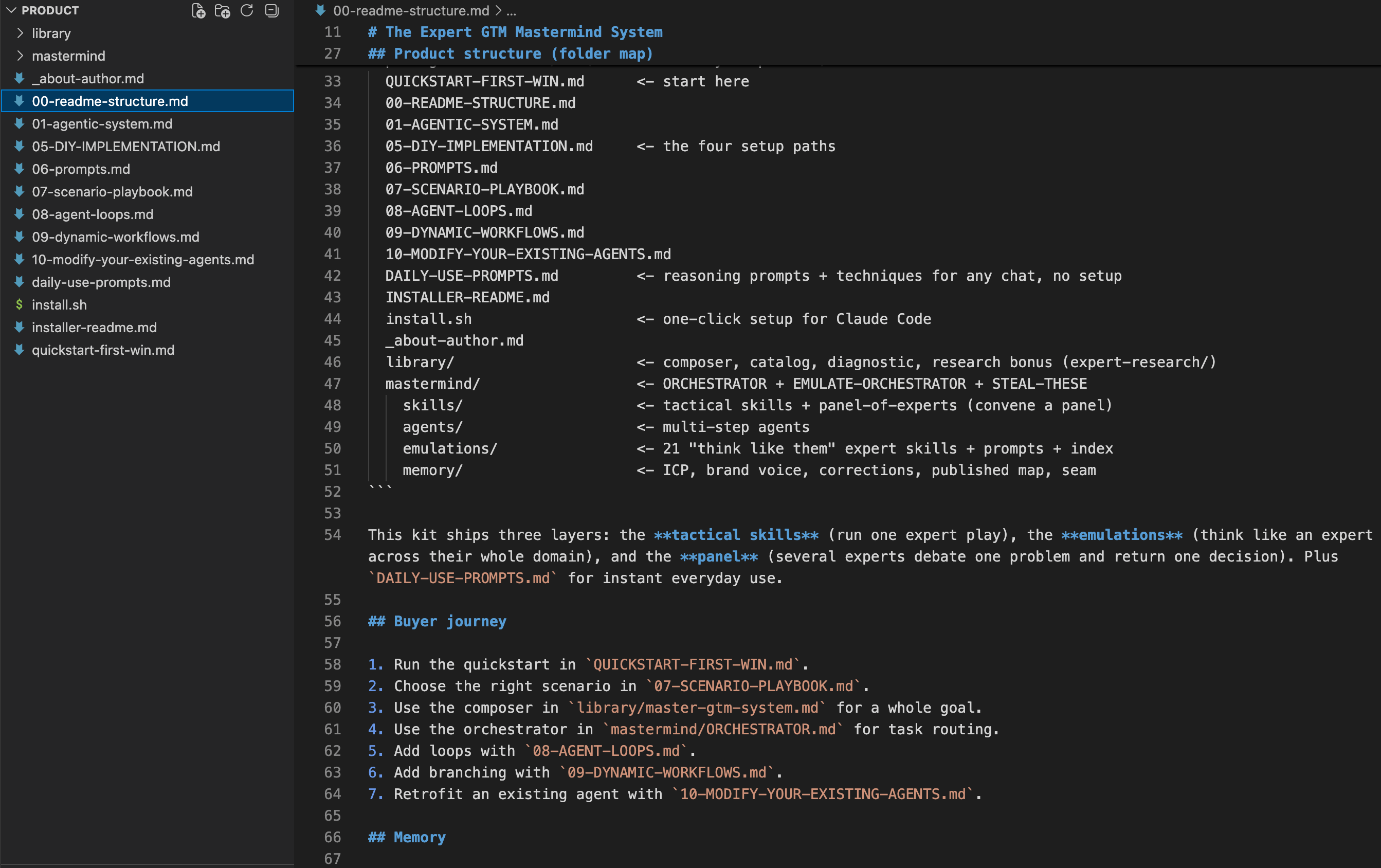
The whole roster is free to download. The Growth Mastermind Emulation Pack is every expert above as a “think like them” file: their full mental models, their decision heuristics, their voice, and a paste-ready prompt that loads them into any AI. Plus one orchestrator that routes your problem to the right expert, or convenes a panel of them to debate it and hand you one call.
What’s inside:
21 emulation skills, one per expert, each with their identity and voice, their full set of sourced mental models, their growth philosophy, their decision heuristics, their do’s and don’ts, a step-by-step in-character reasoning procedure, and a worked example.
21 paste-ready prompts, three modes each: fast (persona plus principles), thorough (a step procedure for a novel problem), and critique (load the expert to tear apart your existing work before you ship it).
The orchestrator, which reads your problem and loads the right expert, or convenes a panel of four to debate it and give you one decision.
An all-in-one file, the whole brain in a single document you can drop into a Claude Project as knowledge.
A start-here guide and the source links behind every model, so you can check the thinking.
Three ways to run it: paste a prompt into any chat, mount the folder in Cowork or Claude Code, or drop the all-in-one file into a Claude Project. No setup tax, no prerequisite.
Grab it in exchange for one thing: refer one friend who’d use it, or mention it once on social. Front-loaded value, both directions.
Free Growth Mastermind Emulation Pack — think like 20 core growth experts plus one bonus specialist, one orchestrator, paste-ready. Send to a friend or post once, and it’s yours. [download]
Or let’s build yours together
If you’d rather not assemble it alone, book a working session and we’ll map your two motions, pick the three expert models that fit your situation, and stand up the first one live.
Book a 30-minute build session — we’ll wire your first expert skill to your real GTM.
Loved this post?
And subscribe to “Agents Prompts Daily Newsletter” as well…
More from me: My Brevv Agents library
The stack above handles memory. These agents handle the work that runs on top of it. Each one is hosted on Brevv, free to run, built for B2B operators who like to think out loud before they ship.
B2B Demand Gen and the 4C trust framework
Trust is the real conversion gate in B2B. These 8 prompts find the gap, name it, and turn it into a calendar you can ship from.
Copy and content
When the asset is the bottleneck, not the strategy.
Comment Engine (each one ships with a walkthrough video)
Comments still pull more qualified pipeline than most posts. These five run my full comment workflow end to end.
Solo and newsletter
If you’re not a subscriber, here’s what you missed earlier:
Agents, Skills, Tool kits, Prompt packs - How to grow an audience with AI lead magnets
The CXO Newsletter Playbook: Why 95% Fail (And the 5-Prompt Strategy System)- Part 1 of 2
Reddit Problem Mining Prompt System: 0→1 Validation in Hours Not Months
The Founder’s Story Bank OS: 52 Repeatable Narratives for GTM, Leadership, Product & Hiring
Your Plan Will Fail - Unless You Invert These 18 Hidden Assumptions (Master Prompt Included)
Subscribe to get access to the latest marketing, strategy and go-to-market techniques . Follow me on Linkedin and Twitter.

The "founder doing their own GTM who keeps re-explaining context to AI every week" line is uncomfortably specific. Worth flagging one risk though: codifying mental models into reusable prompts is powerful, but it can also fossilize a playbook right when the market conditions that made it work have shifted. Worth revisiting the underlying models on a cadence, not just the prompts.