


“In March I followed up with a founder four times over six weeks. I sent two emails, messages - one with my newsletter and one with a follow up. I got no response. In April I left one comment on his post about churn. He replied that afternoon. We were on a call the following Tuesday.”
Sponsored by Sliq, the AI agent that runs outbound motions other tools can’t. Including the one in this issue.
It watches your prospect list, flags when they post, and drafts comments in your voice.

Look at what your sales process asks people to do.
Accept my connection request.
Reply to my message.
Book a call.
Review the proposal.
Check with your team.
Let me know if this is still a priority.
Every one of those asks for their time, their attention and their political capital....and we wonder why there is no response.
I stole the solution from journalists. A good reporter doesn’t build a source list by asking for quotes.
They nurture the source and keep sending them things.
-- An article worth reading.
-- An info about micro and macro movements that would impact them.
These are months of value creation... and then they get what they are looking for.
We do the opposite in sales. We open with the ask. Then we keep asking until people stop replying.
Commenting on your prospects’ posts is the only touch I’ve found that invests and adds value.
-- Sometimes it’s a casual comment on a milestone post.
-- Sometimes it’s a real insight on their arguments.
I’m not telling you to stop following up. I’m telling you this is what makes your follow-up work.
WHY COMMENTING WORKS
Commenting lets you stay visible. You get free reach into a network of people just like your buyer... as your prospect’s connections look like your prospect.
One comment does two jobs.
-- It’s a direct touchpoint with your prospects.
-- It’s also a distribution to many more similar prospects
Nothing else in outbound gives you both.
WHY YOUR COMMENTING ISN’T WORKING
Ask a founder if commenting works. They’ll say yes.
And ask who they commented on last week -- they will probably say “I don’t have time”
That’s the whole problem.
Most of us build the list from people who post a lot .... because of outreach volume and they are easy to find.
There’s always something to react to. Sometimes they reply and it feels like activity and progress.
But almost none of them are buying anything from you.
Your list has to come from buying pressure, not posting frequency.
-- Who has a contract expiring.
-- Who just raised.
-- Who got promoted.
-- Who has open roles.
My list is 58 people. 32 of them posted last month. 12 turned into conversations.
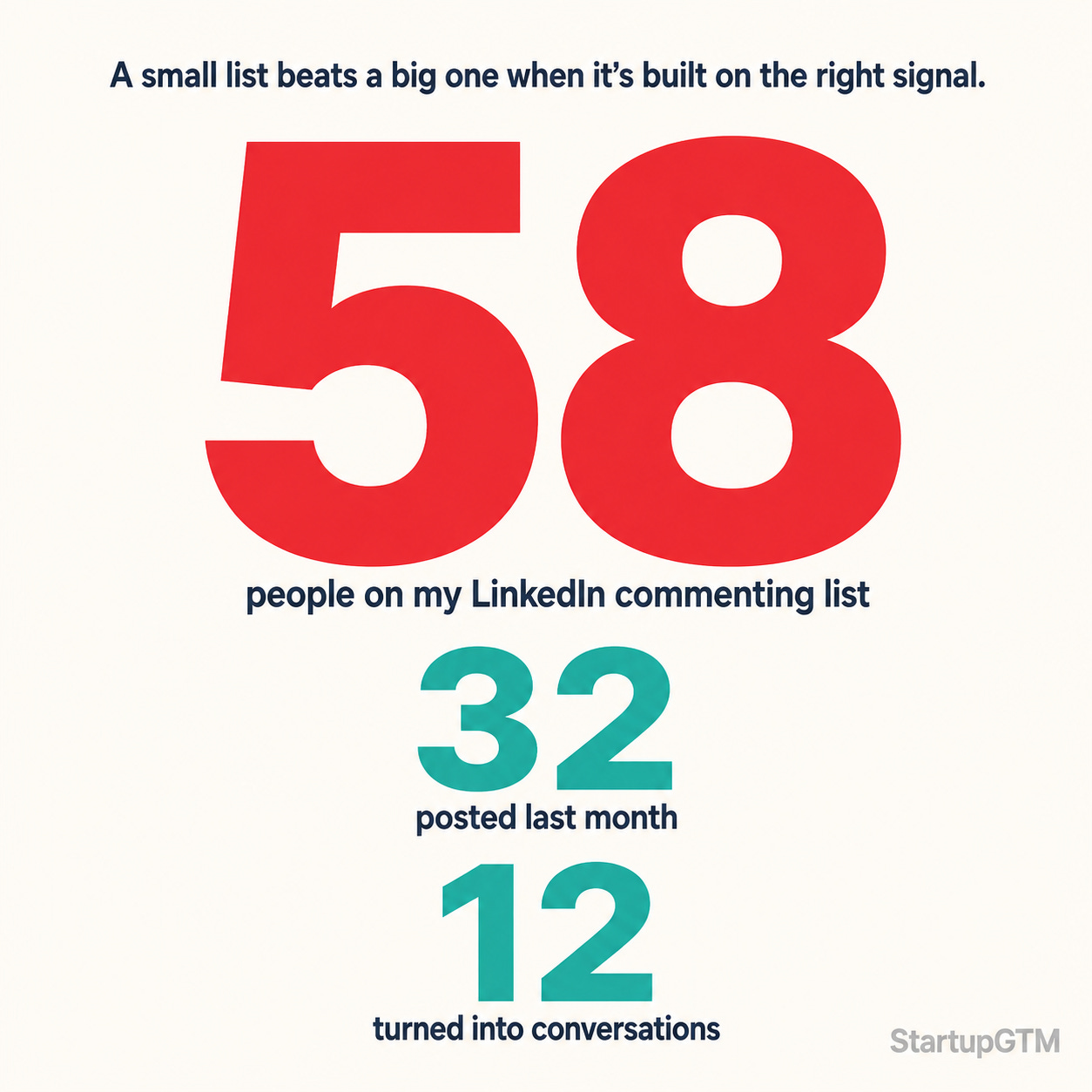
If your commenting activity keeps you busy, you possibly have built the wrong list.
THE COMMENTING SYSTEM
Step 1. Build a list of 30 to 50 people who matter right now
Accounts you’re about to go after
Deals you have moving
Deals that stalled for a reason
Champions who left for somewhere new
Fifty is my ceiling... beyond that it becomes difficult.
Run this PROMPT to build yours:
You’re helping me build a commenting list for LinkedIn.
My closed-won accounts from the last 12 months: [PASTE]
My current open pipeline: [PASTE]
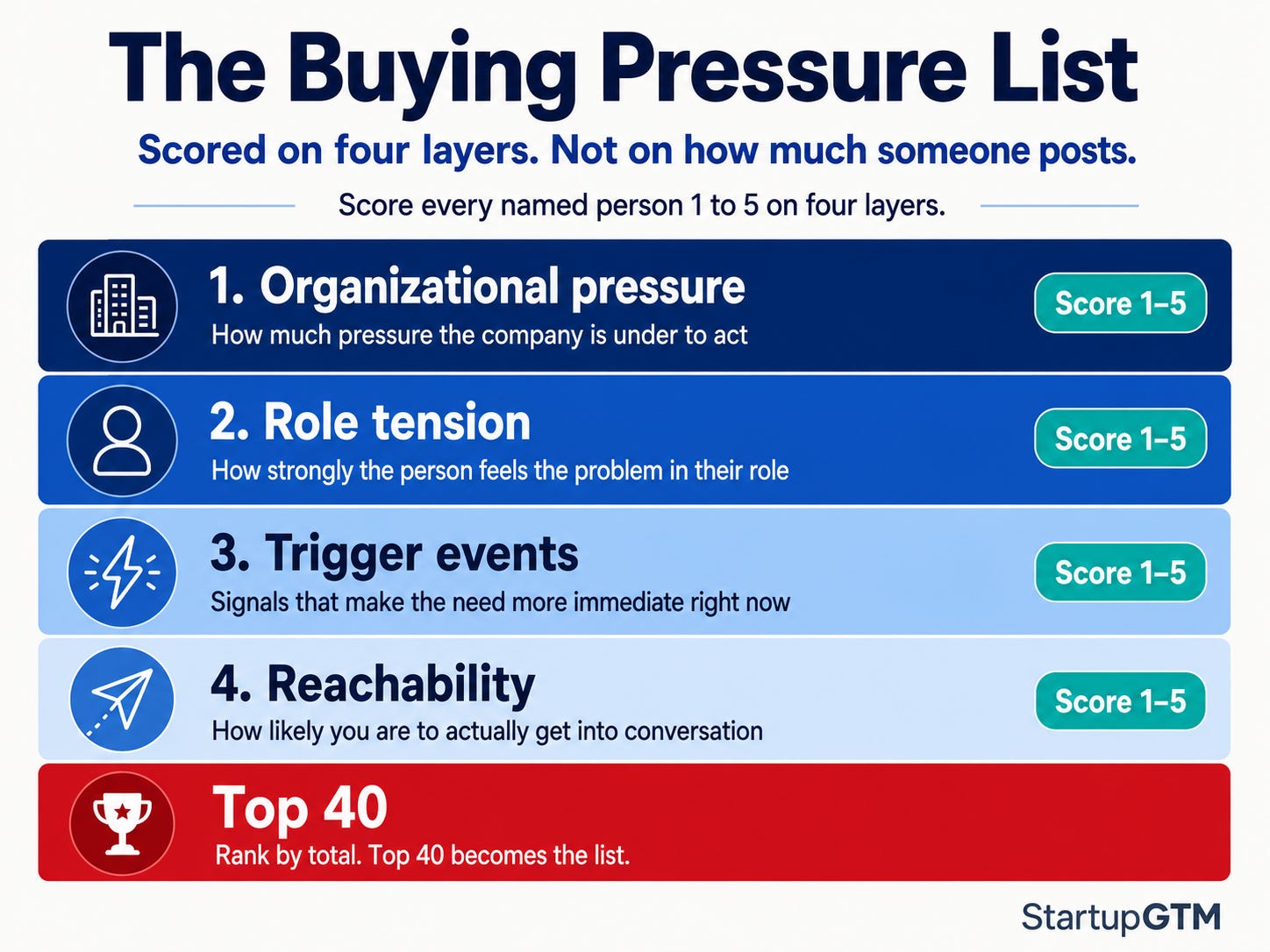
Rank every named person by BUYING PRESSURE, not by how much they post.
Score each one on four layers, 1-5:
1. Organizational pressure. Is there a number, a deadline, or a
contract clock forcing a decision in the next two quarters?
2. Role tension. Does this problem sit on their desk personally,
or can they hand it to someone else?
3. Trigger events. Funding, new role, key departure, reorg,
renewal window, public commitment to a metric.
4. Reachability. Do I have a real reason to be in their world,
or would I be a stranger with an opinion?
Give me the top 40 as a table: name, company, total score, the single
sharpest trigger, and one line on what they’re under pressure to fix.
Then tell me which 5 I’d have written off but shouldn’t, and why.
Export it to a CSV. That’s your list.
Step 2. Get a feed of just those people
LinkedIn won’t do this for you. The feed shows you whatever keeps you on the feed.
You can turn on the bell icon for each profile. It works... but it’s tedious. Or you can run a tool like Sliq that watches the list for you.
Either way, you want their posts without wasting time scrolling through your feed
Step 3. Teach it your voice before you let it draft anything
This is the step everyone skips. It’s why most automated commenting reads like AI Slop.
Below are 15 comments I’ve written on LinkedIn. [PASTE]
Reverse-engineer how I write. I want a spec I can hand to a drafting
tool so its output sounds like me.
Cover:
- Average length, and where I break lines
- How I open. Agreement, a number, a story, a challenge?
- Sentence rhythm. Fragments or full sentences? Where do I go short?
- Capitalization and punctuation habits, including the sloppy ones
- Words I use often. Words I clearly never use.
- How I disagree without being a jerk about it
- How I close. Question, statement, or nothing?
Then write 3 sample comments in my voice on this post: [PASTE A POST]
Flag anything in my writing that’s a tic worth killing rather than
a habit worth keeping.
Step 4. Match your comment to the kind of post
There are two kinds. Most of us use the wrong response for each.
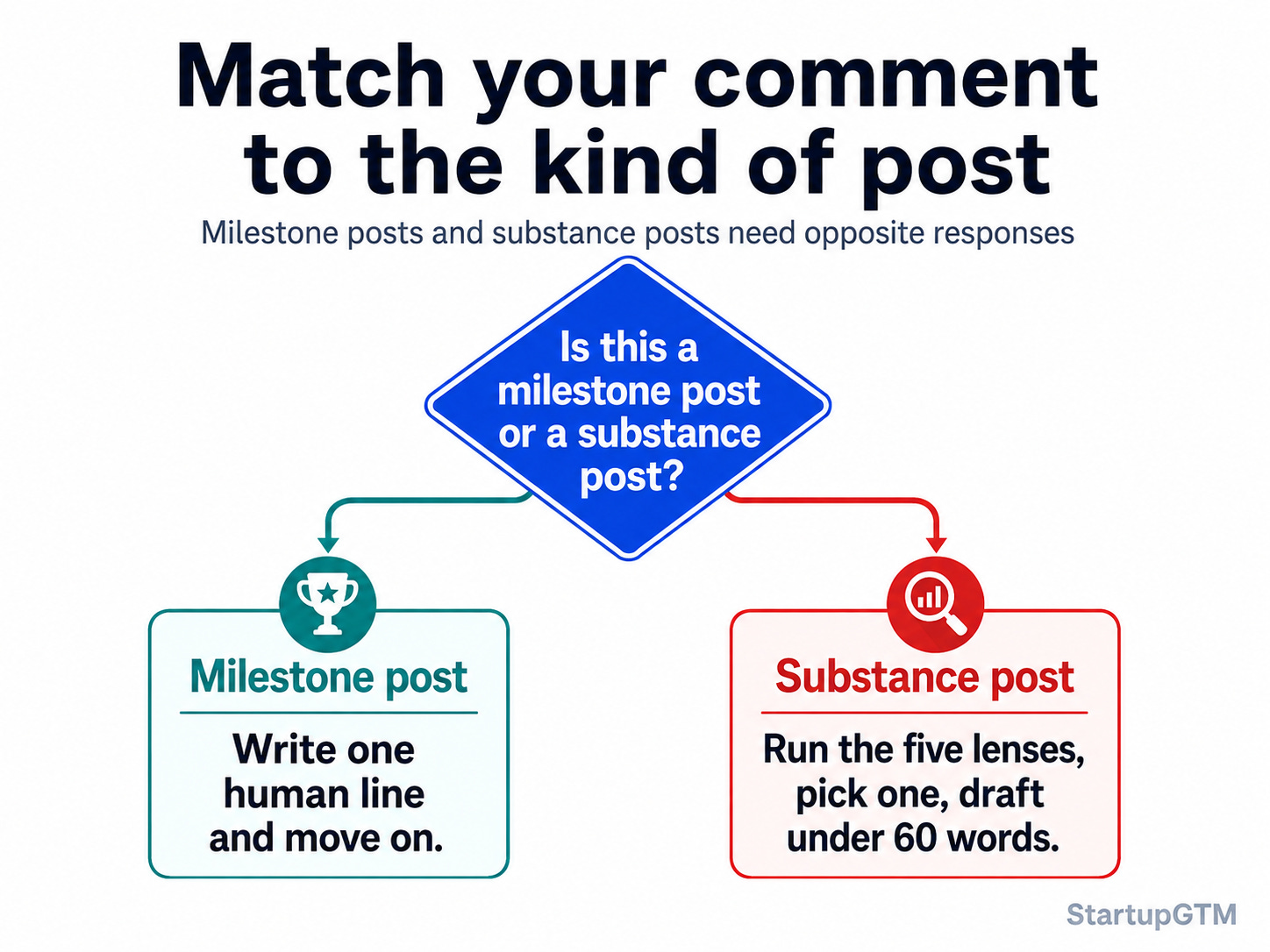
Milestone posts. Promotion, launch, funding, award. Just be a person. “congrats, this is huge” is a complete and correct comment.
Don’t force an insight. Nobody has ever been impressed by the guy who comments on a job announcement post with a hiring tactic.
Substance posts. Opinion, lesson, tactic, teardown. Now you add something.
Don’t do this:
Great post. Completely agree.
Do something closer to this:
You’re right about the system... where most folks are stuck is they’ve got the tactic (feed, 15 mins, value-add comments), but they skip the real work of building actual context on each account.
Context isn’t just “I know their company.” It’s “I know what pressure they’re under and what they’re trying to solve.”.
Formats that work:
A concrete example that backs their point
A real counterpoint, but only if you actually disagree
A distinction they didn’t make
Numbers from your own work
A question that opens the conversation
Keep it to three-four sentences. Nobody reads a comment longer than the post.
FIVE COMMENTING ANGLES FOR WHEN YOU HAVE NOTHING TO SAY
Finding the post is easy. Having something to say that the other commenters don’t is the hard part.
I run every substance post through five lenses. Usually one of them gets more impressions and responses.
1. Inversion. Don’t ask what’s right about their point. Ask what would have to be true for the opposite to work.
2. The behavior gap. They wrote what people should do. You comment on what people actually do. “Everyone agrees with this.... but nobody’s calendar reflects it. For me, it didn’t either until I blocked it.”
3. Cross-industry theft. Same pattern but from a different industry or field. This is the best comment you can leave, because it’s the one they can’t get from anyone else in their industry.
4. Time machine. Where does their point break in eighteen months? What specific pressure breaks it?
5. Uncomfortable truth. The thing their post got close to and stepped around. Use this one carefully. It works when you’re right. It costs you the relationship when you’re showing off.
Run all five at once:
The post: [PASTE]
Who wrote it and why they matter to me: [PASTE]
STEP 1. Classify it. MILESTONE (promotion, launch, funding, award) or
SUBSTANCE (opinion, lesson, tactic, analysis)?
If MILESTONE, stop. Tell me to write one human line and move on.
STEP 2. Run five lenses. Tell me which two actually open here and
which three don’t fit. Don’t force all five.
INVERSION. What would have to be true for the opposite to work?
BEHAVIOR GAP. They wrote what people should do. What do people
actually do?
CROSS-INDUSTRY. Same pattern in a field they don’t work in.
TIME MACHINE. Where does this break in 18 months, and why?
UNCOMFORTABLE TRUTH. What did they get close to and step around?
STEP 3. Recommend one. Tell me why the other is weaker here.
STEP 4. Draft it. Under 60 words. Three sentences max. Specific over
general. No “great post.” No hedging. Contractions where they fit.
It should read like I typed it fast.
STEP 5. Be honest with me. Would the author be glad I commented, or
would they scroll past? If they’d scroll past, say so and try the
other angle.
If someone who only skimmed the headline could have written your comment, delete it.
TWO COMMENTING PROMPTS FOR YOUR WORK
When a stalled deal wakes up:
A deal went cold and something just changed.
My last exchange with them: [PASTE]
Why it stalled: [PASTE]
What changed: [PASTE. Funding, contract window, role change, a post
they just wrote, a competitor move]
Write the reconnect.
- Lead with the change, not with me. The first line is about their
situation, not my follow-up cadence.
- No “just circling back.” No “checking in.” If the message still
works with the change taken out, it’s wrong.
- Reference the original blocker directly. They said no for a reason.
- One ask, and keep it small. Under 80 words.
Then give me a comment-first version. If I’d rather warm this up
publicly before I message them, what do I comment on and what do I
say? Tell me which of the two you’d actually run here.
Monthly, so your list doesn’t rot:
My current commenting list, with dates added and why: [PASTE]
My activity log for the last 30 days: [PASTE]
Audit it. Four buckets:
DROP. Hasn’t posted in 90 days, or the buying pressure is gone.
DEMOTE. Still relevant, not urgent. Moves to a monthly watch list.
PROMOTE. A trigger fired and I didn’t act on it. Flag these first.
INVESTIGATE. I comment on them regularly and nothing happens. Tell me
honestly whether that’s a timing problem or a targeting problem.
Then answer one question. Which names am I keeping because they
engage with me rather than because they’d buy from me?
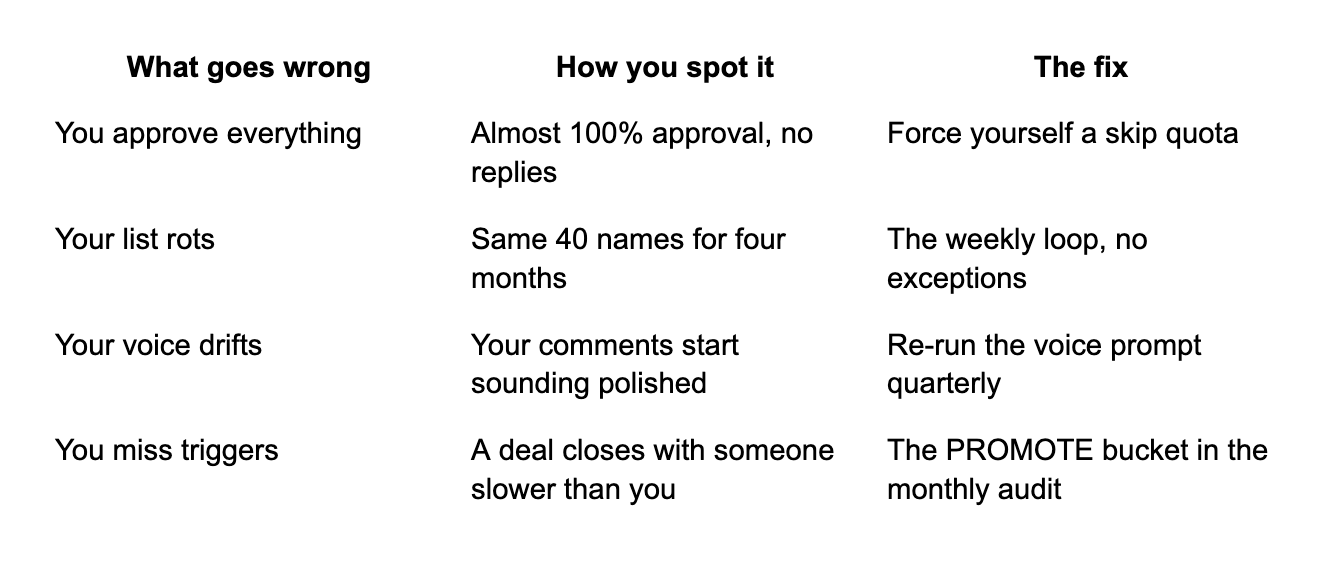
The PROMOTE bucket is where your money is. Missed triggers are the most expensive thing that goes wrong here.
THREE COMMENTING PROMPTS THAT DECIDE IF ANY OF THIS IS WORTH IT
Everything above produces comments. These three decide whether you should be commenting at all.
Monthly:
Here’s my commenting list. For each person, tell me the specific
reason I believe they’ll buy in the next two quarters.
Where my real reason is “they seem relevant” or “they engage with my
content,” say so plainly. Don’t be diplomatic about it.
Then tell me who I’m keeping on this list for comfort rather than for
pipeline. Name them.
Quarterly:
Here are the last 40 comments I’ve left. Read them as a stranger would.
1. What would they conclude I’m an expert in?
2. What would they conclude I sell?
3. Is there a gap between those two? Describe it.
4. If I kept commenting exactly like this for another six months,
what would I be known for? Is that what I want?
Give me three specific adjustments. Not general advice.
Quarterly, and this is the one that matters:
I’ve spent roughly [X] hours on this in the last quarter.
Here’s what came out of it: [conversations, meetings, deals, revenue].
Here’s my next best use of those hours: [PASTE].
Build me the strongest case for killing this channel.
Then build the strongest case for doubling it.
Tell me which one is stronger. Don’t split the difference. Don’t tell
me to “keep it but optimize.”
If you say continue, give me the exact number that would make me kill
it next quarter.
NOTE - The entire process of collecting comments is manual. Use SLIQ for automating it.
Most of us keep channels alive on sunk cost and call it patience. That last line turns a review into a decision.
HOW TO DO ALL THIS IN SLIQ
Here’s where this usually doesn’t work for people.... Because it becomes a second job.
The manual version is tedious.
-- You subscribe for alerts on specific people.
-- You see their posts.
-- Then you write a comment...and it takes way too long.
Sliq takes the operational load off you. You upload the list of people you want to stay top of mind with. It watches their LinkedIn activity, tells you when they post, and drafts a comment in your voice. You review it, edit it, or skip it.
That leaves you four loops.
Setup. Once, an hour.
Run the list prompt. Export the CSV. Run the voice prompt and cut it to 200 words. Upload both into Sliq.
Daily. Ten minutes, one window.
Sliq tells you who posted and shows you a draft. You approve, edit, or skip.
If you’re approving everything that comes through, you’ve rebuilt volume commenting...in your style.
Weekly. Fifteen minutes.
Add anyone new who entered your pipeline. Drop anyone who went cold for a real reason. Two or three names a week is enough to keep the list updated.
Monthly. Half an hour.
Run the audit prompt. Run the list interrogation prompt.
Quarterly. Forty-five minutes.
The positioning check and the kill-or-continue. This is the loop you’ll skip. Don’t.
What to automate and what to never automate
Automate the monitoring.
Automate the first draft.
Automate the log of who you engaged and when.
Never automate the selection. Never automate the send.
Four ways this breaks
HOW YOU KNOW IF COMMENTING IS WORKING
Two things to watch. Neither one is likes.
Leading. Your reply rate on first messages to people you’ve commented on, against everyone else. Give it six weeks before you judge it. My reply rate has increased to 60%.
Lagging. How your first calls open. When this works, people show up already knowing roughly what you do. You spend the first ten minutes on their problem.
DON’T DO THESE
Pitching your product in the comments
Manufacturing disagreement because it gets reach
Writing like you know someone better than you do
Commenting on every single post from the same person
Sliq watches your prospect list, flags when they post, and drafts comments in your voice.